


A machine shop receives an order for shafts. The drawing calls for 1045 steel. The machinist grabs 1018 from the stock rack because it looks similar and costs less. Two weeks later, the shafts bend under load. The parts fail, the customer is unhappy, and the shop ends up paying for rework.
This type of mistake is more common than many people realize. 1018 and 1045 are both affordable carbon steels, but they are not interchangeable. The key difference is carbon content: 1018 contains about 0.18% carbon, while 1045 contains about 0.45%. That may not sound like much, but it has a significant impact on strength, hardness, machinability, and weldability.
In this article, we compare the two grades across composition, mechanical properties, machining behavior, and typical applications. By the end, you will have a clearer understanding of where each material performs best and how to choose the right steel for your application.
1. 1018 Steel: Properties and Characteristics

1018 is one of the most widely used steels for machined parts. Its carbon content is about 0.18%, which keeps it soft enough to machine easily and weld without pre-heating. Cold-drawn 1018 typically has a tensile strength around 440 MPa, a yield strength around 370 MPa, and a hardness of about 126 HB.
Machinability is one of the main reasons for its popularity. It produces a smooth surface finish, is easy on cutting tools, and performs well in high-volume production. 1018 is also a good carburizing steel. After case hardening, the surface can reach about Rc 42 while the core remains tough.
Compared with many higher-carbon steels, 1018 is easier to machine, easier to weld, and generally more forgiving during fabrication. Cold-drawn 1018 also offers better dimensional accuracy and surface finish than hot-rolled material, making it a common choice for precision-machined components.
2. 1045 Steel: Properties and Characteristics

1045 is a medium-carbon steel with about 0.45% carbon. Compared with 1018, the higher carbon content gives it significantly greater strength and hardness. Cold-drawn 1045 typically has a tensile strength around 585 MPa, a yield strength around 450 MPa, and a hardness of about 190 HB. These values are roughly 30–40% higher than those of 1018.
That extra strength comes with trade-offs. 1045 is more difficult to machine, and its machinability rating is about 64% of 1112 steel. Welding also requires more attention, with thicker sections often needing preheating to reduce the risk of cracking.
One of the biggest advantages of 1045 is its response to heat treatment. Unlike 1018, which is generally limited to case hardening, 1045 can be quenched and tempered to about Rc 50–55. This allows the material to achieve both high strength and improved wear resistance.
Compared with lower-carbon steels, 1045 offers a better balance of strength, hardness, and heat-treatability. For applications where mechanical performance matters more than ease of fabrication, it is often the preferred choice.
3. Key Differences: Composition, Properties, and Behavior
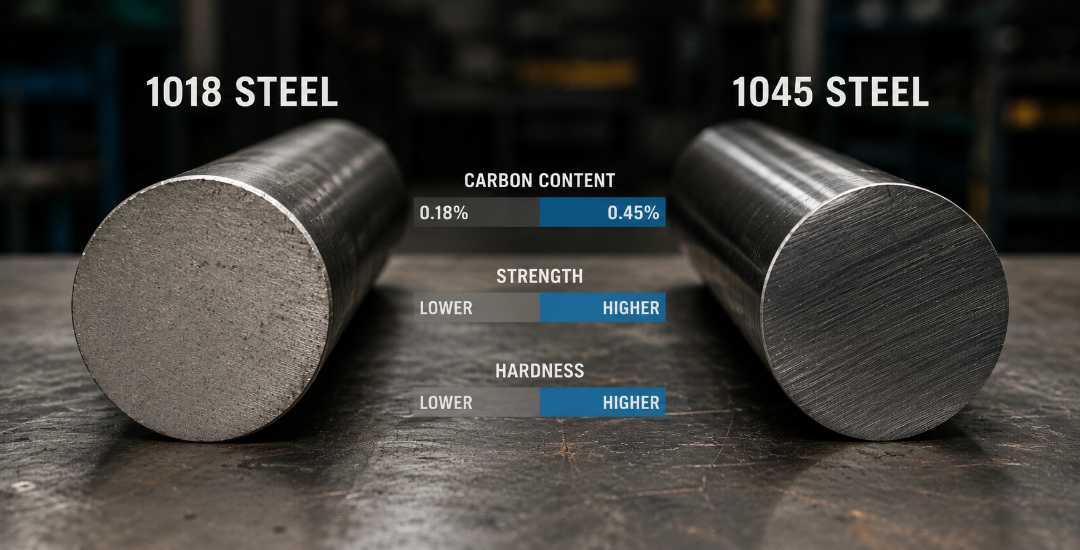
Although 1018 and 1045 are both carbon steels, they behave quite differently in manufacturing and service. The higher carbon content of 1045 improves strength and hardness, but it also affects machinability, weldability, and heat-treatment options.
The table below summarizes the key differences between the two grades.
Mülk | 1018 | 1045 |
|---|---|---|
Carbon content | ~0.18% | ~0.45% |
Tensile strength | ~440 MPa | ~625 MPa |
Yield strength | ~370 MPa | ~520 MPa |
Hardness (HB) | ~126 | ~190 |
İşlenebilirlik | Better (78% rating) | Moderate (64% rating) |
Kaynaklanabilirlik | Excellent, no preheat | Preheating is needed on thick sections |
Heat treatment | Carburizing only | Through‑hardening |
1045 offers roughly 30‑40% higher strength and hardness than 1018. However, 1018 machines more easily, welds without preheat, and costs less. 1045 can be through‑hardened to about Rc 50‑55, while 1018 can only be case‑hardened. The choice depends on whether you prioritize ease of fabrication (1018) or strength and wear resistance (1045).
4. Application Guide: Which Steel Grade Fits Your Component Type?
In many cases, the choice between 1018 and 1045 comes down to the balance between manufacturability and mechanical performance.
4.1 1018 Applications
1018 is commonly used for parts that are easy to machine, weld, or form. Typical examples include fasteners, pins, light-duty shafts, brackets, spacers, and general machine components. It is also widely used for carburized parts such as gears, worms, and ratchets, where a hard surface is needed but the core must remain tough and ductile.
4.2 1045 Applications
1045 is more common in components that experience higher loads, repeated stress, or significant wear. Typical applications include axles, crankshafts, gears, bolts, and power-transmission components. Its ability to be heat treated also makes it suitable for parts that require greater strength and wear resistance than low-carbon steels can provide.
In simple terms, 1018 is often chosen for ease of manufacturing, while 1045 is selected when performance in service becomes the higher priority.
5. 1018 vs 1045: Machining, Welding, and Heat Treatment
The differences between 1018 and 1045 become even more noticeable during manufacturing. While both materials are commonly machined, welded, and heat treated, they behave quite differently once production begins.
| Bakış açısı | 1018 Steel | 1045 Steel |
| İşlenebilirlik | ~78% of B1112; easy on tools | ~64% of B1112; higher tool wear |
| Kaynak | No preheat needed for most sections | Preheat required for thicker sections |
| Heat treatment | Case-hardening only (carburizing) | Through-hardening (quench and temper) |
| Max hardness after heat treat | Rc 42 (surface only) | Rc 50–55 (through section) |
For many shops, the biggest difference is that 1018 is generally easier to work with throughout the manufacturing process. 1045 requires more attention during machining, welding, and heat treatment, but it offers significantly greater strength and hardness in return.
6. Cost Considerations: Material Price, Machining Cost, and Overall Value
Cost differences between 1018 and 1045 go beyond the price of the raw material. Machining time, tool wear, welding requirements, and heat treatment can all affect the final cost of a finished part. In many cases, the lowest material cost does not always result in the lowest overall manufacturing cost.
Maliyet Faktörü | 1018 Steel | 1045 Steel |
|---|---|---|
Raw material cost | Daha düşük | Daha yüksek |
Machining cost | Lower (cuts faster, easier on tools) | Higher (wears tools faster) |
Welding cost | Lower (no preheat) | Higher (preheat often needed) |
Heat treatment cost | Lower (carburizing only) | Higher (quench and temper) |
Overall cost for high‑volume parts | Daha düşük | Daha yüksek |
Overall value for high‑strength parts | Limited | Better (justifies the extra cost) |
For simple parts and high-volume production, 1018 is usually the more economical option. However, if a component requires greater strength, wear resistance, or a longer service life, the additional cost of 1045 can often be justified by improved performance and durability.
7. How to Choose: 1018 or 1045?
There is no universally better choice between 1018 and 1045. The decision usually comes down to balancing strength requirements, manufacturing considerations, and overall cost.
7.1 Choose 1018 when:
- The part needs to be machined, welded, formed, or bent with minimal manufacturing challenges.
- Strength requirements are moderate and wear resistance is not a primary concern.
- Production volume is high and keeping part costs under control is important.
- Surface hardening through carburizing is sufficient for the application.
7.2 Choose 1045 when:
- The part is subjected to higher loads, repeated stress, or greater wear.
- Through-hardening or improved mechanical strength is required.
- Component failure could lead to downtime, costly repairs, or production interruptions.
- Longer service life justifies the additional material and processing costs.
If the choice is still unclear, consider the consequences of under-specifying the material. In applications where strength, durability, and reliability are critical, 1045 often provides a greater safety margin. Where ease of manufacturing and cost efficiency are the priorities, 1018 is often the more practical option.
Çözüm
1018 and 1045 serve different purposes, and the choice is driven by the part’s function and the shop’s priorities. 1018 is the choice when machinability, weldability, and cost are the main concerns. 1045 is the choice when strength, hardness, and wear resistance matter more. The selection comes down to three questions: does the part need welding or forming? Does it carry heavy loads? Does it require heat treatment?
At Beska, we work with both grades daily. Our engineering team helps customers select the right steel for each application, considering not just material properties but also machining costs, lead times, and production volumes. Bize Ulaşın for design review or a quote.
Deeper into Our Resources
İçgörü dolu okumalar için, sizin için özel olarak önerilen makalelerden oluşan bir liste hazırladık:
 Turkish
 English
 Hebrew
 French
 Russian
 German
 Spanish
 Portuguese