


Walk into any chemical plant, power station, or food processing facility, and you will find heat exchangers running around the clock. They transfer thermal energy between fluids without letting them mix, a simple idea, but one that quickly becomes complicated when you factor in pressure, fouling, maintenance, and cost. The textbook thermal calculations are only the starting point. Real-world selection involves trade-offs that often surprise first-time buyers.
The five most common types of heat exchangers are double tube, shell and tube, tube-in-tube, plate, and air-cooled designs. Each offers different advantages in pressure capability, heat transfer efficiency, maintenance, footprint, and operating cost.
This article compares how these designs work, where they are commonly used, and the practical engineering and fabrication factors that should be considered before selecting one for a specific application.
1. What Is a Heat Exchanger?
A heat exchanger is a device that transfers heat between two fluids without allowing them to mix. Heat passes through a solid surface, typically a tube wall, a plate, or a finned surface, while the two fluids remain physically separated. This separation is essential in applications involving corrosive chemicals, food products, pharmaceuticals, or hazardous process fluids, where even a small leak can lead to product contamination, equipment damage, environmental issues, or safety risks.
Heat transfer performance depends on factors such as the heat transfer surface, material properties, wall thickness, flow conditions, and allowable pressure drop. Because operating conditions vary widely, from cryogenic service to high-temperature processing and from clean water to abrasive slurries, no single heat exchanger design is suitable for every application. Different operating requirements have led to the development of a variety of heat exchanger types, each optimized for specific pressure, temperature, maintenance, and performance needs.
2. Types of Heat Exchangers
The following heat exchanger types are the most widely used across industrial applications. Each is designed for different operating conditions, offering different advantages in heat transfer, pressure capability, maintenance, and installation requirements.
Double Tube Heat Exchangers
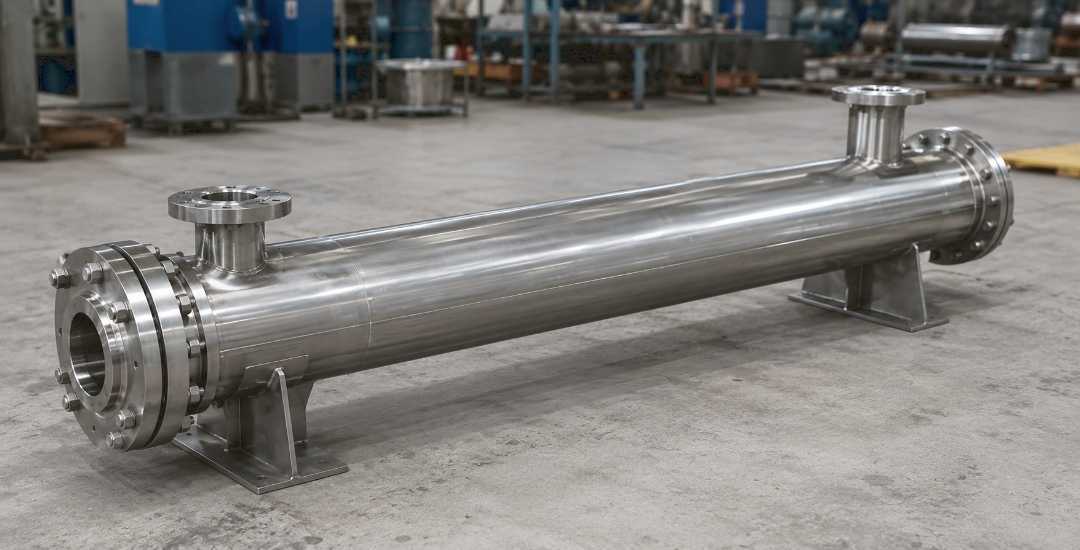
A double tube heat exchanger is one of the simplest heat exchanger designs. It consists of one pipe installed inside a larger pipe, with the hot fluid flowing through the inner tube and the cold fluid passing through the annular space between them. Standard pipe sizes and fittings help keep manufacturing costs predictable and lead times relatively short.
Double tube heat exchangers are commonly used in pilot plants, high-pressure hydraulic oil coolers, and sampling systems where flow rates remain relatively low. Their straight flow path also makes manual cleaning easier than many other exchanger designs.
The main limitation is heat transfer area. Because the available surface is limited by pipe length, increasing capacity usually requires multiple units connected in series or parallel, making the system larger and more expensive. Narrow annular spaces can also make cleaning more difficult.
For small-duty, high-pressure applications, double tube heat exchangers provide a practical and reliable solution. However, they are generally not the most economical choice for large-scale production systems.
Shell and Tube Heat Exchangers

Shell and tube heat exchangers are the most widely used design for high-capacity industrial applications. A cylindrical shell contains a bundle of tubes, with one fluid flowing through the tubes and the other flowing around the outside of the tubes inside the shell.
Three common configurations are available, each designed to balance thermal expansion, maintenance, and manufacturing complexity.
- Fixed tubesheet: Simple and economical, but thermal expansion between the shell and tubes can create stress under large temperature differences.
- U-tube: Allows individual tubes to expand freely, reducing thermal stress, although the tube bends cannot be mechanically cleaned.
- Floating head: Provides the best access for inspection and cleaning while accommodating thermal expansion, but increases manufacturing complexity and cost.
Shell and tube heat exchangers can operate at pressures exceeding 1,500 psi and temperatures ranging from cryogenic service to well above 500°C. They are widely used in power generation, refinery processing, chemical reactors, condensers, and compressor aftercoolers.
Compared with plate heat exchangers, they require more installation space and are generally heavier. Tube-side cleaning is relatively straightforward, while shell-side cleaning often relies on chemical methods because internal baffles restrict mechanical access.
For demanding industrial processes where reliability, long service life, and operating flexibility are the priorities, shell and tube heat exchangers remain the preferred solution.
Tube-in-Tube Heat Exchangers

Tube-in-tube heat exchangers are designed primarily for sanitary processing and applications requiring excellent cleanability. Although their basic structure resembles a double tube exchanger, they typically incorporate sanitary fittings, smooth internal surfaces, and corrugated inner tubes to improve heat transfer while reducing fouling.
These exchangers are widely used in pharmaceutical manufacturing, biotechnology, food and beverage processing, and applications involving high-viscosity fluids or fluids containing particulates.
Their sanitary construction, electropolished stainless steel, and stringent surface finish requirements increase manufacturing cost compared with conventional double tube designs. In addition, the narrow annular passage limits flow capacity because higher velocities quickly increase pressure drop.
Careful design is also essential to eliminate dead legs where fluids may stagnate and promote bacterial growth, particularly in validated pharmaceutical and food processing systems.
Tube-in-tube heat exchangers are best suited for low-flow sanitary applications where hygiene, cleanability, and product quality are more important than compactness or cost.
Plate Heat Exchangers

Plate heat exchangers provide one of the highest heat transfer efficiencies among common heat exchanger designs. A series of thin corrugated metal plates forms alternating flow channels, allowing heat to transfer efficiently between the two fluids while maintaining a very compact footprint.
Their compact size and excellent thermal performance make them widely used in HVAC systems, district heating, dairy processing, beverage production, pharmaceutical clean-in-place systems, and marine cooling applications.
The primary limitation is the gasket system. Repeated thermal cycling and chemical exposure gradually degrade gasket materials, making periodic replacement necessary. Most gasketed plate heat exchangers are also limited to operating pressures of approximately 450 psi. Fluids containing solids or having viscosities above about 20 cP may experience uneven flow distribution, reducing overall heat transfer performance.
For clean fluids operating under moderate pressure where installation space is limited, plate heat exchangers often provide the best combination of efficiency and compactness. However, long-term gasket maintenance should always be included in lifecycle cost evaluations.
Air-Cooled Heat Exchangers
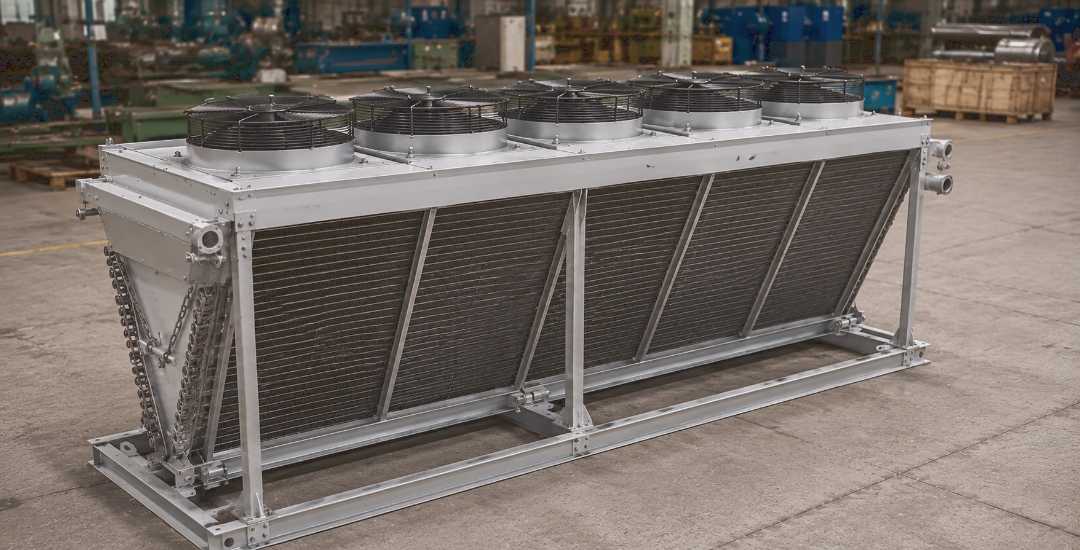
Air-cooled heat exchangers are commonly selected when cooling water is unavailable or limited. The process fluid flows through finned tubes while fans force ambient air across the heat transfer surface. Because air has much lower thermal conductivity and heat capacity than water, extended fin surfaces are required to increase heat transfer efficiency.
These exchangers are widely used in oil and gas facilities, power plants, refrigeration systems, and industrial sites located in regions where water resources are limited.
Their cooling performance is fundamentally limited by ambient air temperature. Under normal operating conditions, the process outlet temperature can only approach approximately 8 to 12°C above the surrounding air temperature. Air-cooled heat exchangers also require considerably larger heat transfer surfaces than water-cooled designs, resulting in larger equipment size, higher fan power consumption, and increased operating noise. Site layout, wind direction, and air recirculation can also influence thermal performance.
When water availability is the primary constraint and the required outlet temperature remains above ambient conditions, air-cooled heat exchangers provide the most practical solution.
Each heat exchanger type is developed to address different engineering challenges rather than outperform every other design. The most suitable choice depends on operating pressure, temperature, fluid properties, maintenance requirements, available installation space, and total lifecycle cost.
3. How to Select the Right Heat Exchanger Type
Selecting the right heat exchanger involves much more than comparing heat transfer efficiency. Operating pressure, temperature, fluid properties, maintenance requirements, available installation space, and lifecycle cost all influence the final decision.
Pressure and Temperature
Pressure and temperature are usually the first factors to consider. Above approximately 450 psi or 200°C, gasketed plate heat exchangers become less suitable because gasket materials may no longer provide reliable sealing. Under these conditions, shell and tube or double tube heat exchangers are generally the safer choice. For demanding services such as superheated steam or high-pressure process systems, shell and tube designs remain the industry standard because of their mechanical strength and operating reliability.
Fluid Properties
Fluid characteristics are equally important when selecting a heat exchanger.
- Clean, low-viscosity fluids: Plate heat exchangers maximize heat transfer efficiency while minimizing installation space.
- Dirty or fouling fluids: Shell and tube heat exchangers with removable tube bundles allow mechanical cleaning and easier maintenance.
- High-viscosity fluids or slurries: Tube-in-tube designs or shell and tube exchangers with wider flow passages generally provide more reliable performance.
It is also important to remember that corrosion resistance depends primarily on material selection rather than heat exchanger type. Stainless steel, titanium, nickel alloys, and other corrosion-resistant materials are available across multiple heat exchanger designs, although material costs can vary significantly.
Flow Flexibility and Turndown
Flow flexibility is often overlooked during equipment selection but can have a significant impact on long-term performance.
A common example occurs when a highly efficient plate heat exchanger is selected based only on its design operating conditions. During periods of reduced production, flow rates may decrease by 60% or more. Lower flow velocities reduce turbulence, accelerate fouling, and increase cleaning frequency. Under the same operating conditions, a shell and tube heat exchanger typically tolerates large flow variations more effectively because of its larger flow passages.
For this reason, minimum operating flow should always be evaluated alongside the nominal design point when selecting a heat exchanger.
Space, Maintenance, and Lifecycle Cost
Installation constraints and long-term operating costs often determine the final selection.
- Limited installation space: Plate heat exchangers offer the most compact solution.
- Available floor space: Shell and tube heat exchangers remain a practical option and are often cost-effective for larger duties.
- Frequent maintenance: Designs with removable tube bundles or plate packs simplify inspection and cleaning.
- Lifecycle cost: Consider capital investment, maintenance, spare parts, downtime, and operating costs rather than purchase price alone.
In our experience at Beska, food and pharmaceutical projects often underestimate the production downtime associated with gasket replacement during routine maintenance. Although shell and tube heat exchangers require more installation space, they can reduce maintenance interruptions and lower total operating costs over the equipment’s service life.
The highest heat transfer efficiency does not always result in the best engineering solution. Reliable operation, ease of maintenance, fabrication quality, and total lifecycle cost often have a greater impact on long-term system performance than thermal efficiency alone.
4. Manufacturing Considerations for Heat Exchangers
Manufacturing quality has a direct impact on the reliability, service life, and maintenance requirements of a heat exchanger. Even small fabrication errors can lead to leakage, reduced thermal performance, difficult assembly, or costly repairs. The following manufacturing considerations are among the most important factors affecting long-term performance.
Tube-to-Tubesheet Welding
Tube-to-tubesheet welding is one of the most critical manufacturing processes in shell and tube heat exchangers. Every joint must provide a reliable seal because even a small leak can allow the two process fluids to mix, often requiring the entire tube bundle to be removed for repair.
Orbital welding is commonly used to improve weld consistency, but welding procedures should always be qualified for the tube material and wall thickness being used. Weld quality is typically verified using dye penetrant or helium leak testing, with helium testing preferred for applications where even minor cross-contamination cannot be tolerated.
Shell Distortion Control
Shell distortion is another common manufacturing challenge. Welding around shells, heads, and nozzles can introduce deformation that affects dimensional accuracy, misaligns the tubesheet, and makes tube installation more difficult.
Proper fixturing, a controlled welding sequence, and post-weld stress relieving for large shells help minimize distortion and improve assembly accuracy.
Tubesheet Drilling Accuracy
Tubesheet drilling accuracy is often overlooked, yet it has a significant influence on fabrication efficiency. Even small positional errors can accumulate across hundreds of tube holes, making tube bundle assembly difficult and increasing production time.
In our manufacturing experience, tubesheet drilling accuracy often has a greater impact on assembly efficiency than the welding process itself. A hole position error of only 0.1 mm can create alignment problems across an entire tube bundle. CNC drilling combined with in-process coordinate verification helps prevent costly rework before assembly begins.
Plate Pressing Quality
Plate heat exchangers rely on highly consistent plate geometry to maintain sealing performance and thermal efficiency. Plate thickness is typically only 0.5 to 0.6 mm, while corrugation depth often needs to be controlled within ±0.05 mm.
Key quality controls include:
- Maintaining consistent plate thickness and corrugation geometry
- Using precision pressing dies and stable pressing pressure
- Inspecting finished plates for dimensional consistency before assembly
Small variations in plate geometry can reduce heat transfer efficiency, affect gasket sealing, and increase the risk of leakage.
Thermal Expansion Management
Thermal expansion should be considered during both design and manufacturing. Fixed tubesheet heat exchangers without sufficient expansion allowance may experience tube buckling, tubesheet cracking, or excessive thermal stress during operation.
When significant temperature differences are expected, U-tube or floating head designs generally provide a more reliable solution. If a fixed tubesheet design is required, expansion bellows and differential thermal movement should be evaluated during the design stage.
Tube Rolling Quality
Tube rolling directly affects the sealing performance between tubes and the tubesheet. Improper rolling remains a common cause of leakage in service.
Particular attention should be paid to:
- Under-rolling, which may leave microscopic gaps that eventually develop into leaks.
- Over-rolling, which can crack the tubesheet or excessively thin the tube wall.
Rolling parameters should be qualified for each tube material, calibrated rolling tools should be used, and representative sample joints should be destructively tested before production whenever required.
High-quality fabrication is just as important as sound thermal design. Careful control of welding, machining, dimensional accuracy, forming, assembly, and inspection significantly improves reliability while reducing maintenance requirements and total lifecycle cost.
5. Performance Comparison: Shell and Tube vs. Plate Heat Exchangers
Both shell and tube and plate heat exchangers are widely used in industrial applications, but they are designed for different operating conditions. The following comparison highlights the key engineering differences to help guide equipment selection.
Faktör | Shell and Tube | Plate and Frame |
Pressure rating | Up to 1,500+ psi | Typically up to 450 psi |
Temperature range | Very wide; handles high temps | Limited by gasket material |
Heat transfer efficiency | Lower; needs more surface area | Higher; compact design |
Footprint | Larger | One-fifth to one-tenth of shell and tube |
Cleaning access | Tube side: mechanical; Shell side: chemical | Disassemble plate pack |
Gasket replacement | None internally | Regular gasket replacement required |
Capital cost | Daha yüksek | Lower for same duty |
Operating cost | Lower maintenance | Gasket replacement adds cost |
Sources: Typical values are based on TEMA Standards, ASME Boiler and Pressure Vessel Code Section VIII, API 661, manufacturer technical documentation, and common engineering practices. Actual performance varies by heat exchanger design, materials, operating conditions, and manufacturer specifications.
No single heat exchanger performs best in every application. The comparison above illustrates the engineering trade-offs between the two designs rather than identifying a universally superior solution.
As a general guideline:
- Choose a plate heat exchanger when operating pressure is moderate, fluids are clean, and installation space is limited.
- Choose a shell and tube heat exchanger when pressure or temperature is high, fouling is expected, or long-term reliability and maintenance flexibility are the primary concerns.
The highest heat transfer efficiency does not always result in the best engineering solution. Reliable operation, maintenance requirements, operating conditions, and total lifecycle cost should always be evaluated together before selecting a heat exchanger.
6. Typical Applications for Different Heat Exchanger Types
Different heat exchanger designs are developed to meet different process requirements. The following examples illustrate how operating conditions influence heat exchanger selection and highlight several manufacturing considerations that help ensure reliable long-term performance.
Chemical Reactor Cooling
Shell and tube heat exchangers are commonly selected for chemical reactor cooling because they can safely withstand high pressure and elevated temperatures. In this example, the exchanger operates with cooling water at 300 psi and 250°C, conditions that exceed the practical limits of most gasketed plate heat exchangers.
Because even minor cross-contamination can trigger unwanted chemical reactions, tube-to-tubesheet welds are typically verified using helium leak testing. Post-weld stress relieving is also recommended to minimize shell distortion caused by repeated thermal cycling.
Dairy Pasteurisation
Plate heat exchangers are widely used for dairy pasteurisation because they combine high heat transfer efficiency with a compact footprint and excellent cleanability. Their removable plate packs also simplify routine cleaning and maintenance in sanitary processing environments.
Maintaining consistent plate geometry is essential during manufacturing. Plate pressing tolerances are typically controlled within ±0.05 mm, while product-contact surfaces should meet 3A sanitary standards to reduce the risk of bacterial adhesion. Gasket replacement should also be considered as part of the planned maintenance schedule.
Oil and Gas Remote Sites
Air-cooled heat exchangers are often the preferred solution for remote oil and gas facilities where cooling water is unavailable. In this application, finned tube heat exchangers use ambient air to cool compressor lubricating oil without requiring additional water resources.
Particular attention should be paid to fin-to-tube bond quality during fabrication. Loose fins reduce heat transfer efficiency and may eventually lead to vibration fatigue, so bond strength is typically verified during production to ensure reliable long-term performance.
Pharmaceutical High-Purity Heating
Tube-in-tube heat exchangers are well suited for pharmaceutical heating systems because they support hygienic operation while minimizing the risk of product contamination. Electropolished surfaces and dead-leg-free flow paths are essential for sterile water applications and other high-purity processes.
Weld quality is especially important in sanitary applications. Orbital welds should achieve full penetration with smooth internal surfaces, and borescope inspection is commonly used to verify weld quality before the equipment is placed into service.
Although these examples represent different industries, the engineering principles remain the same. Selecting the right heat exchanger depends on matching the equipment to the operating pressure, temperature, fluid characteristics, hygiene requirements, maintenance strategy, and long-term reliability requirements of the application.
7. Quick Selection Matrix
The following table provides a quick reference for selecting a heat exchanger based on the most common application requirements. It is intended as a practical starting point, while the final selection should always consider the complete operating conditions and engineering requirements.
| If Your Application Requires… | Recommended Heat Exchanger |
| High pressure (>450 psi) | Shell and tube |
| High temperature (>200°C) | Shell and tube |
| Limited installation space | Plate heat exchanger |
| Fouling or dirty fluids | Shell and tube (removable bundle) |
| Sanitary or high-purity processing | Tube-in-tube or sanitary plate heat exchanger |
| Water-scarce locations | Air-cooled heat exchanger |
| Frequent thermal cycling | U-tube or floating head shell and tube |
| Small-capacity, high-pressure applications | Double tube heat exchanger |
| Lower initial investment for clean fluids | Plate heat exchanger |
This guide provides a quick starting point for equipment selection rather than a final design recommendation. Operating pressure, temperature, fluid properties, maintenance requirements, installation space, and total lifecycle cost should always be evaluated together before selecting the most appropriate heat exchanger.
Çözüm
There is no single heat exchanger that is suitable for every application. The best solution comes from matching the exchanger design to the operating conditions, maintenance requirements, and long-term performance goals rather than focusing on heat transfer efficiency alone. Careful selection at the beginning of a project often reduces maintenance, improves reliability, and lowers lifecycle costs.
At Beska, we help customers select and manufacture heat exchangers for a wide range of industrial applications. By combining practical engineering experience with reliable manufacturing and inspection processes, we deliver solutions that are built for long-term performance. If you are planning a new project or evaluating an existing design, our engineering team is ready to help.
Deeper into Our Resources
İçgörü dolu okumalar için, sizin için özel olarak önerilen makalelerden oluşan bir liste hazırladık:
 Turkish
 English
 Hebrew
 French
 Russian
 German
 Spanish
 Portuguese