


Tool steel is used for punches, dies, molds, cutting tools, and other wear-resistant components where ordinary steel cannot provide sufficient hardness, toughness, or dimensional stability. Different grades are designed to resist different failure modes, including wear, impact, heat, and distortion during heat treatment.
Each grade offers a different balance of wear resistance, toughness, machinability, heat treatment response, and cost. Using the wrong grade can shorten tool life, increase manufacturing cost, or create unnecessary machining and heat treatment challenges.
This guide explains the most common tool steel grades, including O1, A2, D2, S7, and H13. It compares their properties, applications, manufacturing considerations, and selection criteria to help engineers choose the right material for practical production.
1. What Is Tool Steel?
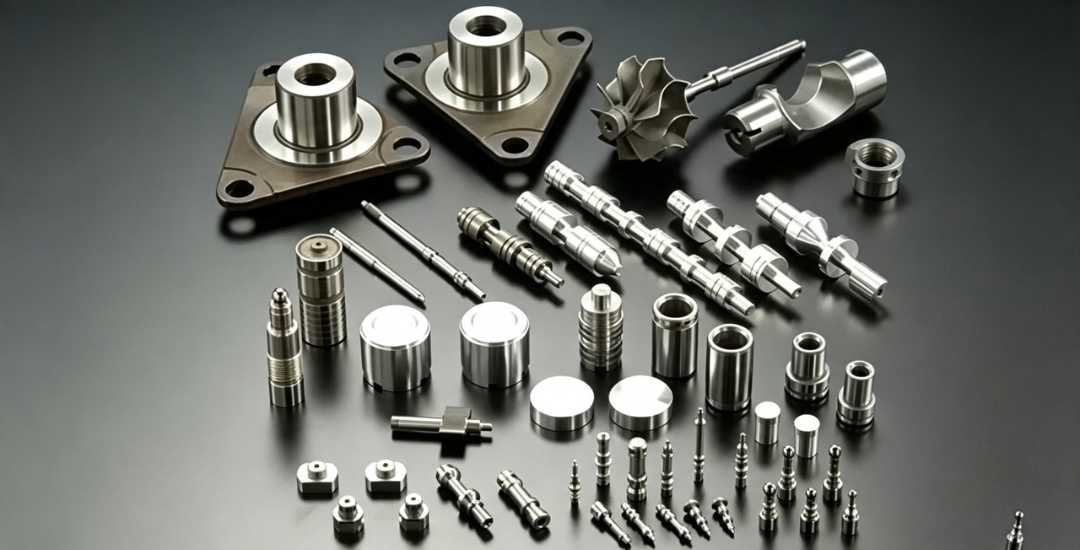
Tool steel is a family of carbon and alloy steels developed for tools, dies, molds, and other wear-resistant components. Compared with ordinary carbon steel, tool steels contain carefully controlled alloying elements such as chromium, molybdenum, vanadium, and tungsten to improve hardness, wear resistance, toughness, and high-temperature performance.
Most tool steels are classified under the AISI system, which groups grades by their primary application or hardening method. Common categories include water-hardening (W), oil-hardening (O), air-hardening (A), high-carbon high-chromium (D), shock-resisting (S), hot-work (H), and high-speed (M/T) steels.
In practice, experienced tooling engineers rarely begin by asking, “Which tool steel grade should I use?” They first identify the tool’s most likely failure mode. That decision provides the starting point for selecting the most suitable material, while the following sections explain how different grades address different manufacturing requirements.
2. Common Types of Tool Steel
The grades below represent the most widely used tool steels in manufacturing. Each is developed to solve a different tooling problem, whether the priority is wear resistance, toughness, heat resistance, distortion control, or manufacturing cost.
O1: The economical workshop standard. An oil-hardening tool steel that is easy to machine and widely used for general-purpose tooling. It provides a good balance of wear resistance and toughness but tends to distort more during heat treatment, making it better suited to simple geometries.
A2: The balanced all-round performer. An air-hardening grade known for its low distortion, good wear resistance, and reliable toughness. It is often selected for tooling that requires tighter dimensional stability. In practice, many manufacturers move from O1 to A2 when heat treatment distortion becomes a recurring issue.
D2: The wear-resistance specialist. Its high carbon and chromium content provide outstanding abrasion resistance, making it ideal for long-production runs and abrasive materials. The trade-off is lower machinability and reduced impact toughness, so it is not well suited to shock-loaded applications.
S7: The toughness specialist. Designed for applications involving repeated impact and shock loading, S7 is commonly used for heavy punches, chisels, shear blades, and forging dies. It sacrifices some wear resistance in exchange for excellent resistance to chipping and cracking.
H13: The hot-work standard. Developed for tooling exposed to repeated heating and cooling, H13 offers excellent hot strength and thermal fatigue resistance. It is widely used for die casting, aluminum extrusion, and hot forging, where conventional cold-work grades cannot maintain performance.
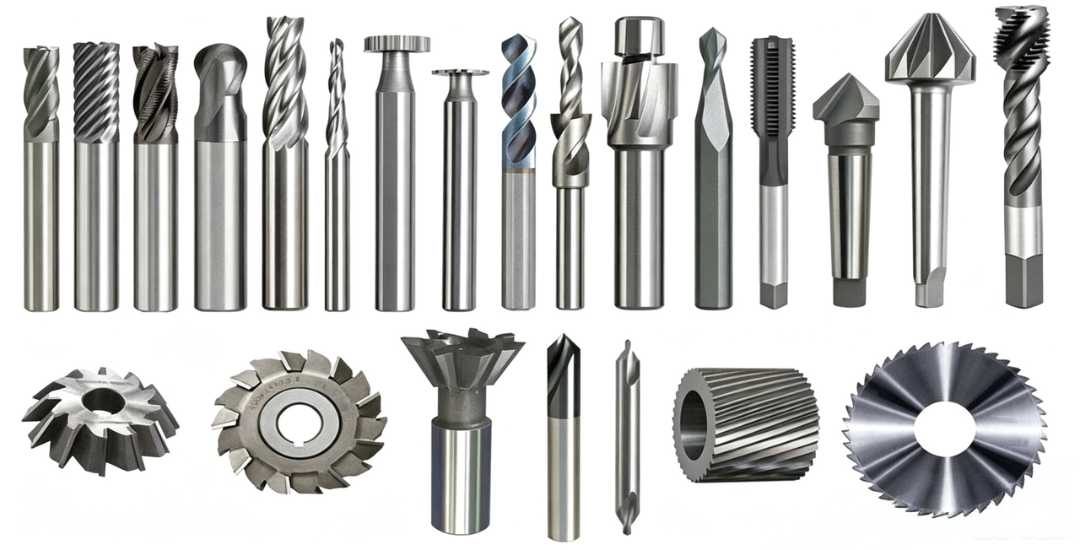
Each grade is designed for a different operating environment rather than a single measure of performance. Knowing these strengths and limitations makes it easier to compare their properties and select the most suitable material for a specific application.
3. Tool Steel Comparison: Key Properties at a Glance
Each tool steel grade is designed for a different balance of wear resistance, toughness, machinability, heat treatment distortion, and cost. Comparing these key properties side by side makes it easier to understand where each grade performs best and what compromises come with that choice.
Seviye | Hardening Method | Typical Hardness (HRC) | Aşınma Direnci | Dayanıklılık | İşlenebilirlik | Distortion During HT |
O1 | Oil | 58-62 | İyi | İyi | 90% | Ilıman |
A2 | Air | 58-60 | İyi | Good-Very Good | 70-80% | Düşük |
D2 | Air | 58-60 | Harika | Fair | 60-70% | Düşük |
S7 | Air/Oil | 54-58 | Fair-Good | Harika | 70-80% | Düşük |
H13 | Air | 40-52 | Fair | Harika | 70-80% | Düşük |
Use this comparison as an initial screening tool. Final material selection should always consider operating conditions, heat treatment, part geometry, and manufacturing requirements.
Sources: AISI classifications; ASM Handbook; SSAB; Crucible Industries; MatWeb; manufacturer technical data. Typical values vary with heat treatment, section size, supplier, and processing conditions.
4. Heat Treatment: Where Performance Is Made or Broken
Heat treatment determines the final hardness, toughness, dimensional stability, and service life of tool steel. Even the right material can fail prematurely if the heat treatment process is not properly controlled. The process typically consists of austenitising, quenching, and tempering, but each tool steel grade responds differently.
O1: Oil-quenched. Expansion is approximately 0.0015 in/in (about 0.11 mm on a 300 mm part). Complex geometries are more prone to bending and twisting, so 0.3–0.5 mm of grinding stock per side is typically recommended.
A2 and D2: Air-hardening grades with lower distortion, making them well suited to tight-tolerance tooling. However, they require accurate austenitising temperature control, as overheating can cause grain growth and reduce toughness.
S7: Can be hardened by either oil or air quenching. Air hardening minimizes distortion but may not achieve full hardness in heavy sections.
H13: Requires vacuum or controlled-atmosphere heat treatment to prevent decarburisation (surface carbon loss). Although vacuum processing increases cost, it is generally necessary for hot-work tooling.
Decarburisation
During heat treatment, carbon can be lost from the surface, creating a soft outer layer that wears much faster than the core material. At Beska, we occasionally detect decarburisation on customer-supplied H13 blanks, where the surface hardness measures 2–3 HRC lower than the core. Vacuum heat treatment and post-process surface hardness verification are effective ways to prevent this issue.
Quenching Cracks
Sharp corners and abrupt section changes concentrate stress during quenching, increasing the risk of cracking. O1 is generally more susceptible than A2 or D2 because oil quenching produces greater thermal stress. Generous radii and smooth section transitions help reduce this risk.
Inadequate Tempering
Tempering should be performed immediately after quenching. Delayed tempering increases the likelihood of cracking, while double tempering is commonly recommended for A2, D2, S7, and H13 to improve dimensional stability and toughness.
Successful tool performance depends on both material selection and heat treatment quality. Even the best tool steel cannot compensate for poor heat treatment, making an experienced heat treatment supplier an important part of the manufacturing process.
5. Manufacturing Considerations for Tool Steel Components
Even the right tool steel can fail prematurely if it is not machined and finished correctly. Machining, grinding, and wire EDM all influence the final performance of the tool, especially after heat treatment.
İşleme
Most tool steel is machined in the annealed condition before heat treatment because hardened material significantly increases tool wear and machining difficulty. O1 is relatively easy to machine, while higher-alloy grades such as D2 require lower cutting speeds, rigid setups, and sharp carbide tooling to handle their hard carbides. Stable workholding and appropriate cutting parameters help maintain dimensional accuracy and extend tool life.
Bileme
Grinding is usually the final machining operation after heat treatment and has a direct impact on dimensional accuracy and surface quality. Excessive grinding heat can soften the surface or introduce residual stresses that shorten tool life.
Grinding Burn
Grinding burn may appear as discoloration, but it is often invisible to the naked eye. At Beska, we have seen die edges lose 2–3 HRC because of excessive grinding heat, reducing tool life by more than half.
Prevention: Use soft-bond, coarse-grit grinding wheels, dress them regularly, apply sufficient coolant, avoid aggressive material removal, and perform stress-relief tempering after significant grinding when required.
Tel Erozyon
Wire EDM is widely used to machine hardened tool steel and complex profiles that are difficult to produce by conventional machining. However, the process leaves a thin recast layer, often called the white layer, which contains high residual stress and microscopic cracks.
EDM Recast Layer
If the recast layer is not properly removed, microscopic cracks can become the starting point for edge chipping and fatigue failure under cyclic loading. We have traced premature tool failures to inadequate post-EDM finishing.
Prevention: Use multiple low-energy finishing passes, perform stress-relief tempering after EDM when appropriate, and lightly grind or polish critical cutting edges to remove the recast layer.
Successful tool performance depends on more than selecting the right material. Careful control of machining, grinding, EDM, and subsequent finishing processes is equally important for achieving consistent dimensional accuracy, reliable tool life, and predictable production performance.
6. Failure-Mode-First Tool Steel Selection
One of the fastest ways to narrow down tool steel options is to identify how the tool is most likely to fail. Experienced tooling engineers rarely start by comparing hardness values or alloy compositions. Instead, they first determine whether wear, impact, heat, or distortion is the primary concern, then select the grade that best addresses that failure mode.
| Failure Mode | Typical Cause | Recommended Grade |
| Abrasive wear | Long production runs, abrasive materials | D2 |
| Chipping or cracking | Impact loading, interrupted cutting | S7 |
| Thermal fatigue | High operating temperatures, repeated heating and cooling | H13 |
| Heat treatment distortion | Tight tolerances, complex geometries | A2 |
| General-purpose tooling | Moderate wear and impact with balanced performance | O1 or A2 |
This approach provides a practical starting point rather than a final material selection. Factors such as part geometry, production volume, heat treatment capability, machining cost, and budget should always be evaluated before specifying a tool steel grade.
7. Real Engineering Examples
Different tooling applications place different demands on tool steel. The examples below show how operating conditions, manufacturing requirements, and expected failure modes influence material selection in real production.
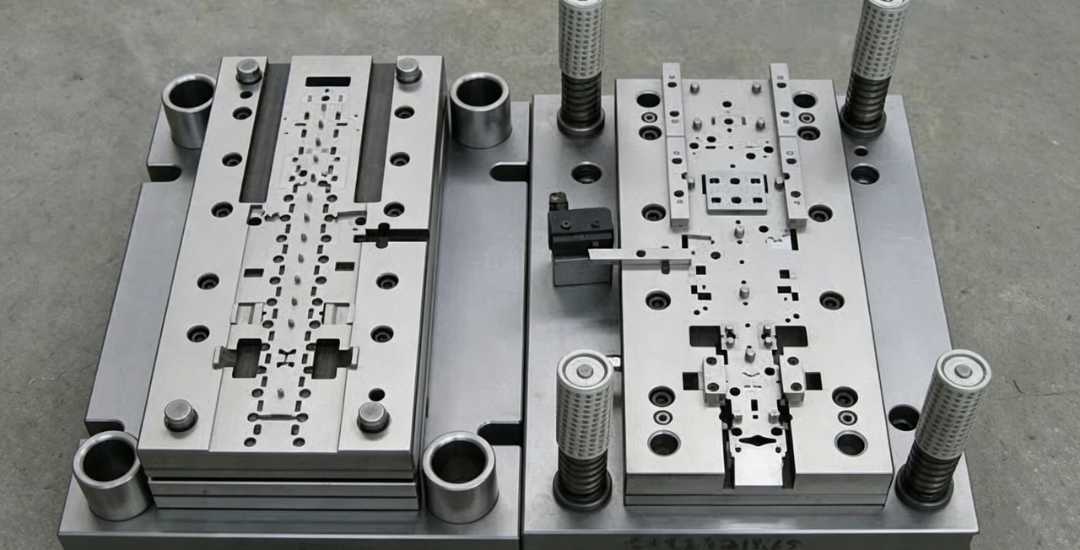
Automotive Blanking Die
An automotive blanking die producing more than one million high-strength steel parts required exceptional wear resistance. D2 was selected because abrasive wear, rather than impact loading, was the primary cause of tool failure. Carbide tooling was used during machining, followed by finish wire EDM and controlled grinding after heat treatment to maintain edge quality. The die achieved a service life of more than one million parts with minimal wear.
Injection Mold for Glass-Filled Nylon
A mold for 30% glass-filled nylon required excellent wear resistance because the glass fibers rapidly accelerated cavity wear. D2 was chosen to maximize tool life. Cooling channels were drilled before heat treatment, complex features were finished by EDM, and diamond compounds were used to achieve the required surface finish. The mold maintained good dimensional stability throughout long production runs.
Aluminum Forging Die
An aluminum forging die operated under repeated heating and cooling cycles where thermal fatigue was the primary concern. H13 was selected for its hot strength and resistance to thermal cracking. Vacuum heat treatment minimized decarburisation, and controlled preheating before production reduced thermal shock. The die delivered stable performance with predictable maintenance intervals.
8. How to Select the Right Tool Steel Type
After identifying the most likely failure mode, the remaining selection is refined by operating temperature, dimensional requirements, production volume, and overall manufacturing cost. These factors help determine which tool steel grade is the most practical for a specific application.
Operating temperature is usually the first consideration. H13 is the preferred choice for tooling exposed to sustained high temperatures because it maintains strength and resists thermal fatigue. For room-temperature applications, O1, A2, D2, and S7 are generally more suitable.
Dimensional stability becomes important for tight-tolerance tooling. Air-hardening grades such as A2 and D2 produce less heat treatment distortion than O1, making them better suited to complex geometries. In our experience, manufacturers often move from O1 to A2 when repeated straightening and finish grinding begin to increase production cost.
Production volume also influences material selection. O1 and A2 are often economical choices for prototypes and low-volume tooling, while D2 becomes more cost-effective for long production runs because its superior wear resistance extends tool life and reduces downtime.
Budget should be evaluated in terms of total tooling cost rather than material price alone. Although D2 and H13 are more expensive than O1 or A2, material and heat treatment usually account for only a small portion of the overall tooling cost. For long production runs, a higher-grade material often delivers lower lifetime cost through reduced maintenance, fewer replacements, and more consistent production.
The best material is rarely the one with the highest hardness or wear resistance. It is the grade that best matches the operating conditions, manufacturing process, expected service life, and overall production requirements.
Çözüm
Tool steel selection is an engineering decision rather than a search for the hardest or most wear-resistant material. The best choice depends on how the tool is expected to fail, the operating environment, manufacturing requirements, dimensional tolerances, and the total cost of production over the tool’s service life.
A structured selection process starts by identifying the most likely failure mode, then balancing wear resistance, toughness, heat resistance, distortion control, machinability, and cost. Evaluating these factors together leads to more reliable tooling, longer service life, and lower overall manufacturing cost.
Şu anda Beşka, we support customers with material selection, heat treatment planning, machining, and finishing for custom tooling and wear-resistant components. Whether you need a prototype or production tooling, our engineering team can help identify the most suitable manufacturing solution for your application.
Deeper into Our Resources
İçgörü dolu okumalar için, sizin için özel olarak önerilen makalelerden oluşan bir liste hazırladık:
 Turkish
 English
 Hebrew
 French
 Russian
 German
 Spanish
 Portuguese