


You bend a sheet metal part to 90 degrees. After the bending force is released, the angle opens to 91.5 degrees. That change is called springback. In sheet metal bending, springback is the elastic recovery that occurs after the bending load is removed.
Springback directly affects part fit, assembly accuracy, and dimensional consistency. If it is not properly controlled, parts may require rework, fail assembly, or fall outside tolerance even when the bending process appears correct.
This article explains why springback occurs, how different materials and bending methods affect it, and the practical techniques used to predict and control springback in sac metal imalatı.
1. Why Springback Happens
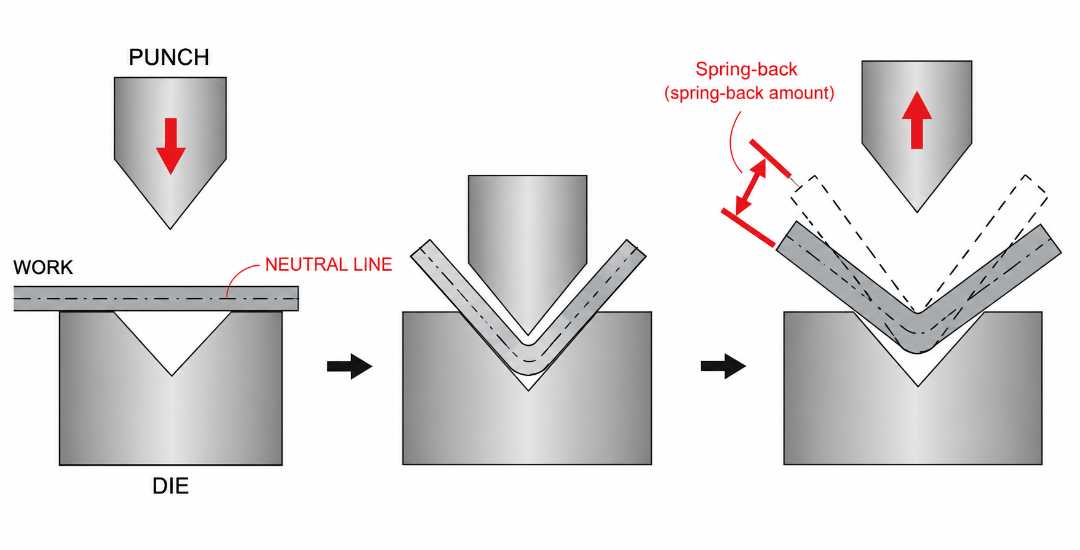
Springback occurs because sheet metal undergoes both elastic and plastic deformation during bending. Material near the outside of the bend stretches in tension, while material near the inside is compressed. The outer layers deform permanently, but the material closer to the neutral axis remains partly elastic. When the bending force is removed, this elastic recovery causes the part to spring back toward its original shape.
A steel ruler provides a simple example. Bend it slightly and it returns to its original shape. Bend it beyond its yield point and it remains bent, but still springs back slightly after the force is removed. Sheet metal behaves in the same way, although the amount of springback depends on the material and bending conditions.
In most sheet metal applications, springback is primarily influenced by three factors.
- Material yield strength is the first. Higher-strength materials store more elastic energy before yielding, resulting in greater springback. This is why high-strength steels and many aluminum alloys generally exhibit more springback than mild steel.
- Inside bend radius relative to material thickness is the second. A larger bend radius reduces the amount of plastic deformation and generally increases springback.
- Bending method is the third, and it is often the easiest factor to control. Air bending typically produces the greatest springback, bottoming reduces it, and coining minimizes it through additional plastic deformation. These methods are discussed in more detail later in this article.
Material batch variation, rolling direction, tooling condition, machine accuracy, and other process variables can also influence springback. For production parts, validating the bending process with trial parts is often more reliable than relying solely on theoretical values or material data.
2. How to Calculate Springback
Springback cannot be predicted with complete accuracy because it depends on both material behavior and manufacturing conditions. For most sheet metal applications, a simple engineering calculation provides a useful starting point, but the final bending angle should always be verified during production.
One common estimation method uses the springback factor (Sf), which is the ratio between the overbent angle and the desired final angle. If the required final angle is 90° and experience shows the part springs back by 2°, the bend should be formed to 92°: Sf = 92° / 90° = 1.0222
The same concept can also be applied to the inside bend radius. Multiply the expected inside radius by the springback factor to estimate the relaxed radius after bending: 0.062 in. × 1.0222 = 0.063 in.
This estimated radius can then be used as a reference when calculating bend allowance and bend deduction. It provides a practical starting point for process planning, although the final values should always be confirmed during production.
Actual springback is influenced by material properties, sheet thickness, inside bend radius, bend angle, tooling, and the bending method. Because these variables interact with one another, calculated values should be treated as estimates rather than exact predictions.
For this reason, many manufacturers verify springback by producing several trial bends with progressively increasing overbend angles until the required final angle is achieved. The measured result then becomes the production baseline for that material, tooling, and press brake setup.
Engineering calculations provide a useful starting point, but production validation is still required to achieve consistent bending results.
Sources: ASM Handbook, Volume 14B: Metalworking: Sheet Forming; Machinery’s Handbook; press brake manufacturer technical documentation.
3. Common Springback Problems in Sheet Metal Bending
Springback can lead to several common production problems. The examples below are frequently encountered during sheet metal fabrication.
Why do parts open after bending?
This is the most common effect of springback. After the bending force is released, the part relaxes to a larger angle than intended because of elastic recovery in the bend zone. The problem is usually corrected by applying the appropriate overbend or selecting a bending method that reduces springback.
Why are bend angles inconsistent during production?
Variations in material properties, sheet thickness, tooling wear, and machine conditions can all affect the final bend angle. Running trial parts at the beginning of each production batch and checking bend angles periodically helps maintain consistent results.
Why does stainless steel show more springback?
Stainless steel generally exhibits greater springback than mild steel because of its higher yield strength and different elastic properties. Additional overbend is often required, although the exact compensation depends on the material grade, sheet thickness, tooling, and bending method.
Why is springback more difficult to control in high-strength steel?
Advanced high-strength steels (AHSS) have higher strength and lower formability than conventional steels, resulting in greater springback and higher forming forces. Bottoming or coining is often preferred because these bending methods reduce springback more effectively than air bending.
Although springback cannot be eliminated completely, it can be controlled through appropriate material selection, tooling, process validation, and bend compensation.
4. Material Selection and Springback Behavior
Springback varies significantly between materials because each alloy has different mechanical properties. Material selection therefore has a direct influence on bend accuracy and process consistency. The table below summarizes the typical springback behavior of commonly used sheet metal materials.
Malzeme | Relative Springback | Key Consideration |
Mild steel (low-carbon) | Düşük | Predictable, minimal overbend needed |
Stainless steel (304) | Moderate to high | May require 2° to 4° overbend for 90° bends |
High-strength steel (DP980, CP980) | Yüksek | Significant springback, may need specialized control |
Aluminum (5052, 6061) | Ilıman | Less stiff than steel, often springs back more than mild steel |
Aluminum (7075) | Yüksek | Avoid sharp bends, high springback and cracking risk |
The table shows that springback is closely related to material properties. Materials with higher strength or lower elastic modulus generally require greater bend compensation than mild steel.
When selecting materials for bent parts, do not assume all steels or aluminum alloys behave the same. A material change can significantly affect springback and may require adjustments to bending parameters, tooling, or overbend values.
Rolling direction also influences springback. Bending across the grain and bending with the grain produce slightly different results because of the material’s rolling structure. For critical parts, bend direction should be defined on the drawing or confirmed during process planning to improve production consistency.
Sources: ASM Handbook, Volume 14B; MatWeb material property database; manufacturer technical data.
5. How Different Bending Methods Affect Springback
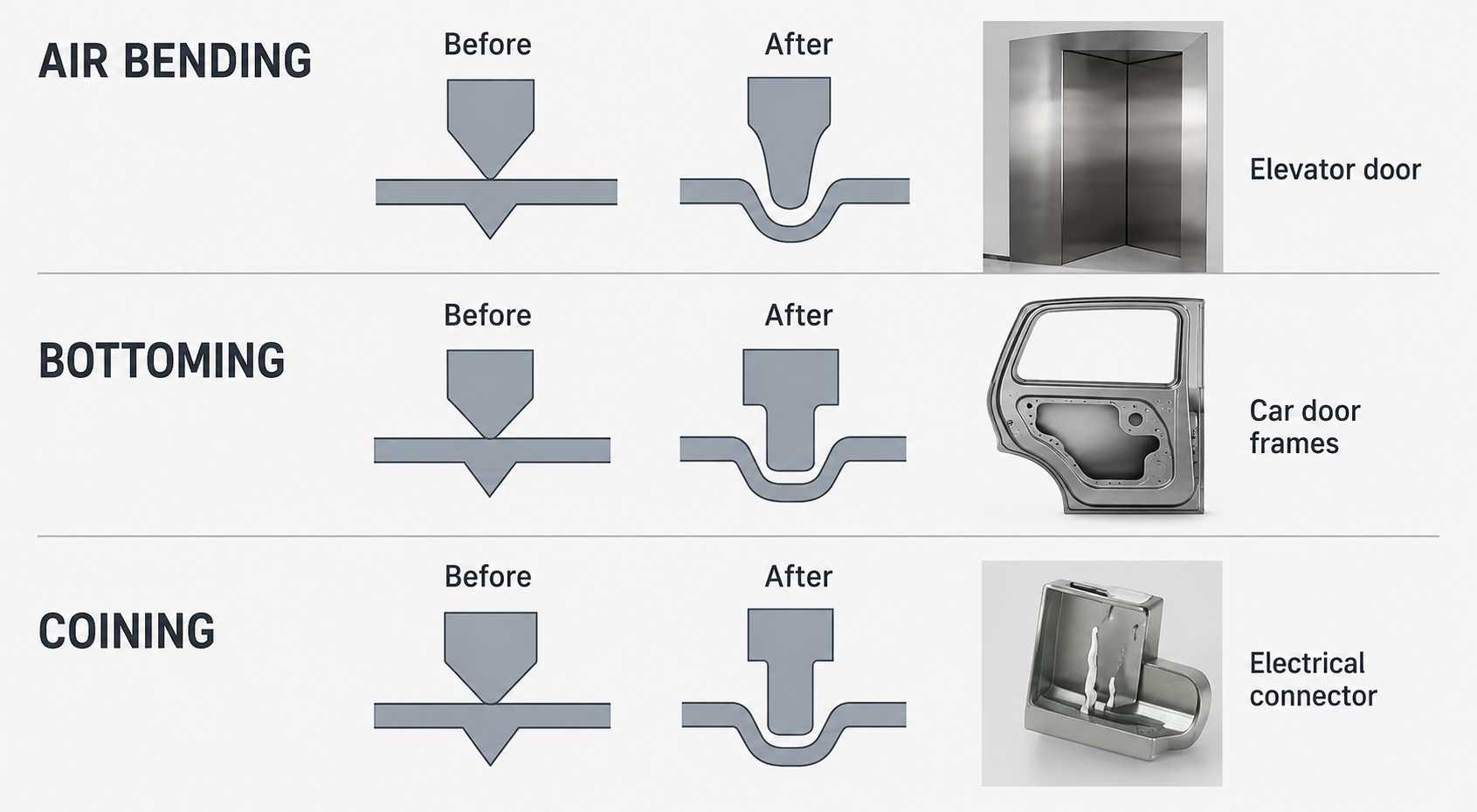
The bending method has a major influence on springback. Air bending, bottoming, and coining each produce different levels of elastic recovery because the material is deformed differently during the bending process.
Hava Bükme
In air bending, the punch pushes the sheet into a V-die without forcing it to the bottom of the die. The bend angle is determined by the punch stroke.
Springback is greatest with this method because the material is only partially plastically deformed. Its main advantage is flexibility, allowing different bend angles to be produced with the same tooling by adjusting the punch stroke. Air bending is widely used for prototypes and low to medium production volumes because it offers fast setup and relatively low tooling costs.
Dip
In bottoming, the punch forces the sheet against the bottom of the die, and the die angle largely determines the final bend angle. Additional forming force compensates for elastic recovery, allowing the finished angle to more closely match the die geometry.
Compared with air bending, bottoming produces less springback and more consistent bend angles. It is commonly used for parts with tighter dimensional tolerances but requires higher forming force and dedicated tooling for each bend angle.
Para basımı
Coining applies the highest forming force of the three methods. The punch penetrates the material, creating extensive plastic deformation at the bend line. As a result, springback is almost eliminated.
Coining provides the highest bending accuracy and repeatability, but it also requires significantly greater tonnage, increases tooling wear, and is generally reserved for applications where maximum precision justifies the additional manufacturing cost.
In general, air bending is suitable for general fabrication, bottoming is preferred when tighter bend tolerances are required, and coining is selected for applications where minimizing springback is the highest priority.
Sources: ASM Handbook, Volume 14B: Metalworking: Sheet Forming; press brake manufacturer technical documentation.
6. How to Reduce Springback in Press Brake Operations
Several practical methods can be used to reduce springback during press brake operations. The appropriate approach depends on the material, tooling, bend geometry, and required dimensional accuracy.
Overbending
Overbending is the most direct compensation method. The part is bent beyond the target angle by the expected amount of springback so that it relaxes to the required final angle. Recording overbend values for different materials and tooling combinations helps reduce setup time on repeat production.
Reduce the V-Die Opening
A smaller V-die opening increases plastic deformation during bending, which generally reduces springback. The trade-off is higher forming force and a smaller minimum inside bend radius, so press brake capacity should always be verified before changing tooling.
Increase Holding Time
Holding the punch briefly at the bottom of the stroke allows additional material stabilization before unloading. Although the effect is relatively small, it can improve bend consistency for certain materials without increasing tooling costs.
Use Bottoming or Coining
Bottoming and coining produce less springback than air bending because they introduce greater plastic deformation. These methods are commonly selected for parts requiring tighter bend tolerances, although they require higher forming forces and dedicated tooling.
Run Trial Parts
Material properties can vary between production batches. Producing several trial bends before full production allows bend compensation to be adjusted for the actual material, tooling, and machine conditions.
Monitor Tooling Condition
Tool wear gradually changes the contact geometry between the punch, die, and sheet material, affecting bend accuracy and springback. Regular inspection and timely replacement of worn tooling help maintain consistent production quality.
Use Press Brake Compensation Functions
Modern CNC press brake controls often include angle compensation functions that automatically adjust punch stroke based on programmed material data and measured bending results. These functions improve bend consistency, particularly in high-volume production.
No single method eliminates springback under every condition. Reliable results are achieved by combining appropriate tooling, process validation, bend compensation, and stable production parameters.
7. Springback Control in Real Sheet Metal Applications
Springback requirements vary across industries because materials, tolerances, and production volumes are different. The following examples illustrate how springback is managed in typical sheet metal applications.
Automotive Seat Rail
Seat adjustment rails are commonly manufactured from advanced high-strength steels such as DP980 to achieve the strength required for safety while reducing vehicle weight. The higher yield strength of these materials also increases springback, making bend angles more sensitive to material variation between production batches. For high-volume manufacturing, bottom bending combined with closed-loop angle compensation is often used to improve bend consistency and reduce variation throughout the production run.
Aerospace Bracket
Aircraft interior brackets are frequently made from 5052 aluminum because of its low weight and good corrosion resistance. Compared with mild steel, aluminum generally exhibits greater springback, and variations between material batches can further affect bend accuracy. Since many aerospace components also have visible surfaces, excessive forming force is avoided to minimize tool marks. Air bending with carefully controlled overbend is commonly used, while bottoming or coining is reserved for parts requiring tighter angular tolerances.
Electronics Enclosure
Server rack chassis and electronic enclosures are typically manufactured from cold-rolled steel using multiple bend features that must fit together accurately during assembly. Although mild steel has relatively predictable springback, small variations across several bends can accumulate and affect the final dimensions of the enclosure. To improve consistency, manufacturers typically establish overbend values for each bend feature, verify them with trial parts, and optimize the bend sequence before full production.
Although the materials and applications differ, the objective remains the same: produce consistent bend angles that meet assembly requirements. Selecting the appropriate bending method, validating the process with trial parts, and maintaining stable production conditions are the foundation of effective springback control.
8. Precision Sheet Metal Bending with Controlled Springback at Beska
At Beska, springback compensation is built into every stage of our sheet metal bending process, from prototype validation to production. The objective is not only to achieve the required bend angle, but also to maintain consistent results throughout the entire production run.
We manufacture sheet metal parts in stainless steel, aluminum, and high-strength steel, adjusting bend compensation according to the material, tooling, and production conditions. Trial bends are used to verify springback before production, and the results are documented to improve repeatability for future orders.
For engineering and OEM projects, we provide:
- Prototype bend validation to verify springback compensation before production begins.
- In-process angle verification to maintain consistent bend accuracy throughout production.
- Material-specific bend compensation parameters developed for commonly used stainless steel and aluminum grades.
- Documented production settings that improve consistency for repeat production and future orders.
During production, bend angles are inspected at defined intervals. If any deviation is detected, machine settings or tooling are adjusted before the variation affects subsequent parts, helping maintain stable quality throughout the production run.
Çözüm
Springback is an inherent part of sheet metal bending, but it can be predicted and controlled through the right manufacturing approach. Consistent results depend on understanding material behavior, selecting the appropriate bending method, and validating the process before production rather than relying on theoretical calculations alone.
Engineering calculations provide a useful starting point, but reliable bend accuracy is achieved by verifying the process with the actual material, tooling, and press brake setup. Documenting proven bending parameters and applying them consistently helps improve repeatability across production runs.
At Beska, we work closely with customers to optimize sheet metal designs for reliable manufacturing. From prototype development to production, our focus is on achieving consistent bend accuracy, stable quality, and efficient production for every project.
Deeper into Our Resources
İçgörü dolu okumalar için, sizin için özel olarak önerilen makalelerden oluşan bir liste hazırladık:
 Turkish
 English
 Hebrew
 French
 Russian
 German
 Spanish
 Portuguese