


118° and 135° are two of the most common drill point angles, but choosing between them involves more than matching an angle to a material. Point angle changes how a drill enters the workpiece and how cutting forces develop, which can influence hole quality and tool performance.
However, point angle is only one part of drill geometry. A 135° split-point drill, for example, behaves differently from a conventional 135° drill. Cutting-edge design, tool material, machining parameters, and workpiece properties also affect drilling performance.
This article explains how drill point angle influences the drilling process, compares common point angles, and outlines the key factors to consider when selecting drills for CNC işleme.
1. What Is Drill Point Angle?
The drill point angle is the included angle between the two main cutting lips at the tip of a drill, measured by projecting them onto a plane parallel to the drill axis. On a conventional twist drill, it describes how pointed or flat the drill tip is.
For a symmetrically ground drill, a 118° point angle corresponds to 59° on each side of the drill axis, while a 135° point angle corresponds to 67.5°. The angle can be checked using a drill point gauge or an optical measuring system.
A smaller point angle produces a longer, more pointed tip, while a larger angle creates a shorter, flatter profile. This difference affects how the cutting edges engage the workpiece, but point angle is only one part of drill geometry.
Other important features include:
- Chisel edge and web thickness: Influence material displacement and axial thrust near the center of the drill.
- Split-point geometry: Modifies the central cutting region to reduce the chisel edge’s contribution to thrust and improve starting behavior.
- Lip relief angle: Provides clearance behind the cutting edges to prevent excessive rubbing.
- Flute geometry: Influences chip formation and evacuation during drilling.
These features work together to determine drilling performance. Two drills with the same point angle can behave differently because of their overall geometry and cutting-edge design.
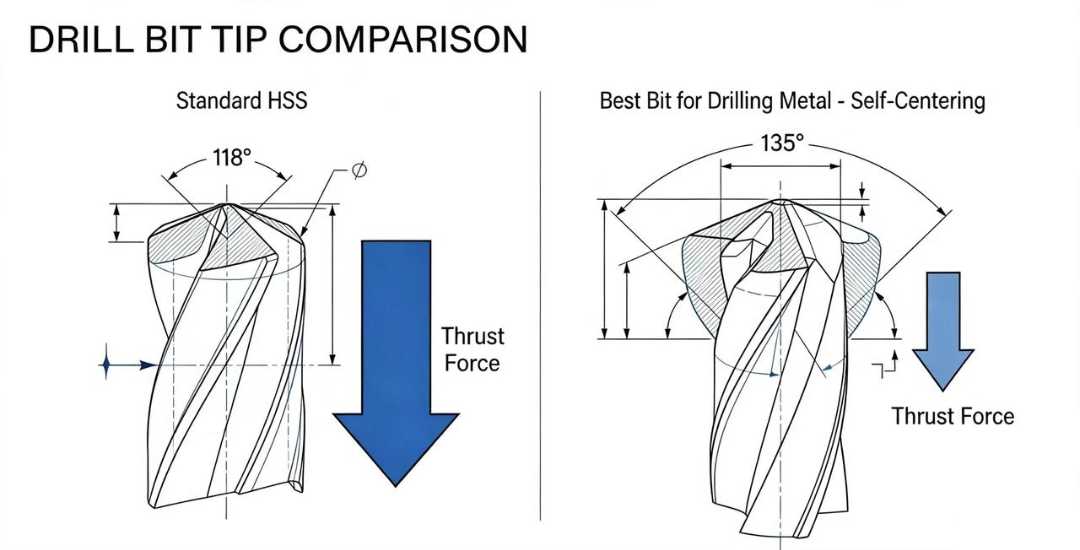
2. 118° vs. 135° Drill Point Angle
118° and 135° are two common point angles used in twist drills. The main difference is the shape of the drill tip, which affects cutting-edge engagement and drilling behavior. However, neither angle is inherently better for every material or application.
118° Drill Point Angle
A 118° drill has a relatively pointed tip and is widely used in general-purpose high-speed steel (HSS) drills. It is a common choice for routine drilling in mild steel, aluminum, and other readily machinable materials.
Traditional 118° drills often use a conventional conical point with a chisel edge at the center. This region displaces material rather than cutting it efficiently, contributing to axial thrust during drilling. Modified geometries, including split points, can reduce this effect.
Although 118° remains a practical option for many applications, its suitability depends on the complete drill design and cutting conditions.
135° Drill Point Angle
A 135° drill has a shorter, flatter tip than a 118° drill of the same diameter. This angle is commonly found on drills designed for industrial metalworking, including applications involving stainless steel and alloy steels.
Many 135° drills incorporate a split-point design, which modifies the chisel edge to reduce material displacement near the drill center. This can lower thrust requirements and improve the drill’s ability to start accurately on a flat surface.
However, these benefits come primarily from the split-point geometry, not the 135° angle alone. A conventional 135° drill and a 135° split-point drill can behave differently under the same cutting conditions.
Which One Should You Use?
The choice between 118° and 135° should not be based on material hardness alone. Both angles are available in different drill designs, and their performance depends on cutting-edge geometry, tool material, coating, and machining conditions.
For example, while 118° is common in general-purpose drills, specialized drills for aluminum may use 135° or larger point angles. Similarly, a properly designed 118° drill can be suitable for applications beyond basic drilling in softer materials.
Rather than treating either angle as a fixed rule, use the drill manufacturer’s recommendations for the specific material and operation.
3. How Drill Point Angle Affects Drilling Performance
Drill point angle influences how the cutting edges engage the workpiece and how cutting forces develop during drilling. These changes can affect hole position, burr formation, tool wear, and overall hole quality. However, the results also depend on the drill’s complete geometry, cutting conditions, and machine setup.
Cutting Forces and Tool Wear
Changing the point angle alters the orientation of the cutting edges and the distribution of cutting forces. This can affect axial thrust, cutting-edge loads, and tool deflection.
However, a larger point angle does not always mean higher or lower thrust. The result depends on other features, particularly chisel edge geometry, web thickness, and cutting-edge design.
These factors also influence tool wear. Excessive cutting forces, heat, or unstable cutting conditions can accelerate edge wear and chipping. Neither 118° nor 135° guarantees longer tool life without considering the workpiece material and overall drill design.
Hole Entry and Position
Point angle affects how the drill engages the workpiece at the start of a hole. However, accurate positioning also depends on the drill’s centering geometry, tool alignment, and setup rigidity.
On angled or uneven surfaces, the cutting edges may engage the material unevenly, generating lateral forces that can cause the drill to deflect. This increases the risk of positional errors and poor hole straightness.
For difficult entry conditions, additional preparation or a drilling strategy suited to the surface geometry may be necessary.
Exit Burr Formation
As a drill approaches the exit surface, the remaining material becomes thinner and may deform before the cutting edges fully break through. Point angle changes the drill tip profile and breakthrough sequence, which can influence burr formation.
However, burr size also depends on material ductility, feed rate, cutting-edge condition, and support beneath the workpiece. Changing the point angle alone does not guarantee smaller burrs.
Hole Accuracy and Surface Finish
Hole quality involves more than positional accuracy. Diameter, roundness, straightness, and surface finish are also important in precision machining.
Point angle can influence these characteristics through its effect on cutting forces and drilling stability. However, drill runout, tool deflection, chip evacuation, and machining parameters often play equally important roles.
For holes with tight dimensional or surface finish requirements, drilling may need to be followed by a finishing operation such as reaming or boring.
4. How to Choose the Right Drill Point Angle
Choosing a drill point angle depends on the workpiece material, drill design, and machining requirements. While 118° and 135° are common, specialized drills may use different angles for the same material.
The table below provides a practical reference for common CNC drilling Uygulamalar.
| Malzeme | Common Point Angle Options | Key Considerations |
| Hafif Çelik | 118° HSS; specialized carbide geometries | General-purpose drilling, tool life |
| Alüminyum | 118° HSS; 135°–140° specialized drills | Chip evacuation, material adhesion |
| Paslanmaz çelik | 135° split point; specialized carbide geometries | Work hardening, heat, tool wear |
| Döküm demir | 118° HSS; specialized carbide geometries | Abrasive wear, material grade |
| Titanium & Nickel Alloys | Specialized geometries, often around 135°–140° | Heat control, edge strength, chip evacuation |
These are common examples, not fixed recommendations. Actual tool geometry varies by manufacturer and application.
Other Factors to Consider
Hole depth also matters. Deeper holes require greater attention to chip evacuation, coolant delivery, and drill rigidity. Machine stability, tool runout, and cutting parameters should also be considered.
Other point geometries serve specific purposes. For example, flat-bottom drills with near-180° points are used for certain flat-bottom hole applications, while composite materials may require specialized drills to reduce delamination.
For reliable results, start with the drill manufacturer’s recommendations and verify hole quality and tool wear under actual machining conditions.
5. Spot Drilling and Hole Entry Considerations
Spot drilling creates a small conical recess to help guide the main drill into the correct position. It can improve hole entry accuracy, but it is not always necessary, especially when using short, rigid drills with suitable centering geometry.
Matching Spot Drill Angles
When spot drilling is required, the spot drill angle should generally be equal to or slightly larger than the main drill’s point angle.
For example, a 120° spot drill can be used before a 118° drill, while a 142° spot drill can accommodate drills with 135°–140° points. This allows the drill tip to engage first, reducing the risk of uneven cutting-edge loading.
Drilling on Angled Surfaces
Angled or uneven surfaces create additional challenges because the cutting edges may not engage the material simultaneously. This can cause drill deflection, vibration, or positional errors.
For significantly inclined surfaces, milling a small flat area before drilling may provide a more stable entry. Tool rigidity and appropriate entry conditions are also important.
6. Common Drilling Problems and What to Check
Poor drilling results are not always caused by an incorrect point angle. When hole quality or tool performance becomes inconsistent, checking the drill geometry, cutting conditions, and setup can help identify the cause.
| Drilling Problem | What to Check | Possible Adjustments |
| Drill Walking or Hole Position Errors | Tool runout, cutting lip symmetry, entry surface, and workholding rigidity | Correct tool alignment, check drill geometry, or prepare a flat entry surface |
| Excessive Exit Burrs | Feed at breakthrough, material ductility, cutting-edge wear, and workpiece support | Optimize breakthrough feed, replace worn drills, or improve exit-side support |
| Premature Tool Wear or Chipping | Cutting speed, coolant delivery, chip evacuation, and cutting-edge geometry | Adjust cutting parameters, improve cooling, or select a drill designed for the material |
These checks help narrow down the likely causes before changing the point angle or replacing the drill type. Any adjustments should be verified against hole quality and tool life under actual machining conditions.
Çözüm
Choosing the right drill point angle involves more than matching 118° or 135° to a particular material. Drill geometry, hole requirements, and machining conditions all influence hole quality, tool wear, and overall drilling performance.
For reliable results, consider the complete drill design, follow the tool manufacturer’s recommendations, and verify performance under actual cutting conditions.
Şu anda Beşka, we provide custom CNC machining services from prototyping to production, with attention to dimensional accuracy and manufacturability. If you have a part with specific drilling or hole tolerance requirements, contact our team to discuss your project.
 Turkish
 English
 Hebrew
 French
 Russian
 German
 Spanish
 Portuguese