


Sheet metal parts can be joined in several ways, but welding, riveting, clinching, and threaded fastening behave very differently once material type, sheet thickness, surface finish, and assembly access come into play.
A welded joint may suit automated steel assemblies, while riveting can be more practical when heat must be avoided. Clinching removes the need for separate fasteners, and threaded fastening is useful when parts need to be removed or serviced later. The right choice depends on how the joint needs to perform in production and in use.
1. Resistance Spot Welding

Resistance nokta kaynak is widely used for joining overlapping sheet metal parts, particularly in steel assemblies. Two electrodes clamp the sheets together and pass a high electrical current through the joint. Resistance at the interface generates heat and forms a localized weld nugget between the sheets.
Advantages and Limitations
Spot welding is fast, repeatable, and well suited to automated production. Because it does not require a separate fastener, it is commonly used for sheet metal assemblies with many repeated joints.
Heat input is the main limitation. The weld zone experiences localized thermal changes, and thin or distortion-sensitive parts require controlled welding parameters. Surface coatings can also affect weldability or be locally damaged by heat, depending on the coating type.
Material compatibility is another consideration. Similar steels are generally straightforward to spot weld, while dissimilar combinations such as aluminum and steel are more difficult because of their different thermal behavior and the formation of brittle intermetallic compounds.
Spot welding is therefore most suitable when production speed, repeatability, and permanent joining are important, and when the material combination and surface condition are compatible with the process.
2. Riveting for Sheet Metal Assemblies

Perçinleme joins sheet metal with a separate mechanical fastener and does not require welding heat. Conventional rivets are installed through aligned holes, while blind rivets are useful when only one side of the assembly is accessible.
Why Riveting Is Used
Because there is no heat-affected zone, riveting works well for heat-sensitive parts, coated panels, and some dissimilar-material assemblies. It can be used with steel, stainless steel, aluminum, and other sheet materials when the rivet type and joint design are suitable.
Riveting is also practical for prototypes, low-volume production, and field assembly because the equipment requirements can be relatively simple.
Design and Installation Considerations
Each joint requires a separate fastener, so hole size, alignment, edge distance, and rivet selection all affect joint performance.
Local deformation, surface marking, or coating damage may occur around the joint depending on installation force and rivet type. For assemblies exposed to vibration or repeated loading, clamp-up and installation consistency also become important.
3. Sheet Metal Clinching: How It Works and When to Use It
Clinching joins two or more sheet metal layers by locally deforming the material to create a mechanical interlock. A punch forces the sheets into a die, where the material flows and locks the layers together.
Unlike riveting, clinching does not require a separate fastener. It also avoids the heat input associated with welding.
How Clinching Works
The joint is formed by cold deformation rather than melting the material. Because no welding heat is introduced, there is no heat-affected zone, and the surrounding sheet is less exposed to thermal distortion.
Clinching can also be used with many coated or pre-painted sheets, although the coating must be able to tolerate the local forming process.
Material and Thickness Limits
Material formability is one of the main limits of clinching. The sheet must be ductile enough to deform without cracking during joint formation.
Low-carbon steels, many stainless steels, and ductile aluminum alloys are commonly used, but suitability depends on material strength, ductility, thickness, and tooling.
Conventional clinching is often used with relatively thin sheet, commonly around 0.5 to 3 mm per layer, although the practical range varies with the material and clinching system.
Joint Design Requirements
Clinching normally requires access to both sides of the joint because the punch works against a die.
The joint also needs sufficient overlap around the clinch point. Sheet thickness combination, joint location, tooling geometry, and required joint strength should therefore be considered together rather than relying on one fixed overlap or thickness rule.
When Clinching Is a Good Fit
Clinching is especially useful for repetitive sheet metal assemblies where welding heat should be avoided and the materials have enough formability.
It can also work well in automated production because no separate rivet, screw, or welding consumable is required at each joint.
4. Self-Clinching Fasteners: Threads in Thin Metal
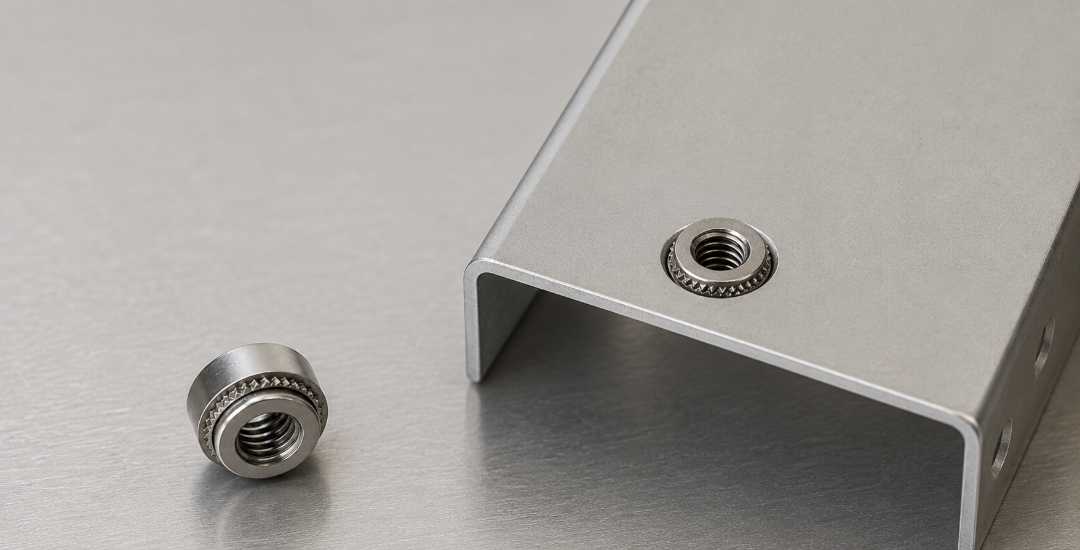
Self-clinching fasteners are used when thin sheet metal needs a strong, reusable threaded attachment point. Instead of tapping the sheet or welding a separate nut in place, a nut, stud, or other fastener is mechanically locked into a prepared hole in the panel.
How Self-Clinching Fasteners Work
During installation, a press applies a controlled squeezing force that causes the sheet material to cold-flow into the fastener’s locking features. Once installed, the fastener remains permanently attached to the sheet, while the screw connection it supports can be assembled and removed repeatedly.
Most self-clinching fasteners require access to both sides of the sheet during installation because the fastener must be pressed against an opposing tool or anvil.
Material and Hole Requirements
Successful installation depends on the relationship between the fastener and the sheet material. The sheet must be soft and ductile enough to flow into the locking features, so each fastener type specifies suitable sheet hardness and minimum thickness.
Hole size is also tightly controlled. A hole that is too large may reduce retention, while an undersized hole can damage the fastener or distort the surrounding sheet. Edge distance, sheet thickness, material hardness, and installation force should therefore follow the manufacturer’s data for the selected fastener.
Self-clinching hardware is particularly useful in enclosures, brackets, panels, and other thin-sheet assemblies that need durable threaded mounting points without welding a nut or relying on threads formed directly in the sheet.
5. Sheet Metal Joining Methods Compared
The main differences between these joining methods come down to heat input, fastener use, tool access, and joint function.
| Faktör | Spot Welding | Perçinleme | Clinching | Self-Clinching Fasteners |
| Heat input | Evet | HAYIR | HAYIR | HAYIR |
| Separate fastener | HAYIR | Evet | HAYIR | Evet |
| Typical tool access | Both sides | One or both sides, depending on rivet type | Both sides | Usually both sides during installation |
| Joint function | Permanent sheet-to-sheet joint | Permanent mechanical joint | Permanent mechanical interlock | Permanent insert with reusable threaded connection |
| Main design constraint | Material weldability and heat effects | Hole design and rivet selection | Material formability and tool access | Sheet hardness, thickness, and hole size |
| Common use | Repetitive steel assemblies | Coated parts, field assembly, mixed materials | Repetitive ductile-sheet assemblies | Threaded mounting points in thin sheet |
6. How to Choose a Sheet Metal Joining Method
The right joining method depends on how the joint needs to function, the materials being joined, and how the part will be manufactured and serviced.
Joint Function and Tool Access
Start with whether the joint needs to remain permanent or allow later disassembly. Spot welding, riveting, and clinching normally create permanent joints, while self-clinching hardware provides a permanent threaded insert that can support a removable screw connection.
Tool access also matters. Spot welding and conventional clinching normally require access from both sides of the joint. Blind riveting is more suitable when only one side is accessible.
Material and Surface Condition
Material compatibility can quickly eliminate some options. Spot welding works well with compatible sheet metals, while clinching depends on sufficient material ductility. Riveting generally offers greater flexibility for dissimilar materials, although fastener selection and corrosion compatibility still need to be considered.
Surface condition should also be checked early. Welding introduces heat that may affect coatings or finished surfaces, while mechanical joining methods can often preserve more of the surrounding finish.
Production and Assembly Requirements
Production volume influences the balance between tooling, cycle time, consumables, and flexibility. Spot welding and clinching can suit repetitive automated production, while riveting is often practical for prototypes, lower-volume assemblies, and field installation.
The final choice should consider joint strength, material behavior, access, surface finish, production volume, and future service requirements together rather than selecting a process based on cost or speed alone.
7. DFM Considerations for Sheet Metal Joining
Joining problems often come from part geometry rather than the joining process itself. A few design details should be checked before drawings are released for production.
Tool Access and Joint Space
Spot welding and clinching normally require access from both sides of the joint, so narrow channels, deep flanges, or nearby bends can block the electrode, punch, or die.
Riveted and clinched joints also need enough material around the connection point. Edge distance and overlap should be matched to the selected rivet or tooling rather than using one fixed rule for every part.
Holes and Finishing Sequence
Rivet and self-clinching fastener holes should follow the specified diameter, sheet thickness, and edge-distance requirements. For self-clinching hardware, oversized holes or excessive deburring can reduce the material available to lock the fastener into the sheet.
The joining sequence should also be planned with coating or plating in mind. Welding is usually completed before finishing, while mechanical fastening may be installed before or after finishing depending on the fastener and surface treatment.
Çözüm
Sheet metal joining is closely tied to the part design itself. Spot welding needs electrode access, riveting depends on hole and fastener design, and clinching requires suitable material formability and punch-die access. These requirements should be resolved before the drawing and assembly sequence are finalized.
Beska provides custom sheet metal fabrication and mechanical assembly for prototype and production parts. We can manufacture according to your drawings and coordinate joining, finishing, and assembly requirements as part of the production process.
 Turkish
 English
 Hebrew
 French
 Russian
 German
 Spanish
 Portuguese