


A design engineer sizing a pump shaft has two options: a single keyway, cheap and easy to machine, or an involute spline, which costs more but distributes load across multiple teeth and lets the impeller hub slide on and off without losing alignment. For shaft-hub connections, the choice between a spline and a keyway affects torque transmission, shaft strength, assembly method, and production cost. Picking the wrong one shows up as premature failure on the test stand or as unnecessary cost on the production quote.
This article explains what keyways and splines are, how their structural differences affect torque transmission and shaft integrity, how each is machined, three real parts where the choice matters, and when a keyway is the correct specification and when a spline is.
1. What Are Keyways and Splines

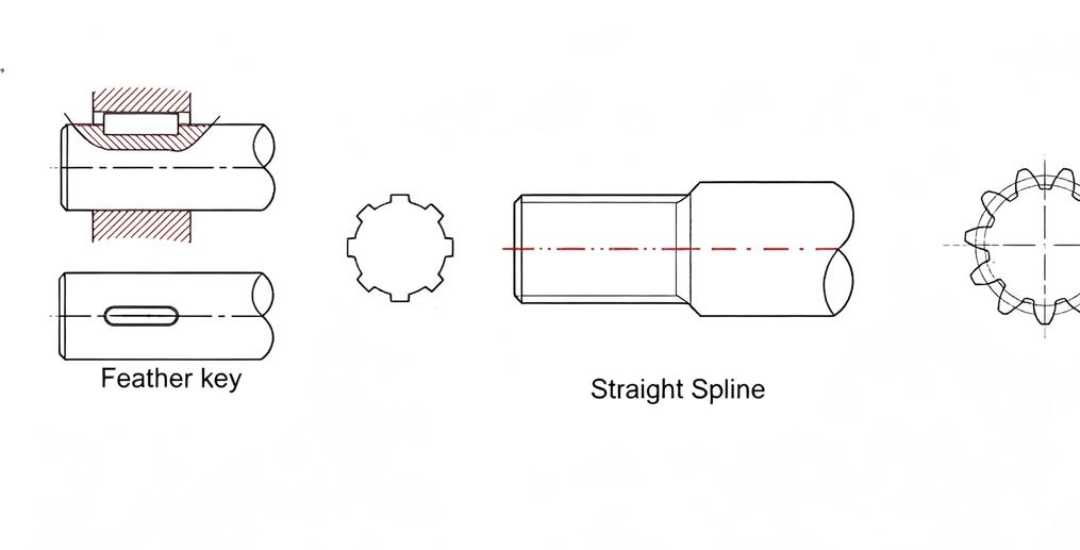
A keyway is a single rectangular slot cut into a shaft and a matching slot in the hub. A flat piece of hardened steel sits in both slots and transmits torque through mechanical interference on its two side faces. The connection is simple, tolerances are wide, and assembly is straightforward: slide the hub on, drop the key in, and secure it.
A spline is a set of longitudinal teeth cut around the full circumference of a shaft, with matching grooves inside the hub. Instead of one contact point, the load spreads across all teeth simultaneously. Splines also self-center the hub on the shaft and can be designed to allow axial sliding while maintaining rotational alignment.
The fundamental difference is how torque is transmitted. A keyway concentrates load on a single key, while a spline distributes it across multiple teeth around the shaft circumference.
2. How They Transmit Torque: The Structural Difference
The way each connection handles load determines what happens to the shaft and the hub under real The structural difference between a keyway and a spline determines how torque is transmitted, how stress is distributed, and ultimately how the connection performs under real operating conditions.
Single Key vs Multiple Teeth
A single key concentrates shear and compressive stress on two small contact areas. Under steady torque, that stress is manageable. Under shock loads or torsional vibration, the key can shear and the keyway walls can deform. When the key fails, the connection fails immediately with no backup load path.
A spline distributes torque across multiple teeth, although the actual load sharing depends on tooth accuracy, fit, alignment, and operating load. If one tooth surface shows slight wear, the remaining teeth still carry load. This redundancy is why splines are specified where unexpected load spikes occur, such as transmissions and drive axles.
The difference in load distribution also affects the shaft itself. Beyond torque capacity, the way material is removed from the shaft has a significant influence on fatigue life.
Stress Concentration and Shaft Integrity
A keyway cuts a deep rectangular notch into the shaft, creating a stress concentration where fatigue cracks initiate under cyclic torsion. On shafts with reversing loads or torsional vibration, the keyway is often where the shaft eventually breaks.
A spline removes material around the full circumference, but the teeth are smaller and evenly distributed. The net stress concentration is lower because the remaining cross-section is more symmetric. A splined shaft typically outlasts a keyed shaft under the same conditions, not because the teeth are stronger, but because the shaft is less weakened by the machining.
For applications subjected to repeated load cycles or reversing torque, preserving shaft integrity is often more important than maximizing the strength of the connection itself.
3. Spline vs Keyway: Direct Comparison
Although the structural differences determine how each connection performs, engineers usually compare keyways and splines based on torque capacity, shaft strength, assembly method, manufacturing cost, and maintenance requirements. The following comparison highlights the practical differences between the two connection methods.
| Facteur | Keyway | Spline |
| Torque capacity | One contact point; adequate for steady, moderate loads | Distributed across all teeth; handles shock and reversal |
| Rotational alignment | Depends on key fit; backlash under cyclic load | Self-centering; minimal backlash |
| Axial movement | Fixed; key locks hub in place | Can allow controlled sliding engagement |
| Shaft fatigue risk | High; notch corners concentrate stress | Low; symmetric geometry preserves cross-section |
| Machining cost | Low; standard tooling, single slot | Higher; dedicated hob or broach required |
| Assemblée | Drop key into slot; no alignment needed | Match tooth position during hub insertion |
Sources: ISO 4156 involute splines; DIN 6885 parallel keys; Machinery’s Handbook; manufacturer machining data. Values and recommendations vary by shaft diameter, material, fit class, heat treatment, and load condition.
Neither connection is universally better. A keyway is often the most economical solution for steady torque and permanent assemblies, while a spline becomes the better choice when torque reverses, axial movement is required, or long-term fatigue performance is critical.
4. Machining a Keyway vs Machining a Spline
The choice between a keyway and a spline affects more than connection performance. It also determines the machining process, tooling requirements, production cost, and manufacturing lead time.
Milling and Broaching a Keyway
A keyway on a shaft is most commonly produced by milling with a slotting cutter or by broaching in higher-volume production. Milling is flexible and works across a wide range of shaft diameters without dedicated tooling. Broaching is faster for repetitive production but requires a matching broach.
For hubs, internal keyways are typically broached in a single pass. Standard broaches are readily available for common key sizes, helping keep machining costs and lead times low.
Because standard tooling is widely available, keyways remain one of the simplest and most economical shaft connections to manufacture, particularly for prototypes and low-volume production.
Hobbing and CNC Milling a Spline
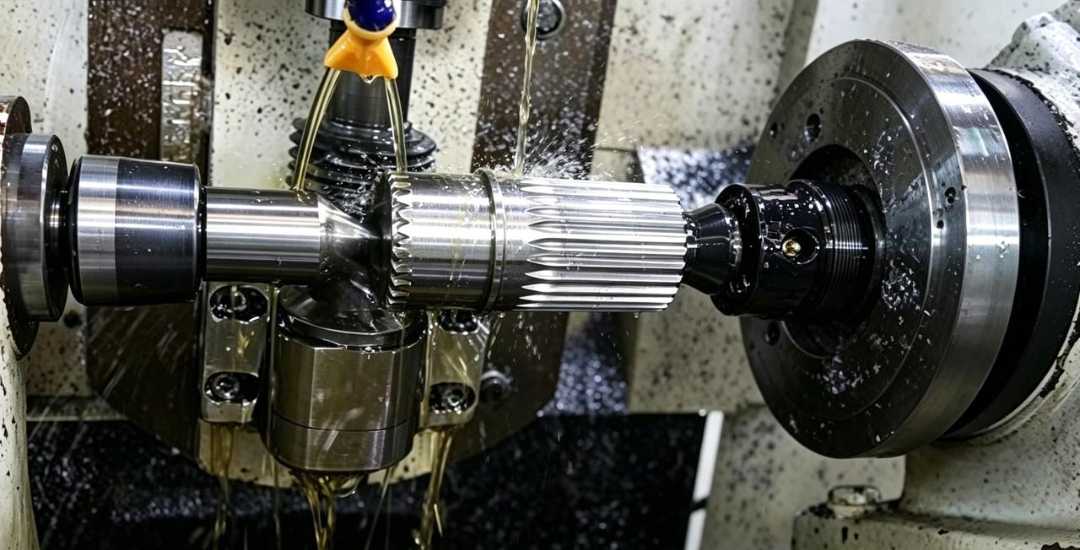
External splines for production parts are typically generated by hobbing. Once the hob is set up, it produces accurate tooth profiles with short cycle times, although each hob is dedicated to a specific spline geometry.
For prototypes or small production runs, Fraisage CNC is often the preferred option because it avoids the cost of dedicated hobbing tools. The trade-off is longer machining time and greater dependence on CAM programming accuracy.
Internal splines are usually produced by broaching, providing excellent profile accuracy but requiring a dedicated broach matched to the spline specification.
From a manufacturing perspective, keyways minimize tooling cost and setup time, while splines require tighter geometry control and dedicated tooling but deliver higher performance where application requirements justify the additional manufacturing effort.
5. Spline vs Keyway on Real Parts
Real engineering applications make the difference much clearer. The following examples show how operating conditions, rather than personal preference, determine whether a keyway or a spline is the better choice.
Pump Shaft
A centrifugal pump shaft transmits steady torque from the motor to the impeller at a fixed speed. The load is moderate, the direction does not reverse, and the impeller is assembled once and left in place for the life of the pump. A keyway is the right choice here. The stress concentration from the keyway is acceptable because the torsional loading is steady, while the simple machining process keeps manufacturing straightforward and cost-effective.
Transmission Input Shaft
A transmission input shaft receives engine torque through the clutch and transmits it to the gear train. The load reverses during gear shifts, torsional vibration is present, and the clutch hub must slide along the shaft during operation. A spline is required here. It distributes torque across multiple teeth, allows axial movement, and maintains accurate shaft-to-hub alignment under repeated shock loading.
Conveyor Roller
A conveyor roller shaft drives a belt at constant speed with relatively low torque. The sprocket or pulley is installed once and rarely removed. A keyway is the practical solution because the torque demand is well within its capacity, axial movement is unnecessary, and the operating conditions do not justify the additional machining complexity of a spline.
Robotic Joint Shaft
A robotic joint shaft connects a servo motor to a reduction gear at the elbow or wrist. The load reverses continuously, and even small amounts of backlash reduce positioning accuracy. A spline is the preferred choice because it maintains accurate alignment and distributes torque evenly under repeated reversing loads. A keyed connection would gradually develop wear at the contact surfaces, increasing backlash and reducing repeatability over time.
Across these applications, the selection pattern is consistent. When torque is steady and the hub remains fixed, a keyway is usually the simplest and most economical solution. When the application involves reversing loads, shock loading, or axial movement, a spline provides better long-term performance. The connection should always be selected according to operating conditions rather than manufacturing cost alone.
6. Design Considerations Before Choosing Spline or Keyway
Choosing between a spline and a keyway involves more than comparing torque capacity. Several design factors determine which connection provides the best balance of performance, manufacturability, and cost.
Shaft Diameter. On small-diameter shafts, the stress concentration created by a keyway removes a significant portion of the remaining cross-section. As shaft diameter decreases, the keyway occupies a larger percentage of the load-bearing material. In these cases, a spline or press-fit connection often preserves more shaft strength.
Torque and Shock Load. Steady, moderate torque generally favors a keyway. Reversing torque or shock loads favor a spline because distributing the load across multiple teeth reduces the risk of single-point failure. Under severe shock loading, a key may shear before the shaft reaches its material limit.
Material Strength and Fatigue. High-strength shaft materials are generally more sensitive to stress concentrations. The sharp corners at the base of a keyway can become fatigue initiation points under cyclic loading. For quenched-and-tempered alloy steels, a spline often provides better fatigue performance by reducing local stress concentration. On lower-strength carbon steels, a keyway remains a practical solution.
Hub Length and Engagement. A short hub increases bending stress at the shaft-hub interface. Because multiple teeth share the load, splines generally perform better with limited engagement length. When installation space restricts hub length, a spline is often the safer choice.
Fit Tolerance and Alignment. Keyways typically use standard clearance fits and do not automatically center the hub. When alignment directly affects system performance, a close-fit involute spline provides more accurate self-centering. Where alignment is controlled by bearings or housings, a keyway is usually sufficient.
Assembly Frequency. If the hub is assembled once and remains in place throughout the product’s service life, a keyway is generally adequate. If periodic disassembly is required for maintenance, adjustment, or replacement, a spline allows repeated assembly without significantly reducing connection quality.
Production Volume. Low-volume production generally favors a keyway because no dedicated tooling is required. As production volume increases, the initial investment in hobs or broaches is spread across more parts, making splines increasingly cost-effective despite the higher tooling cost.
At Beska, we evaluate these design factors together with material selection, machining capability, production volume, and service requirements before recommending a shaft connection. Identifying potential reliability and manufacturability issues early in the design stage helps reduce unnecessary cost while improving long-term performance.
7. When to Use a Keyway and When to Use a Spline
Choosing between a keyway and a spline usually comes down to three practical questions:
- Does the application involve reversing loads or shock loading? If yes, a spline is usually the better choice.
- Does the hub need to slide along the shaft during operation or assembly? If yes, specify a spline.
- Is the application operating under steady, moderate, one-directional torque with a permanent assembly? If yes, a keyway is generally sufficient.
If the application involves steady torque and a permanently mounted hub, a keyway is usually the simplest and most economical solution. When reversing loads, shock loading, or axial movement are present, a spline provides better long-term reliability and performance, particularly where the cost of failure is high.
There are also situations where neither connection is the best option. Light-torque applications on small shafts can often use a press-fit or taper-lock connection without machining a slot. High-precision positioning at low torque may be better served by a zero-backlash friction coupling. Keyways and splines are the most common shaft connections, but understanding their strengths and limitations makes it easier to identify when an alternative solution is the better engineering choice.
Conclusion
The cost of a shaft connection is measured not only by its machining cost, but also by its long-term performance in service. A keyway may reduce manufacturing cost, but it can increase maintenance and downtime if the application demands shock resistance or axial movement. A spline often requires more complex machining, yet it can deliver a lower lifetime cost by improving reliability and reducing the risk of failure.
The best shaft connection is not the one with the lowest initial cost, but the one that consistently meets the functional requirements of the application throughout its service life.
At Beska, shaft connection selection is evaluated together with material properties, torque requirements, manufacturing capability, production volume, and assembly conditions. This engineering-first approach helps customers balance performance, manufacturability, and long-term reliability before production begins.
Deeper into Our Resources
Pour des lectures enrichissantes, nous avons sélectionné pour vous une liste d'articles recommandés :
 French
 English
 Hebrew
 Turkish
 Russian
 German
 Spanish
 Portuguese