


Laser cutting, punching, shearing, and stamping can leave burrs, sharp edges, or dross on sheet metal parts. If these edge defects are not properly controlled, they can interfere with assembly, create handling risks, affect coating coverage, and reduce the consistency of the finished part.
Sheet metal deburring removes or smooths these unwanted edge conditions while protecting the dimensions and features defined on the drawing. This article explains how burrs form, the most common deburring methods, how to choose the right process, and how DFM decisions can reduce edge-finishing problems before production.
1. What Is Sheet Metal Deburring
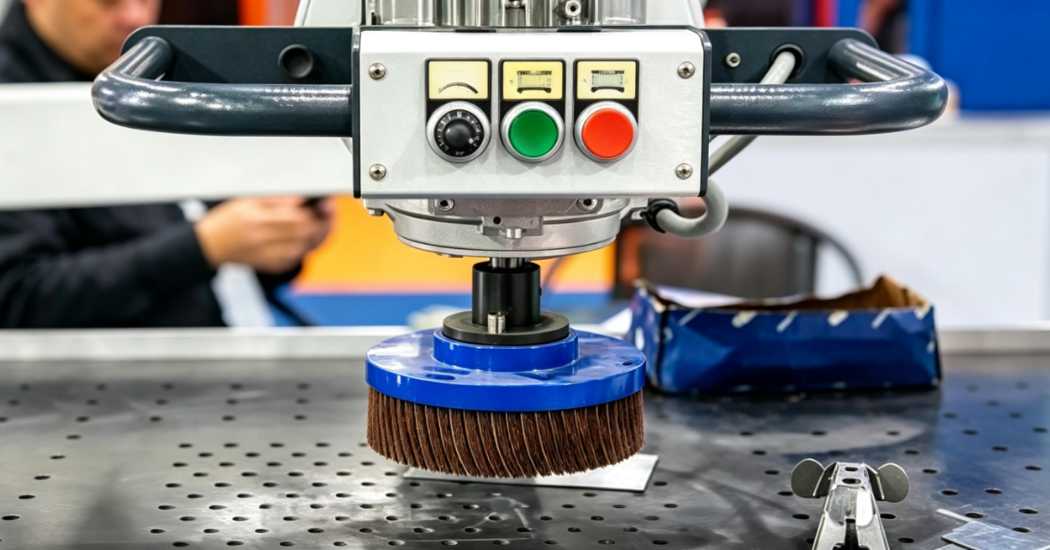
Sheet metal deburring is the process of removing unwanted burrs and sharp edge irregularities left after cutting, punching, shearing, or stamping. The goal is to create a safer and more consistent edge without unnecessarily changing the part dimensions or geometry.
Not every edge defect is technically a burr. Mechanical cutting processes can leave raised or torn burrs, while découpe laser may leave re-solidified dross along the cut edge. A part may also have a sharp edge even when no visible burr remains.
Deburring removes these unwanted projections, while edge rounding or edge breaking intentionally creates a small radius or softened edge when required for handling, assembly, coating, or the drawing specification. The amount of material removed should therefore depend on the part geometry, tolerance, edge requirement, and downstream process rather than a fixed deburring value.
2. Common Sheet Metal Edge Defects and Their Risks
Sheet metal edge defects can come from both mechanical cutting and thermal cutting processes. Their size and shape depend on the material, tooling condition, cutting parameters, and part geometry.
Common Sources of Burrs and Edge Defects
- Punching and shearing. Mechanical cutting leaves a fracture zone along the cut edge, and a burr can form as the material separates from the punch or blade. Punch-to-die clearance has a strong influence on burr height and edge quality. The correct clearance depends on material strength, sheet thickness, tooling, and the required cut condition rather than one fixed percentage.
- Laser cutting. Laser-cut parts may develop dross or re-solidified material along the lower cut edge. Its formation can be influenced by cutting speed, assist gas, gas pressure, focus position, power, and material condition.
- Other thermal cutting processes. Plasma and flame cutting can leave heavier slag or rougher cut edges that may require more aggressive finishing before the part moves to coating, welding, or assembly.
Why Unfinished Edges Cause Problems
Burrs, dross, and sharp edges can create problems beyond appearance. They may interfere with part fit, create handling hazards, damage mating components, or leave loose metal particles in an assembly.
Edge condition also matters before surface finishing. Sharp or irregular edges can make uniform coating coverage more difficult, while controlled edge rounding can improve coating adhesion and reduce the risk of premature corrosion at exposed edges.
For production parts, the required edge condition should therefore be controlled according to the drawing, assembly requirements, surface treatment, and final use of the component.
3. Common Sheet Metal Deburring Methods
The appropriate deburring method depends on the burr size, material, part geometry, required edge condition, and production volume. No single process is suitable for every sheet metal component.
Manual Deburring
Manual tools such as files, abrasive pads, rotary tools, and hand-held grinders are useful for prototypes, small batches, and localized edges that are difficult to reach with automated equipment.
The main advantage is flexibility, but the result depends heavily on operator technique. Excessive pressure or grinding can remove too much material, particularly on thin or delicate features.
Abrasive Belt Deburring
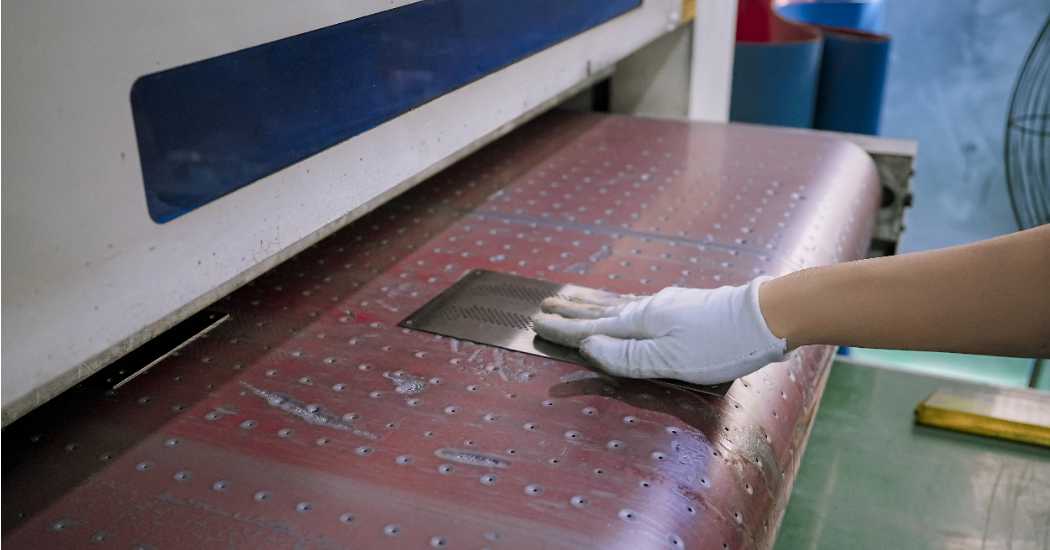
Abrasive belt and wide-belt machines are widely used to remove burrs, dross, and surface irregularities from flat sheet metal parts. They are well suited to laser-cut, punched, and sheared components that can pass through an automated finishing machine.
Belt type, abrasive grade, contact pressure, and feed speed are selected according to the material and the amount of edge material that needs to be removed.
Rotary Brush and Edge Rounding
Rotary brush systems are commonly used after primary burr removal to break sharp edges and create a more uniform edge radius. They are particularly useful for flat parts that require consistent edge conditioning before coating or assembly.
Their effectiveness depends on whether the brush can physically reach the edge, so deep recesses and enclosed internal features may require another finishing method.
Vibratory Tumbling
Vibratory finishing processes multiple small parts together with abrasive media. It can provide relatively uniform deburring and edge rounding for stamped, punched, or small sheet metal components.
Because the entire part is exposed to the media, process time and media selection need to be controlled when dimensional features or surface appearance are important.
Specialized Deburring for Internal Features
Parts with internal passages, intersecting holes, or difficult-to-access edges may require specialized processes. Abrasive flow machining uses a controlled abrasive media that flows through internal features to remove burrs, polish surfaces, or create a controlled edge radius.
These methods are generally selected when conventional belts, brushes, or manual tools cannot reach the required area.
4. How to Choose a Sheet Metal Deburring Method
The best deburring process depends on more than production volume. Burr size, part geometry, material, edge accessibility, required edge condition, and downstream finishing all influence the choice.
| Part or Process Condition | Suitable Deburring Approach |
| Prototypes or irregular low-volume parts | Manual deburring |
| Flat laser-cut or punched sheet parts | Abrasive belt or wide-belt deburring |
| Parts requiring consistent edge breaking or rounding | Rotary brush finishing |
| Small stamped or punched components processed in batches | Vibratory tumbling |
| Internal or difficult-to-access edges | Specialized internal deburring methods |
For simple flat parts, automated belt or brush systems can provide consistent results and higher throughput. Manual deburring remains useful when only a few parts are required or when the geometry is difficult for automated equipment to reach.
Small components that can be processed together may benefit from vibratory finishing, while enclosed passages or inaccessible internal edges may require specialized methods such as abrasive flow machining.
The final process should be selected according to the required edge condition rather than batch size alone. A part that only needs burr removal may require a different process from one that needs a controlled edge radius before coating or assembly.
5. Drawing Requirements and DFM for Sheet Metal Deburring
Deburring quality depends not only on the finishing process but also on how edge requirements are defined on the drawing and how easily the part can be accessed during fabrication.
Define Edge Requirements Clearly
A general note such as “Remove all burrs” may be sufficient for non-critical edges, but functional edges often need more specific requirements. Drawings should make it clear whether an edge only needs burr removal, requires a small edge break, or must have a defined chamfer or radius.
This becomes especially important around mating surfaces, sealing areas, hand-contact edges, coated surfaces, and features with limited assembly clearance. If the edge geometry affects fit or function, the required radius or chamfer should be dimensioned rather than left to the fabricator to determine.
ISO 13715 can also be used to define requirements for edges whose exact geometry is not otherwise specified. Clear edge requirements help avoid both incomplete deburring and excessive material removal.
Reduce Deburring Problems Through DFM
Good sheet metal design can make downstream deburring easier and more consistent. Narrow recesses, enclosed features, very small tabs, and delicate edge geometry can limit tool access or become more sensitive to distortion during finishing.
For punched or sheared parts, punch-to-die clearance should be selected according to the material, sheet thickness, and required cut quality to reduce excessive burr formation. Parts that require coating, cosmetic surfaces, or controlled edge rounding should also account for finishing access early in the design stage.
Considering these requirements before production allows cutting, forming, and deburring to be planned together instead of relying on additional finishing to correct avoidable edge problems later.
Conclusion
Effective sheet metal deburring is about achieving the right edge condition for the part, not simply removing as much material as possible. The suitable method depends on the burr type, material, geometry, drawing requirements, and downstream processes such as coating or assembly.
Beska supports custom sheet metal fabrication for prototypes and production parts, including cutting, forming, surface treatment, and assembly requirements. If your project has specific edge, surface, or dimensional requirements, our team can manufacture the parts according to your drawings and application needs.
 French
 English
 Hebrew
 Turkish
 Russian
 German
 Spanish
 Portuguese