


PPSU and PEEK are both high-performance thermoplastics used in medical, industrial, and precision engineering applications, but their strengths are different. PPSU is valued for impact toughness and repeated steam sterilization, while PEEK offers higher temperature capability, stiffness, creep resistance, and broad chemical resistance.
These differences matter when a part must hold dimensions under heat, carry a sustained load, survive repeated sterilization, or meet tight machining requirements. Material grade, reinforcement, part geometry, and service conditions can also change how each plastic performs in production.
A useful PPSU vs PEEK comparison therefore goes beyond tensile strength or a single temperature rating. The sections below compare their thermal, mechanical, chemical, machining, and cost characteristics to show where each material has a practical advantage.
1. What Are PPSU and PEEK: Material Overview
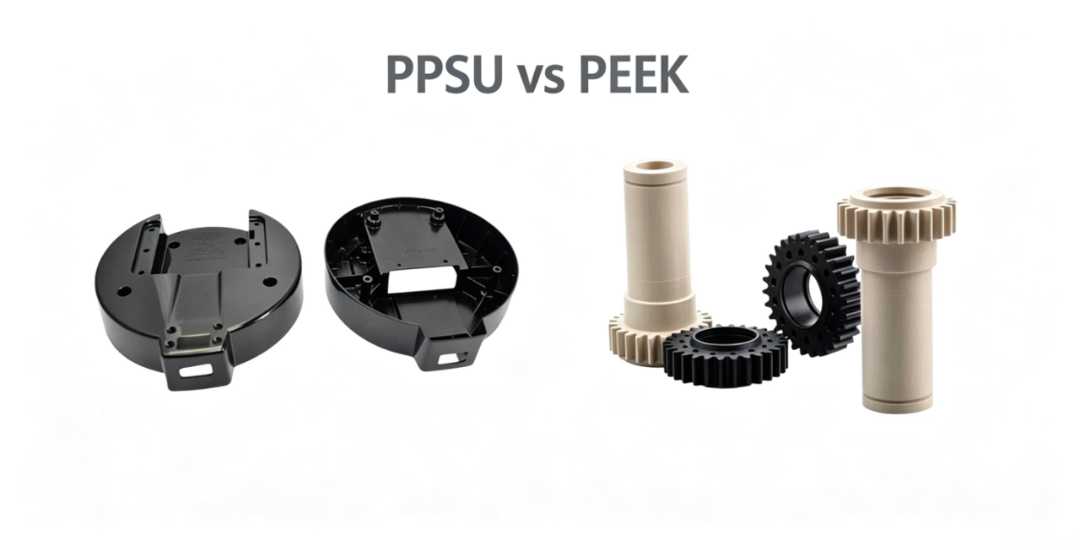
PPSU and COUP D'OEIL are both high-performance thermoplastics, but they have different polymer structures and performance profiles.
- PPSU (Polyphenylsulfone) is an amorphous thermoplastic known for high impact toughness, heat resistance, hydrolytic stability, and repeated steam sterilization performance. Because it is amorphous, it does not have a crystalline melting point and softens progressively above its glass transition temperature. These properties make PPSU widely used in reusable medical devices, sterilization equipment, fluid-handling components, and other applications exposed to heat and moisture.
- PEEK (Polyether Ether Ketone) is a semi-crystalline thermoplastic with a combination of high strength and stiffness, creep resistance, chemical resistance, and high-temperature performance. Its crystalline and amorphous regions allow it to retain useful mechanical properties under demanding thermal and mechanical conditions, which is why PEEK is often selected for highly loaded precision components and aggressive service environments.
The amorphous structure of PPSU and the semi-crystalline structure of PEEK help explain many of their differences, but material grade, reinforcement, processing history, and part design also affect final performance.
2. PPSU vs PEEK: Key Material Properties
PPSU and PEEK overlap in many high-performance applications, but their mechanical and thermal profiles are quite different. The table below uses representative unfilled stock grades to show the general comparison.
| Propriété | PPSU | COUP D'OEIL |
| Polymer structure | Amorphous | Semi-cristallin |
| Densité | ~1.29 g/cm³ | ~1.31 g/cm³ |
| Tensile strength at yield | ~79 MPa | ~110 MPa |
| Tensile modulus | ~2.3 GPa | ~4.5 GPa |
| Elongation at break | ~60% | ~30% |
| Heat deflection temperature | ~207°C | ~160°C |
| Long-term service temperature | ~150°C | ~250°C |
| Impact toughness | Plus haut | Lower than PPSU |
| Steam sterilization resistance | Excellent | Excellent |
| Chemical resistance | Bien | Broader overall resistance |
These values show why a single temperature or strength figure can be misleading. PPSU can have a higher heat deflection temperature in some grades while still having a lower long-term service temperature than PEEK. PEEK, meanwhile, offers substantially higher stiffness and tensile strength, while PPSU retains an advantage in impact toughness.
Actual values vary with resin grade, reinforcement, stock form, and test method, so the material specification for the selected grade should be checked before final design.
3. Temperature Resistance and Sterilization
PPSU and PEEK both perform well at elevated temperatures, but their temperature ratings describe different things. Heat deflection temperature, glass transition temperature, and long-term service temperature should not be treated as interchangeable values.
Long-Term Temperature Performance
PEEK has the stronger advantage when a component must retain mechanical properties during prolonged exposure to high temperature. For unfilled PEEK grades, long-term mechanical temperature ratings can reach around 240°C, although the usable temperature of an actual part still depends on load, geometry, environment, and material grade.
PPSU also offers high heat resistance, but its long-term service temperature is generally lower. Representative medical-grade PPSU stock materials are commonly rated around 170°C for long-term use, with higher temperatures possible for shorter periods.
Steam Sterilization
PPSU performs particularly well in applications that undergo repeated steam sterilization. Its hydrolytic stability and impact toughness are major reasons it is widely used for reusable medical-device components, sterilization trays, and instrument handles.
PEEK also tolerates repeated sterilization and offers higher mechanical performance at elevated temperature. The choice between the two therefore depends on more than maximum temperature: load, chemical exposure, dimensional requirements, and the sterilization method all matter.
For reusable medical components, PPSU should not be treated as the lower-performance option simply because it is amorphous. In many steam-sterilization applications, its combination of toughness, hydrolytic stability, and heat resistance is exactly why it is selected.
4. Mechanical Performance: Strength, Impact and Creep
PPSU and PEEK have different mechanical strengths. PEEK generally provides higher tensile strength and stiffness, while PPSU stands out for impact toughness and its ability to tolerate repeated handling or shock without brittle failure.
Strength and Stiffness
Unfilled PEEK is typically stronger and stiffer than PPSU. This makes it better suited to structural components where the material must resist deformation under mechanical load or maintain tight dimensional relationships.
PPSU has lower stiffness, but its high toughness is valuable in components exposed to impact, repeated handling, or accidental drops. This is one reason PPSU is widely used in reusable medical equipment and protective components.
Creep Under Sustained Load
PEEK also has an advantage when a part carries a continuous load, especially at elevated temperature. Its semi-crystalline structure helps it retain stiffness and resist creep better than many amorphous thermoplastics.
PPSU can also support structural loads, but creep becomes more important when stress, temperature, and service time increase. For interference fits, clamped components, or other load-bearing features, long-term deformation should therefore be checked against the actual material grade and service conditions rather than relying only on room-temperature tensile data.
Fatigue and Repeated Loading
Both materials can perform well under repeated loading, but fatigue behavior depends strongly on stress level, temperature, geometry, surface condition, and material grade. PEEK is often favored when high stiffness and sustained mechanical performance are required, while PPSU may be more attractive where impact resistance and toughness are the dominant concerns.
5. PPSU vs PEEK for CNC Machining
Both PPSU and PEEK can be machined into tight-tolerance components, but machining behavior depends strongly on the material grade, stock condition, part geometry, and required tolerance.
Machining Behavior
PPSU machines well with sharp cutting tools and is commonly used for precision medical and industrial components. Because it has lower stiffness than PEEK, thin or lightly supported features may require careful fixturing to limit deflection during cutting.
Unfilled PEEK also has good machinability. Its higher stiffness can support dimensional control, while sharp tools and proper heat management help maintain surface quality. Reinforced PEEK grades containing glass or carbon fibers are more abrasive and can increase tool wear, so tooling should be selected according to the specific grade rather than treating all PEEK materials the same.
Dimensional Stability and Stress Relief
Heat generation, clamping force, material removal, and residual stress can affect both plastics during precision machining. Parois minces, asymmetric material removal, and tight tolerances require particular attention to fixturing and machining sequence.
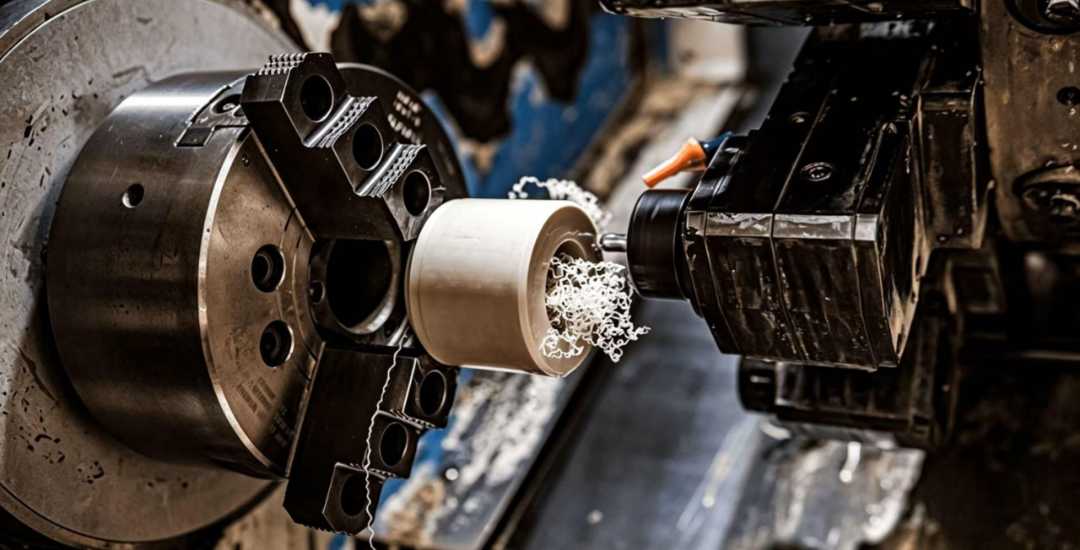
For PEEK parts with demanding dimensional or high-temperature requirements, stress-relief annealing may be used before final machining to reduce later dimensional change. It is not required for every PEEK component, and the need should be determined by the stock condition, geometry, tolerance, and service requirements.
6. Cost and Material Selection
PEEK generally carries a higher raw material cost than PPSU, but material price alone does not determine the final part cost. Stock size, material grade, reinforcement, part geometry, tolerance, machining time, tool wear, and any required post-machining treatment can all affect the manufacturing cost.
When PPSU Makes More Sense
PPSU can be a cost-effective choice when its heat resistance, impact toughness, chemical resistance, and sterilization performance already meet the application requirements. Paying for the higher mechanical and thermal capability of PEEK adds little value if the part does not need it.
When PEEK Is Worth the Higher Cost
PEEK becomes more attractive when the application requires higher stiffness, better creep resistance, broader chemical resistance, or stronger mechanical performance at elevated temperature. In these cases, material selection should be based on the service requirement rather than the lowest initial material price.
For CNC-machined parts, the cost difference should be evaluated using the actual grade and part design. Reinforced PEEK, very tight tolerances, thin walls, or stress-relief requirements can increase machining complexity, while unfilled PEEK should not automatically be treated as difficult or inefficient to machine.
7. PPSU vs PEEK: Application Selection
PPSU and PEEK overlap in many medical and industrial applications, so the better choice depends on which property matters most in the final part.
| Application Requirement | PPSU Advantage | PEEK Advantage |
| Repeated steam sterilization | Excellent hydrolytic stability and impact toughness; widely used in reusable medical devices | Also highly resistant to steam, with higher strength and temperature capability |
| Continuous high-temperature service | Suitable for demanding heat and moisture exposure | Better choice when higher long-term temperature capability and mechanical retention are required |
| Sustained mechanical load | Good toughness and structural performance | Stronger advantage in stiffness and long-term creep resistance |
| Impact or repeated handling | Strong advantage due to high impact toughness | Good toughness, but generally selected more for stiffness and high-temperature performance |
| Aggressive chemical exposure | Good resistance to many cleaning agents, disinfectants, and aqueous chemicals | Broader overall chemical resistance |
| Precision CNC components | Machinable with appropriate tooling and fixturing | Also highly machinable; reinforced grades may require more wear-resistant tooling |
| Cost-sensitive high-performance parts | Often more economical when PPSU already meets the service requirements | Higher material cost is easier to justify when its additional thermal, mechanical, or chemical performance is required |
Neither material should be selected from a single temperature or strength value. Sterilization method, sustained load, chemical exposure, required stiffness, part geometry, and material grade should be considered together.
Conclusion
PPSU and PEEK overlap in many demanding applications, but they solve different engineering priorities. PPSU stands out for impact toughness, hydrolytic stability, and repeated steam sterilization, while PEEK offers higher stiffness, better creep resistance, broader chemical resistance, and stronger mechanical performance at elevated temperatures.
For CNC-machined plastic parts, Beska can manufacture PPSU and PEEK components to drawing requirements and review material grade, geometry, tolerance, and machining considerations before production. The better material is the one whose properties match the actual service conditions without adding unnecessary cost or performance margin.
 French
 English
 Hebrew
 Turkish
 Russian
 German
 Spanish
 Portuguese