


CNC tornalama and centerless grinding are both widely used for shafts and cylindrical components, but they solve different manufacturing problems. Turning is highly flexible for creating steps, threads, grooves, bores, and other rotational features, while centerless grinding is commonly used to improve the dimensional consistency, roundness, and surface condition of cylindrical outside diameters.
The choice is not always one process or the other. A complex shaft may be turned to create its main geometry and then centerless ground on selected diameters that require tighter finishing control. Part geometry, tolerance requirements, surface finish, shaft proportions, and production volume all influence whether turning, centerless grinding, or a combination of both is the more appropriate manufacturing route.
1. Basic Overview of CNC Turning and Centerless Grinding
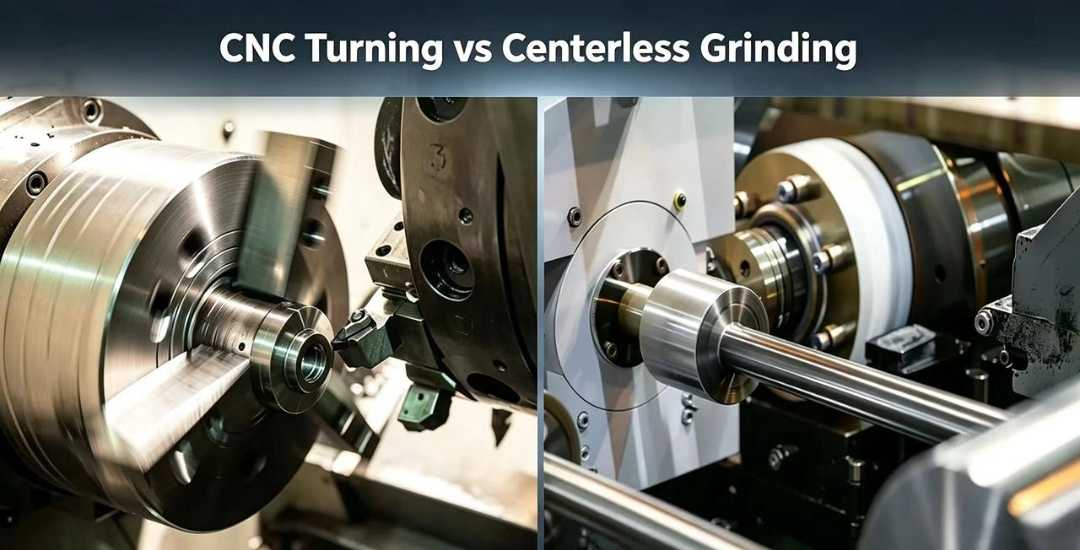
The main difference between CNC turning and centerless grinding is what each process is intended to accomplish. CNC turning creates part geometry through controlled cutting, while centerless grinding primarily refines cylindrical outside diameters through abrasive material removal.
Core Features of CNC Turning
In CNC turning, the workpiece rotates in the spindle while a cutting tool removes material along a programmed path. The part is typically held in a chuck, collet, or between centers, with additional support used when required.
Turning can produce a wide range of rotational features, including external diameters, shoulders, tapers, grooves, threads, and bores. Turn-mill machines with live tooling can also produce features such as flats, cross-holes, and slots, reducing the need for additional setups on more complex components.
Core Features of Centerless Grinding
Centerless grinding removes material from a cylindrical outside diameter without holding the workpiece in a conventional chuck or between centers. Instead, the part is supported between a grinding wheel, regulating wheel, and work-rest blade.
The grinding wheel performs the material removal, while the regulating wheel controls workpiece rotation and, in through-feed grinding, helps move the part axially through the grinding zone. Because conventional chucking is not required, the process can reduce some workholding-related deformation concerns.
Centerless grinding is commonly used when outside-diameter consistency, roundness, surface finish, and production efficiency are important, particularly for cylindrical components produced in repeated quantities.
2. Fundamental Differences Between CNC Turning and Centerless Grinding
The practical differences between CNC turning and centerless grinding come largely from how the workpiece is supported, how material is removed, and which features the process is intended to control.
Positioning and Workholding
CNC turning establishes a defined rotational axis through the machine spindle and workholding setup. When multiple diameters, shoulders, bores, or other rotational features are machined in the same setup, their positional relationships can often be controlled effectively.
Centerless grinding does not locate the workpiece from a pre-established center or conventional chucking datum. This makes it highly effective for controlling cylindrical outside diameters, but less suitable when the finished OD must maintain a tightly controlled positional relationship with a bore, thread, shoulder, or other separately machined feature.
Material Removal and Feature Capability
CNC turning is primarily used to generate part geometry. Depending on the machine and setup, it can perform roughing, finishing, threading, grooving, boring, and other operations required to produce a complete rotational component.
Centerless grinding is primarily an OD finishing process. It removes controlled stock from cylindrical outside surfaces to improve diameter consistency, roundness, and surface finish. For parts with additional features, grinding is often used after turning rather than as a replacement for it.
Slender-Part and Deformation Considerations
Long, slender shafts can be challenging to turn because cutting forces, workholding, unsupported length, vibration, and thermal effects can contribute to deflection or dimensional variation. Tailstocks, steady rests, follower rests, tooling, and appropriate cutting parameters can help control these effects.
Centerless grinding eliminates the need for conventional chucking or center support during the grinding operation. This can make it advantageous for long cylindrical components that require consistent outside diameter and straightness, although grinding forces, heat, and machine setup still influence the final geometry.
3. Comprehensive Performance Comparison of Two Processes
The table below compares CNC turning and centerless grinding across the factors that most often affect process selection.
| Comparison Factor | CNC Tornalama | Centerless Grinding |
| Feature Capability | Can produce ODs, steps, tapers, grooves, threads, bores, and other rotational features | Primarily used for cylindrical OD finishing; feature capability depends on the grinding method and part geometry |
| Geometric Control | Good control of relationships between features machined in the same setup | Well suited to controlling OD size and roundness; relationships to other part features require additional consideration |
| Yüzey Kaplama | Depends on tooling, feed, material, and cutting conditions; feed marks may remain | Commonly selected when a finer OD surface finish is required |
| Long / Slender Parts | Requires careful workholding, support, and cutting control as the length-to-diameter ratio increases | Can be advantageous for long cylindrical parts because conventional chucking or center support is not required |
| Üretim Hacmi | Flexible for prototypes, low-volume production, changing geometries, and custom parts | Particularly efficient for repeated production of suitable cylindrical parts |
| Maliyet Hususları | Lower setup burden for many custom parts; cost depends on machining time and complexity | Setup and wheel preparation can add initial cost, while repeat production can reduce unit processing cost |
Actual results depend on material, part geometry, machine capability, tooling, setup, tolerance requirements, and production volume.
4. Typical Application Scenarios of Two Processes
Part geometry and finishing requirements usually provide the clearest indication of whether CNC turning, centerless grinding, or a combination of both is appropriate.
When CNC Turning Is Commonly Used
CNC turning is commonly selected for rotational components that require multiple machined features, such as stepped shafts, threaded shafts, grooved pins, bushings with internal bores, and components with shoulders or tapers.
When several related features are machined in the same setup, turning can also help control their positional relationships and reduce errors introduced by additional setups. This is particularly useful when multiple diameters, shoulders, and bores must function together during assembly.
When Centerless Grinding Is Commonly Used
Centerless grinding is commonly used for cylindrical components whose critical requirements are concentrated on the outside diameter, roundness, straightness, or surface finish.
Typical examples include precision pins, straight shafts, guide rods, bearing components, and cylindrical blanks. Through-feed centerless grinding can also provide efficient continuous processing for suitable parts produced in repeated quantities.
For long or slender cylindrical components, centerless grinding can be advantageous when workholding, support, and deflection control make conventional turning more challenging.
When Turning and Centerless Grinding Are Combined
Some components benefit from using both processes. CNC turning can first create the main geometry, including steps, grooves, threads, shoulders, and bores, while selected cylindrical surfaces are left with a controlled grinding allowance.
Centerless grinding can then be used to finish those outside diameters when tighter control of OD size, roundness, or surface finish is required.
5. Practical DFM Guidelines for Process Selection
Process selection usually starts with four factors: part geometry, critical tolerances, shaft proportions, and production volume.
Parça Geometrisi
CNC turning is generally required when the part includes features such as steps, shoulders, threads, grooves, tapers, or internal bores. These features are generated directly through controlled tool movement and cannot normally be produced by centerless grinding alone.
For parts dominated by cylindrical outside surfaces, centerless grinding may be considered when OD size, roundness, or surface finish requires additional control. A complex shaft can therefore be turned first and centerless ground afterward on selected diameters.
Critical Tolerances and Surface Requirements
When several diameters, shoulders, bores, or other features must maintain controlled positional relationships, the turning setup and datum strategy become important.
When the critical requirements are concentrated on a cylindrical OD, particularly diameter consistency, roundness, or surface finish, centerless grinding may provide a more suitable finishing process. If both feature relationships and demanding OD requirements are present, combining turning and grinding is often the more practical process route.
Shaft Length-to-Diameter Ratio
As the length-to-diameter ratio increases, turning becomes more sensitive to cutting forces, unsupported length, workholding, vibration, and thermal effects. Tailstocks, steady rests, follower rests, and appropriate cutting parameters can help control deflection.
For suitable long or slender cylindrical components, centerless grinding can be advantageous because the grinding operation does not require conventional chucking or center support. The final choice still depends on part geometry, stock allowance, material, and required tolerances.
Üretim Hacmi
CNC turning offers greater flexibility for prototypes, low-volume production, mixed part families, and components whose geometry changes frequently. Programming and setup can be adapted without requiring a dedicated centerless grinding configuration for each part family.
Centerless grinding becomes particularly attractive for repeated production of suitable cylindrical components. Once the wheel, work-rest, and feeding conditions are established, the process can provide efficient throughput and consistent OD finishing across larger quantities.
6. Process Limitations and Common Machining Defects
Both processes have limitations that become more important as geometry, tolerance, surface finish, or production requirements become more demanding.
CNC Tornalama
Long or slender shafts are more sensitive to deflection, vibration, workholding forces, and thermal effects during turning. Without adequate support and appropriate cutting conditions, these factors can contribute to diameter variation, poor straightness, or chatter marks.
Turning may also leave visible feed marks on finished surfaces. When a cylindrical OD requires tighter control of roundness or a finer surface finish than turning can economically provide, an additional grinding operation may be appropriate.
Tool wear, incorrect cutting parameters, and unstable workholding can further contribute to dimensional variation or inconsistent surface quality, particularly on long or thin-walled components.
Centerless Grinding
Centerless grinding is primarily an outside-diameter process and does not independently generate features such as internal bores, threads, or many complex profiles. Parts requiring these features generally need turning or another machining process before grinding.
Because the workpiece is not referenced from a conventional center or chucking datum, controlling the relationship between a ground OD and other separately machined features requires careful process planning.
Incorrect wheel setup, work-rest position, dressing, or grinding parameters can also produce defects such as out-of-round geometry, chatter or waviness, and inconsistent surface finish.
7. Typical Manufacturing Scenarios
The following examples illustrate how part geometry and finishing requirements can lead to different process routes.
Multi-Feature Precision Shaft: CNC Turning
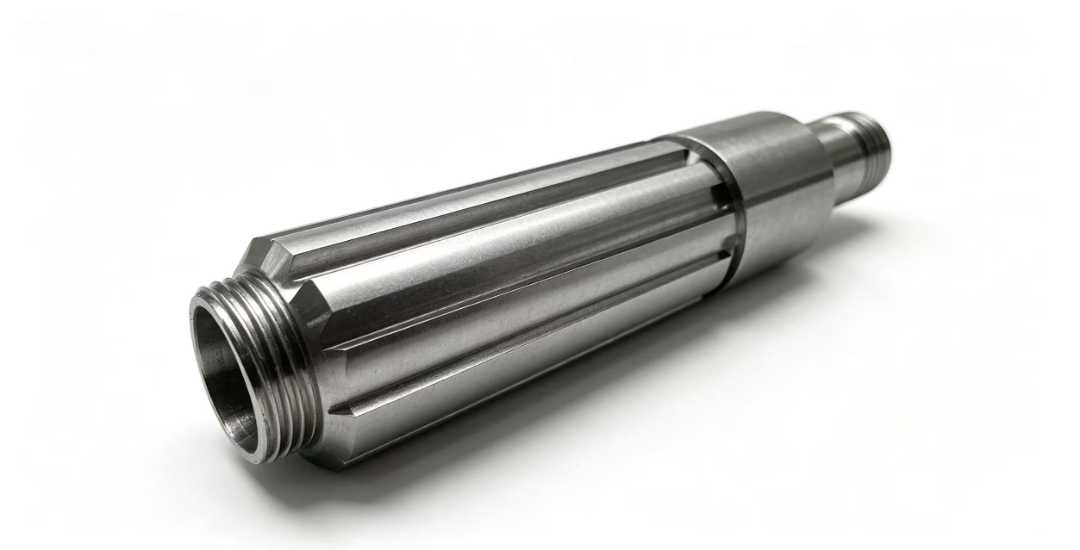
Consider a precision shaft with multiple diameters, shoulders, an internal thread, and a positioning groove. Because several features must be generated and controlled relative to the same rotational geometry, CNC turning is the primary machining process.
Related rotational features can be machined in the same setup where practical to reduce setup-related variation. Tooling, workholding, and finishing parameters can then be adjusted according to the tolerance and surface requirements of the critical diameters.
Centerless grinding cannot independently produce the internal thread or other complex features. However, a selected cylindrical OD could still receive a subsequent grinding operation if its final roundness or surface-finish requirement justifies it.
High-Volume Precision Shaft: Turning + Centerless Grinding
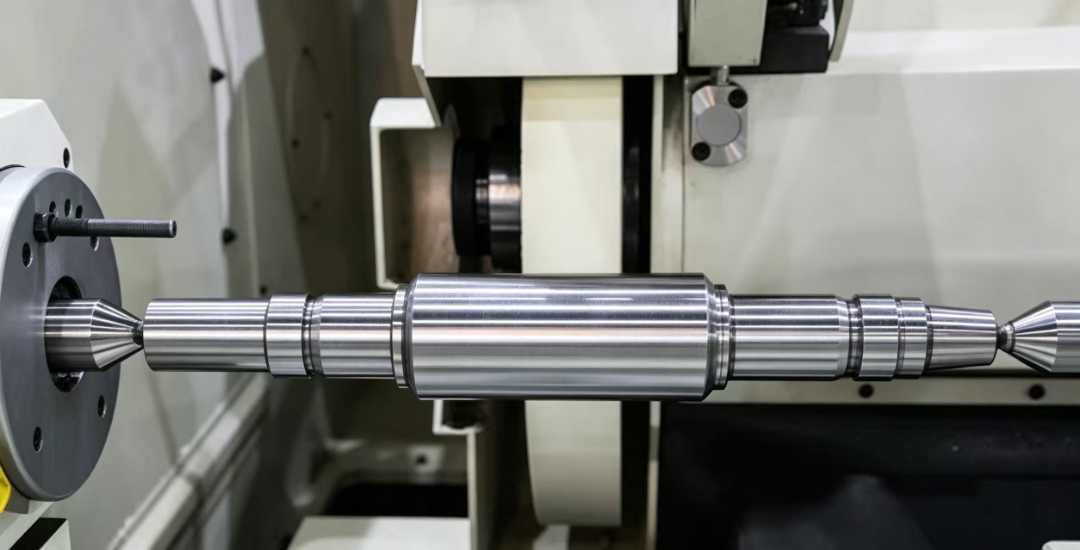
For a long cylindrical shaft produced in repeated quantities, the main geometry can first be created by CNC turning while leaving a controlled finishing allowance on the critical outside diameter.
Centerless grinding can then remove the remaining allowance to improve OD consistency, roundness, and surface finish. This approach can be particularly useful when turning alone is not the most efficient route to the required final OD condition across the production volume.
The two processes therefore perform different roles: turning establishes the part geometry, while centerless grinding provides the final OD finishing where required.
Çözüm
CNC turning and centerless grinding serve different roles in precision shaft manufacturing. Turning provides the flexibility to create complex rotational geometry, while centerless grinding is particularly useful for refining cylindrical outside diameters when tighter control of roundness, consistency, or surface finish is required.
For some parts, the most practical solution is to use both processes: turning creates the main geometry, and centerless grinding finishes selected ODs. The right process route depends on part geometry, critical tolerances, shaft proportions, surface requirements, and production volume.
 Turkish
 English
 Hebrew
 French
 Russian
 German
 Spanish
 Portuguese