


Bolted joints can lose clamp load when they are exposed to vibration, repeated loading, or temperature changes. In these conditions, a standard nut may not provide enough resistance to rotation, especially when the joint is subjected to repeated movement over time.
Lock nuts add an additional locking feature to help resist loosening. Depending on the design, this resistance may come from friction, thread deformation, a mechanical lock, or a wedge-based system. Because each method behaves differently, the most suitable lock nut depends on factors such as temperature, vibration, maintenance frequency, and the requirements of the joint.
1. What Is a Lock Nut?
A lock nut is a threaded fastener designed to provide additional resistance to loosening compared with a standard nut. While a standard nut mainly relies on friction between the mating threads and bearing surface, a lock nut includes an additional locking feature.
That locking feature can take different forms, such as a nylon insert, intentionally deformed threads, wedge-based geometry, or a positive mechanical lock. Each method creates resistance in a different way and has its own limits in terms of temperature, vibration, installation, and reuse.
For this reason, lock nuts are better compared by their locking mechanism than by appearance alone.
2. Common Types of Lock Nuts
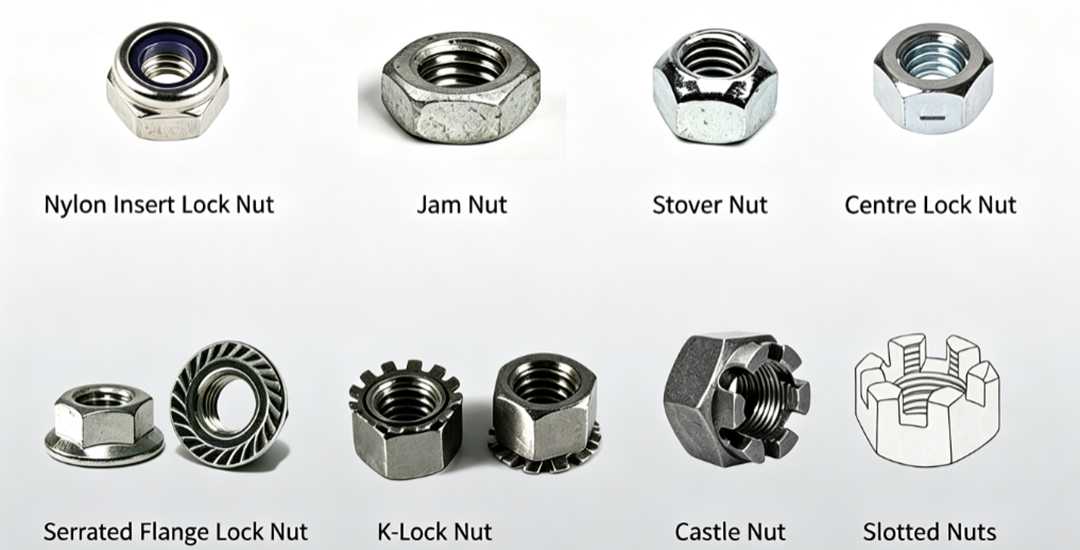
Lock nuts use different methods to resist unwanted rotation. Some create prevailing torque through friction or thread interference, while others rely on serrations, mechanical locking, or wedge-based geometry. Their performance depends on the joint design, operating temperature, vibration, installation method, and maintenance requirements.
Nylon Insert Lock Nuts
A nylon insert lock nut uses a polymer ring at the top of the nut to grip the mating bolt thread. As the bolt passes through the insert, the nylon deforms around the thread and creates additional friction that resists rotation.
These nuts are widely used for general machinery, equipment, and assemblies where temperatures remain within the limits of the insert material. Their locking performance can decrease after repeated installation or exposure to elevated temperatures, so reuse should follow the manufacturer’s requirements.
All-Metal Prevailing-Torque Lock Nuts
All-metal lock nuts create prevailing torque through controlled deformation of the nut threads or locking section. Common designs include top-lock and distorted-thread configurations.
Because there is no polymer insert, these nuts can be used in environments where temperature, chemicals, or other conditions would make nylon unsuitable. The allowable temperature and reuse limits still depend on the nut material, coating, applicable specification, and manufacturer.
Serrated Flange Lock Nuts
Serrated flange lock nuts have teeth or serrations on the bearing surface beneath the flange. When tightened, these serrations increase resistance to rotation at the joint interface.
They are commonly used where a wide bearing surface and additional resistance to loosening are useful. However, the serrations can mark or damage the mating surface, so they are not suitable for every finished, coated, or soft surface.
Castellated Nuts
A castellated nut has slots at one end that align with a drilled hole in the bolt or stud. A cotter pin passes through both components to prevent the nut from rotating beyond the locked position.
This is a positive mechanical locking method rather than a prevailing-torque design. It is used where visible, mechanically retained locking is required, but installation requires alignment between the nut slots and the bolt hole.
Wedge-Locking Systems
Wedge-locking systems use specially shaped contact surfaces to resist rotation when the joint is exposed to vibration or dynamic loading. Some designs use paired wedge-locking washers, while others integrate the locking geometry into the nut assembly.
These systems can be effective in demanding applications, but their installation, temperature capability, reuse, and torque requirements depend on the specific product design rather than on one universal rule.
3. How Lock Nuts Work
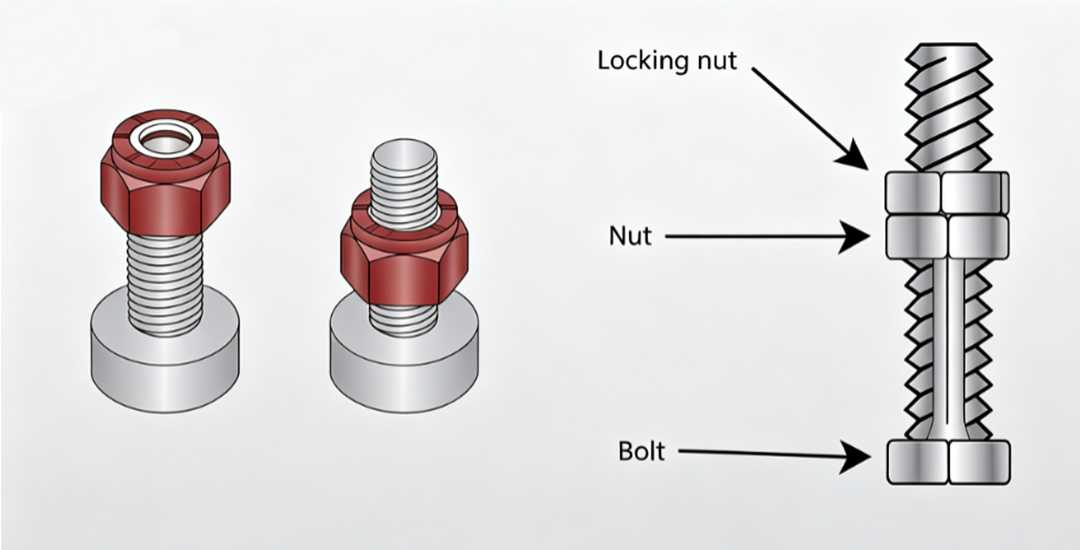
Lock nuts resist unwanted rotation in different ways. Some create additional friction in the threads, some use controlled thread deformation, while others rely on the bearing surface or a separate mechanical locking feature.
Friction from an Insert
Nylon insert lock nuts use a polymer ring that deforms around the bolt thread as the nut is installed. This creates additional friction, known as prevailing torque, even before the nut is fully seated against the joint.
The insert gradually wears with repeated installation, and its performance can also be affected by temperature and the service environment.
Controlled Thread Deformation
All-metal prevailing-torque nuts create resistance by intentionally deforming part of the threaded section. As the bolt passes through this area, the interference between the mating threads produces additional resistance to rotation.
Because the locking feature is entirely metallic, these designs can be used where a polymer insert would not be suitable. Their locking performance still depends on the specific nut design, material, coating, and number of installation cycles.
Bearing-Surface and Mechanical Locking
Some lock nuts resist rotation at the bearing surface rather than through the threads alone. Serrated flange nuts, for example, use teeth beneath the flange to increase resistance between the nut and the mating surface.
Castellated nuts work differently. Once the nut is tightened and aligned with a drilled bolt or stud, a cotter pin physically prevents further rotation. This creates a positive mechanical lock rather than prevailing torque.
Wedge-Locking Systems
Wedge-locking systems use specially designed contact surfaces that respond to relative rotation in the joint. Instead of relying only on friction in the threads, the geometry of the locking surfaces helps resist loosening under dynamic loading.
The exact behavior depends on the particular wedge-locking design, so installation and reuse requirements should follow the product specification rather than a general rule.
4. How to Choose a Lock Nut
The right lock nut depends on how the joint will operate in service. Temperature, vibration, maintenance frequency, surface condition, and specification requirements can all affect which locking method is suitable.
Temperature
Temperature is one of the first factors to check. Nylon insert lock nuts are limited by the heat resistance of the polymer insert, while all-metal designs can generally operate at higher temperatures.
The actual temperature limit depends on the nut material, insert material, coating, and product specification. For high-temperature joints, the selected lock nut should be verified against the manufacturer’s rated service range rather than relying on one general temperature value.
Vibration and Dynamic Loading
Joints exposed to vibration, impact, or repeated loading place greater demands on the locking system. The important question is not only whether the nut resists rotation, but whether the complete joint can maintain the required clamping condition during service.
Prevailing-torque nuts, serrated flange nuts, wedge-locking systems, and positive mechanical locks all resist loosening in different ways. The most suitable option depends on the severity of the loading, the joint design, and any applicable test or performance requirements.
Reuse and Maintenance
Repeated installation and removal can change the locking performance of some lock nuts. Nylon inserts can wear, while deformed-thread all-metal nuts may gradually lose part of their prevailing torque after multiple cycles.
For joints that are opened regularly during maintenance, reuse should be based on the manufacturer’s criteria or the applicable fastener specification. A nut that no longer provides the required locking resistance should not be reused simply because the threads still appear undamaged.
Surface Finish and Lubrication
Plating, coatings, and lubricants affect friction between the nut, bolt, and bearing surface. This changes the relationship between tightening torque and clamp load, which can influence both installation and joint performance.
Surface condition also matters when using serrated flange nuts because the serrations can mark soft, painted, plated, or finished surfaces. The locking method should therefore be compatible with both the required tightening procedure and the surface condition of the joint.
Safety and Specification Requirements
For critical joints, the lock nut should be selected according to the applicable drawing, OEM requirement, or fastener standard rather than by general preference.
Some applications require a specified prevailing-torque performance, while others may require a positive mechanical locking feature or a particular material and coating. These requirements should be confirmed before production, especially where fastener loosening could affect equipment operation or safety.
5. Installation and Torque Considerations
A lock nut can only perform as intended when it is installed correctly. Tightening torque, orientation, thread condition, coatings, and lubrication can all affect the relationship between installation torque, clamp load, and locking resistance.
Installation Torque and Prevailing Torque
For prevailing-torque lock nuts, part of the applied torque is used to overcome the locking feature before the nut is fully seated. The remaining tightening process develops the clamp load in the joint.
This is why the installation torque for a lock nut should not be treated in the same way as that of a free-running nut. The required value depends on the nut design, thread size, surface condition, lubrication, and applicable assembly specification.
Check the Installation Direction
Some lock nut designs have a required installation orientation. Nylon insert nuts, deformed-thread nuts, and wedge-locking systems may use different locking features, so the correct direction should be confirmed from the product drawing or manufacturer’s instructions.
Installing a directional locking feature incorrectly can prevent it from engaging as intended.
Coatings and Lubrication
Plating, coatings, and lubricants change friction at the threads and bearing surface. This can alter the torque needed to achieve a given clamp load and can also affect the measured prevailing torque.
For controlled assembly, the fastener finish and lubrication condition should therefore be defined consistently rather than changed without adjusting the tightening specification.
Torque Variation
Prevailing torque can vary from one lock nut to another because of differences in insert condition, thread deformation, coating, lubrication, and manufacturing variation.
For joints with tight preload requirements, the tightening method should follow the applicable engineering or OEM specification rather than relying on a generic torque value. Where necessary, installation torque and prevailing-torque performance can be verified during assembly or inspection.
6. Common Lock Nut Failure Modes
Lock nuts can lose effectiveness when the locking feature wears, the joint experiences repeated movement, or service conditions exceed the limits of the fastener design. The failure mode depends on both the type of lock nut and the conditions of the joint.
Vibration Loosening
Repeated vibration or cyclic loading can create small relative movements within a bolted joint. If these movements reduce friction or allow gradual rotation, clamp load may decrease over time.
The resistance to loosening varies with the locking method, joint design, preload, and loading conditions. For this reason, vibration performance should be evaluated for the complete joint rather than assumed from the nut type alone.
Loss of Locking Performance at Elevated Temperature
Temperature can affect both the locking feature and the clamp load in the joint. Polymer inserts may soften or lose stiffness when exposed to temperatures beyond their rated range, while metallic lock nuts can also be affected by thermal cycling and changes in material condition.
The allowable service temperature should therefore be based on the specific nut material, insert, coating, and product specification.
Wear or Deformation of Nylon Inserts
The nylon insert in a prevailing-torque nut deforms as it engages the bolt thread. Repeated installation and removal can gradually change the shape of the insert and reduce the resistance it provides.
Elevated temperature and chemical exposure may also affect the insert material. If the prevailing torque has dropped below the required level, the nut should be replaced according to the applicable specification or manufacturer’s guidance.
Wear in All-Metal Prevailing-Torque Nuts
All-metal lock nuts rely on controlled interference in the locking section. Repeated assembly can wear the contact surfaces or reduce the interference that creates prevailing torque.
The amount of acceptable reuse depends on the particular nut design and specification. Thread condition and remaining prevailing torque should therefore be checked rather than assuming an all-metal lock nut can be reused indefinitely.
7. Ordering and Inspection Considerations
Lock nuts should be specified with more than just the basic fastener size. The locking method, material, coating, torque requirements, and service conditions all affect whether the selected nut will perform consistently in production.
Define the Lock Nut Requirements Clearly
When ordering lock nuts, the specification should clearly identify the required type, material, coating, and any applicable torque or temperature requirements.
The locking method should also match the intended service environment. A nylon insert, all-metal prevailing-torque design, serrated flange, or positive mechanical lock may behave differently under heat, repeated installation, or vibration.
Check Locking Performance and Batch Consistency
For applications where locking performance is important, consistency between parts matters as much as the nominal design. Variations in the locking feature, coating, or thread condition can affect installation torque and prevailing torque.
Incoming or production inspection may therefore include checks on thread condition, surface finish, and locking performance where these characteristics are specified.
Consider Traceability for Critical Applications
For more demanding applications, batch identification and inspection records can help confirm that the supplied lock nuts meet the required specification.
Traceability is especially useful when material, coating, or torque performance needs to be verified across production lots. The level of documentation should match the requirements of the final application.
Conclusion
No single lock nut is suitable for every joint. The right choice depends on how the fastener will be used, including operating temperature, vibration, maintenance frequency, surface condition, and any specification or safety requirements that apply to the assembly.
Nylon insert, all-metal prevailing-torque, serrated flange, castellated, and wedge-locking designs all resist loosening in different ways. The most suitable option is the one that matches the joint conditions and can be installed, inspected, and maintained according to the required specification.
 English
 Hebrew
 Turkish
 French
 Russian
 German
 Spanish
 Portuguese