


Brass stamping transforms a flat brass sheet or strip into complex components with high dimensional accuracy and stable mechanical performance. As a core category of metal plastic deformation, this process supports a wide range of modern manufacturing tasks where precision, repeatability, and production efficiency are essential.
This article explores brass material advantages, stamping processes, key technical considerations, and typical applications, providing engineers and designers practical insights for selecting and designing stamped brass components.
1. Material Advantages of Brass in Stamping

Brass, a copper-zinc alloy, is known for its mechanical stability, machining adaptability, and clean visual appearance. These characteristics give it notable advantages when used in stamping operations.
Excellent Ductility and Formability
Brass has strong ductility across multiple tempers, enabling both simple and complex stamped geometries. Whether the requirement involves bending, shallow forming, or multi-stage deep drawing, the material maintains uniform deformation behavior. This minimizes cracking, thickness thinning, and dimensional instability.
Electrical and Thermal Conductivity
Brass has conductivity and thermal transfer properties just below pure copper. These properties are beneficial for fabricating terminals, connectors, and heat-dissipating structures. Stamping enables the mass production of small and intricate parts for electronic assemblies with consistent dimensional profiles.
Corrosion Resistance and Aesthetic Appearance
The alloy forms a natural oxide film that slows the progression of corrosion. Its distinctive golden surface also adds value when appearance is an important factor. Surface treatments such as polishing, plating, or chemical coloring expand its aesthetic range while enhancing durability.
Recyclability
Brass is fully recyclable, and scrap generated during stamping can be reused. This reduces raw material waste and aligns with sustainable manufacturing requirements.
These combined properties make brass an ideal material for producing reliable, high-quality stamped components across a wide range of applications.
2. Common Brass Grades for Stamping
Different brass alloys offer distinct combinations of strength, ductility, and workability, making them suitable for specific stamping applications. The table below summarizes the most commonly used brass grades and their key properties:
| Grade | Cu (%) | Zn (%) | Tensile Strength (MPa) | Elongation (%) | Characteristics |
| H62 | 60.5–63.5 | Balance | ≥350 | ≥10 | High strength, cost-effective |
| H65 | 64.0–67.0 | Balance | ≥320 | ≥15 | Balanced properties |
| H68 | 67.0–70.0 | Balance | ≥300 | ≥25 | High ductility |
| H70 | 68.5–71.5 | Balance | ≥320 | ≥20 | Strong elasticity and strength |
With its combination of formability, conductivity, corrosion resistance, and recyclability, brass provides a versatile material foundation for a wide range of precise and durable stamped components.
3. Core Principles and Process Categories of Brass Stamping
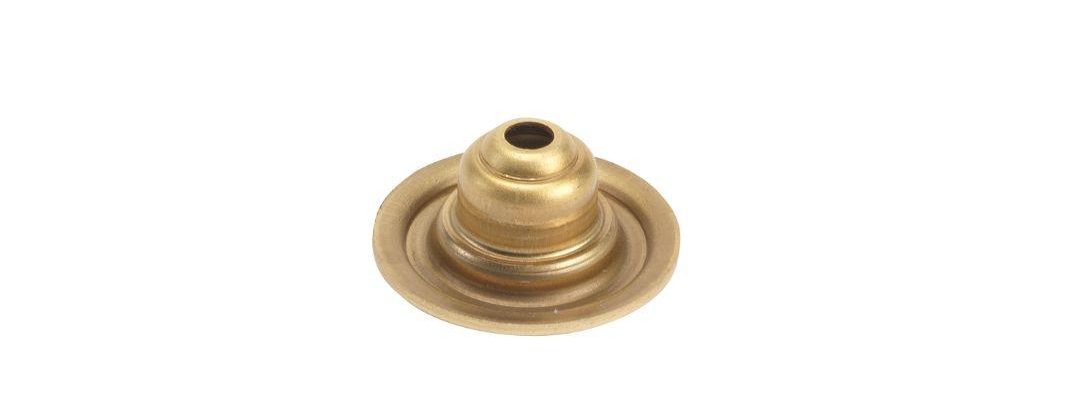
Brass stamping relies on controlled pressure and matched dies. A press applies force rapidly, and the die set reshapes or separates the material into the desired form. According to the manufacturing objective, stamping operations can be grouped into three categories.
3.1 Separation Processes
- Blanking: This process cuts the external shape from the brass sheet, such as shims, while maintaining clean edges. The die clearance is typically 5–10% of the material thickness to prevent burr formation.
- Punching: Punching creates holes or openings, such as ventilation slots or terminal apertures, with precise dimensional control.
- Shearing: Shearing trims the strip stock to the required width before further forming, ensuring consistent material feed.
- Trimming: Trimming removes excess material from formed parts, bringing the component within final dimensional tolerances.
3.2 Forming Processes
- Bending: Bending alters the geometry of the brass sheet to specific angles. Springback compensation of 1°–3° is usually applied depending on the material thickness and temper.
- Drawing: Drawing converts a flat blank into a hollow component, such as a valve core or casing. Deep drawing often requires multiple stages with intermediate annealing to prevent material failure.
- Flanging: Flanging strengthens edges or openings and enhances assembly integrity for the final part.
- Shaping: Shaping includes necking, expansion, or contour modification for specialized components such as bellows or housings.
3.3 Combined Processes
- Compound Die Stamping: This technique integrates multiple operations, like blanking and punching, in a single stroke, which is ideal for miniaturized electronic parts.
- Progressive Die Stamping: Progressive stamping moves the material through several stations sequentially, completing multiple operations continuously. It is suitable for high-volume production, such as heat dissipation fin arrays.
By carefully selecting and combining these operations, manufacturers can produce brass components that meet tight dimensional tolerances and functional requirements, laying the foundation for both high-precision electronics and robust industrial applications.
4. Brass Stamping Process Flow
A complete brass stamping workflow includes material preparation, die design, forming, and post-processing. Each step influences part accuracy and production stability.
Material Preparation
Brass is supplied as strip or sheet. Grade selection depends on part geometry and mechanical requirements. H62, H65, and H68 are commonly used, with thicknesses typically ranging from 0.1 to 3.0 mm.
Die Design
Die structure determines accuracy, dimensional repeatability, and production lifespan. Stamping dies for brass are normally made from high-strength tool steel and require precise machining and heat treatment. Designers must account for springback, press speed, part release, and lubrication flow.
Stamping Operation
Depending on complexity, stamping may use single-stage presses or progressive dies. Progressive stamping improves efficiency and maintains high consistency for complex or high-volume components.
Post-Processing
Post-stamping operations include deburring, polishing, plating, and coating. For electronics, gold or silver plating is common to improve conductivity and corrosion resistance.
Table: Key Process Parameters for Brass Stamping
| Step | Parameter | Typical Range | Influencing Factor | QC Focus |
| Material | Thickness | 0.1–3.0 mm | Structural requirements | ±0.01 mm control |
| Pressing | Stroke speed | 60–400 spm | Material & die complexity | Prevent tearing |
| Die clearance | Clearance ratio | 5–10% of thickness | Thickness & hardness | Minimize burrs |
| Lubrication | Viscosity | 10–100 cSt | Speed & thickness | Uniform coating |
Each stage of the brass stamping workflow is carefully coordinated to ensure the final components meet both dimensional and functional requirements, forming the backbone of reliable and efficient production.
5. Key Technical Considerations for Brass Stamping
Consistent quality requires proper control of material grade, die precision, equipment capacity, and process parameters.
Material–Process Matching Guidelines
| Grade | Suitable Processes | Temper | Tensile (MPa) | Elongation | Advantages | Typical Parts |
| H62 | Bending, shallow drawing, blanking | M / Y2 | 300–400 | 25–35 | Balanced strength and ductility | Shims, radiator fins |
| H65 | Precision blanking, medium flanging | M / Y2 | 320–420 | 30–40 | Stable precision, good finish | Terminals, lock mechanisms |
| H70 | Deep drawing, complex forming | M | 280–380 | 35–45 | High plasticity | Valve cores, medical components |
| H80 | Ultra-deep forming | M | 260–360 | 40–50 | Excellent elongation | Hydraulic connectors |
| H62Sn | High-strength stamping | Y | 480–550 | 15–25 | Fatigue resistance | Automotive safety components |
Additional Technical Points
- Die Design: Clearance must be precisely calculated. Tool materials such as Cr12MoV at HRC58–62 hardness ensure long-term durability. Guiding elements maintain alignment, and venting prevents vacuum defects.
- Equipment: Press tonnage should include a 20–30% safety margin. Servo presses improve repeatability to ±0.01 mm. Automated feeders support high-volume production.
- Process Control: Simple blanking typically runs at 100–200 spm, while deep drawing is slower at 30–80 spm. High-viscosity lubricant is necessary for multi-stage drawing.
Proper alignment of brass grade, die design, equipment selection, and process parameters ensures that stamped components achieve both dimensional precision and functional reliability across a wide range of applications.
6. Common Challenges and Solutions in Brass Stamping
Brass stamping presents several engineering challenges during production.
Material Springback
Elastic recovery after forming causes dimensional deviation. Solutions include die compensation, optimized forming speed, and multi-stage shaping.
Surface Scratching
Brass is relatively soft, making it sensitive to surface defects. High-polish die surfaces, clean lubrication, and protective films help avoid scratches.
Die Wear
Wear affects precision and increases burr height. Regular maintenance, high-hardness die steels, and proper lubrication extend die life.
Common Issues and Solutions
| Issue | Cause | Impact | Solution | Preventive Action |
| High burr | Excessive clearance | Medium | Adjust clearance | Inspect die edges |
| Cracking in deep drawing | Material hardness, high speed | High | Select soft temper | Control drawing rate |
| Warping | Insufficient holding force | High | Increase blank holder pressure | Check guide alignment |
| Scratch marks | Rough die surface | Medium | Polish die | Filter lubricants |
By proactively addressing springback, surface defects, and die wear, manufacturers can ensure brass-stamped components meet both dimensional and functional requirements, supporting reliable production at scale.
7. Applications of Brass Stamping

Brass stamping supports multiple industries because of its electrical performance, corrosion resistance, and stable formability.
Electronics
Used for connectors, terminals, and lead frames. These parts require high conductivity and consistent geometry.
Automotive
Brass stamping is used for sensor housings, decorative elements, and precision mechanical parts exposed to vibration and heat.
Construction and Home Hardware
Common applications include hinges, handles, and lighting accessories. Brass’s surface quality enhances decorative appeal.
Jewelry and Artistic Products
Stamping supports fine and repeatable patterning required for ornaments and small crafted items.
Table: Typical Application Overview
| Industry | Products | Common Grades | Thickness (mm) | Surface Treatment | Annual Demand |
| Electronics | Connectors, terminals | H65, H68 | 0.1–0.5 | Gold/Silver plating | Very high |
| Automotive | Sensor housings, trims | H62, H65 | 0.5–2.0 | Plating, coating | High |
| Construction | Handles, hinges | H62, H59 | 1.0–3.0 | Polishing, chrome | Medium |
| Craft | Jewelry, badges | H68, H70 | 0.2–1.0 | Polishing, gold | Lower |
Across industries, brass stamping delivers both functional reliability and visual appeal, making it a versatile solution for components ranging from high-precision electronics to decorative hardware.
8. Future Outlook
Brass stamping is evolving toward higher efficiency, cleaner processes, and improved precision.
- Automation and Smart Manufacturing: Integration of robotics, vision inspection, and digital simulation. Real-time monitoring improves quality consistency.
- Green Production: Biodegradable lubricants, dry stamping technologies, and advanced coatings reduce environmental load.
- Precision and Miniaturization: Micro-precision presses and hybrid processes support fine geometries and stable tolerance control.
- Expanded Applications: Growing demand from new energy systems, smart devices, and customized components.
As technology advances, brass stamping is positioned to deliver more precise, sustainable, and versatile solutions, meeting the rising demands of modern manufacturing and specialized applications.
Conclusion
Brass stamping remains a highly effective manufacturing method for producing precise and complex metal components. Its integration with advanced die design, automated production lines, and sustainable materials will continue to expand its relevance across industries. With stable performance, broad material adaptability, and strong production efficiency, brass stamping will maintain its role as a critical process in modern manufacturing.
To get the most out of brass stamping and other sheet metal forming processes, it’s important to consult a trusted supplier like the Beska team who can ensure consistent quality and smooth production.
Dive Deeper Into Our Resources
For some insightful reads, we’ve curated a list of recommended articles just for you:
- Bronze vs brass
- Brass vs copper
- CNC machining brass
- How to stamp stainless steel
- Sheet Metal Forming Service



 English
  Hebrew
  Turkish
  French
  Russian
  German
  Spanish
  Portuguese