


Aluminum is one of the most versatile metals used in modern manufacturing, but not all aluminum alloys are created equal. Among the many grades available, 6061 stands out due to its unique blend of mechanical properties, corrosion resistance, and fabrication flexibility. Whether you need structural integrity, ease of machining, or thermal stability, 6061 provides a solid foundation to build on.
For engineers and designers looking to test 6061 in their projects, we offer custom CNC aluminum part samples to verify dimensions, finish, and performance before production. Request your sample here.
But what exactly gives 6061 its reputation across so many industries? And how does it behave under different processing methods? To answer these questions, it’s important to look beyond its popularity and understand the material itself.
This article will break down the details, including its composition, its characteristics, and the reasons behind its wide acceptance in both prototyping and mass production.
1. What Is Aluminum 6061?

Aluminum 6061 is a precipitation-hardened alloy primarily composed of aluminum, magnesium, and silicon. Classified under the 6xxx series, it belongs to a group of heat-treatable alloys known for their moderate-to-high strength and good corrosion resistance. The addition of magnesium improves strength, while silicon enhances workability and reduces melting temperature. It makes the alloy suitable for a broad range of forming and joining processes.
Unlike pure aluminum, which is soft and less durable, 6061 is engineered to meet mechanical demands with excellent machinability or weldability. It’s not the strongest aluminum alloy available, nor the lightest. But it offers a dependable middle ground that engineers and designers often rely on when balancing performance, cost, and fabrication ease.
If you’re working on a part that requires dimensional stability, consistent performance under stress, or compatibility with processes like extrusion, welding, or precision machining, 6061 is likely to appear on your shortlist for material selection.
2. Chemical Composition of 6061 Aluminum
The chemical composition of 6061 is critical to its thermal and mechanical behavior. It’s specifically engineered to maintain a balance of strength, corrosion resistance, and workability.
| Elemento | Content (% by weight) |
| Aluminum (Al) | Balance |
| Magnesium (Mg) | 0.8 – 1.2 |
| Silicon (Si) | 0.4 – 0.8 |
| Iron (Fe) | ≤ 0.7 |
| Cobre (Cu) | 0.15 – 0.4 |
| Cromo (Cr) | 0.04 – 0.35 |
| Zinc (Zn) | ≤ 0.25 |
| Titanium (Ti) | ≤ 0.15 |
This precise composition allows 6061 to undergo T6 and T651 tempers while remaining highly machinable and weldable, even in demanding environments.
3. Physical and Mechanical Properties of 6061
Below are the key physical and mechanical properties of aluminum 6061.
| Propiedad | Categoría | Value | Unit |
| Densidad | Physical Property | 2.7 | g/cm³ |
| Melting Range | Physical Property | 582–652 | °C |
| Conductividad térmica | Physical Property | 180 | W/m·K |
| Electrical Resistivity | Physical Property | 3.97 × 10⁻⁸ | Ω·m |
| Specific Heat Capacity | Physical Property | 896 | J/kg·K |
| Coefficient of Thermal Expansion | Physical Property | 23.6 × 10⁻⁶ | /°C |
| Ultimate Tensile Strength (T6) | Mechanical Property | ≥ 310 | MPa |
| Yield Strength (T6) | Mechanical Property | ≥ 276 | MPa |
| Elongation at Break (T6) | Mechanical Property | ≥ 12 | % |
| Brinell Hardness (T6) | Mechanical Property | ≥ 95 | HB |
| Modulus of Elasticity | Mechanical Property | 68.9 | GPa |
| Fatigue Strength (10⁷ cycles) | Mechanical Property | ~103 | MPa |
| Shear Strength | Mechanical Property | ~207 | MPa |
| Poisson’s Ratio | Mechanical Property | ~0.33 | — |
4. 6061 Aluminum Tempers
6061 is available in several temper designations. Each temper reflects the specific heat treatment and mechanical processing it has undergone.
6061-O (Annealed Condition)
In the O temper, 6061 aluminum is fully annealed, resulting in the lowest strength but excellent ductility. If your part requires extensive forming, bending, or deep drawing, this condition offers a good balance between workability and crack resistance. You’ll often find 6061-O used in the creation of decorative aluminum items, intricate prototypes, or components where strength isn’t a top priority. However, due to its reduced mechanical strength, it’s not recommended for load-bearing structures.
6061-T4 / T451 (Solution Heat-Treated and Naturally Aged)
T4 temper refers to material that has undergone solution heat treatment followed by natural aging. It offers improved strength compared to the O temper, along with good corrosion resistance and moderate formability. It’s also commonly used for pressure-containing applications such as gas cylinders, where corrosion resistance and moderate strength are both required.
6061-T6 / T651 (Solution Heat-Treated and Artificially Aged)
T6 is one of the most widely used 6061 tempers. After solution treatment and artificial aging, it reaches a much higher strength level while maintaining good corrosion resistance and surface finish. If your design involves structural parts for transportation equipment (such as truck frames, railway parts, or marine components) or precision-machined components like molds and tooling plates, T6 is often a dependable choice. Its dimensional stability, weldability, and resistance to surface defects like porosity make it especially suitable for applications where both appearance and mechanical integrity matter.
By selecting the appropriate temper, you can ensure that 6061 aluminum performs optimally for the specific requirements of your part.
5. How Strong Is Aluminum 6061?
The strength of aluminum depends largely on the alloy and temper used. For instance, 6061-T6 aluminum has an ultimate tensile strength of around 310 MPa and a yield strength of approximately 276 MPa, making it suitable for a wide range of load-bearing and high-performance parts. These values are comparable to certain grades of mild steel, but with only about one-third of the weight.

Moreover, aluminum resists deformation under pressure and performs well in fatigued environments. If you’re designing parts that need a strong yet lightweight material, aluminum 6061 in T6 or T651 condition is a highly reliable option. Its strength-to-weight ratio is one of the main reasons it is so widely used in precision CNC machining projects.
6. 6061 Aluminum vs 7075 Aluminum
6061 and 7075 are both precipitation-hardened aluminum alloys, but they are designed for different performance priorities. 6061 belongs to the aluminum-magnesium-silicon (Al-Mg-Si) alloy family, while 7075 is an aluminum-zinc (Al-Zn-Mg-Cu) alloy. Because of this difference in composition, the two alloys show significant differences in strength, corrosion resistance, and manufacturability.
In general, 7075 aluminum is known for its very high strength and is widely used in aerospace and other high-stress applications. 6061 aluminum, on the other hand, provides a more balanced combination of strength, corrosion resistance, weldability, and machinability, making it one of the most commonly used alloys for structural components and CNC machining projects.
The key differences between these two alloys are summarized below.
| Propiedad | 6061 Aluminum (T6) | 7075 Aluminum (T6) |
| Primary alloying elements | Magnesium and silicon | Zinc, magnesium, and copper |
| Typical tensile strength | ~310 MPa | ~570 MPa |
| Corrosion resistance | Bien | Moderado |
| Soldabilidad | Excelente | Poor |
| Maquinabilidad | Bien | Good, but more tool wear |
| Typical applications | Structural parts, automotive components, CNC machined parts | Aerospace structures, high-stress components |
While 7075 provides significantly higher strength, 6061 is often preferred in manufacturing projects that require good corrosion resistance, easier fabrication, and reliable machinability.
7. Common Processing Techniques for 6061 Aluminum
Below are five commonly used fabrication techniques for 6061 aluminum and the characteristics you should consider:
1. Mecanizado CNC (Turning, Milling, Drilling)
With moderate hardness and good machinability, 6061 resists built-up edge formation, helping you achieve clean, precise cuts. It offers a good surface finish, especially under controlled feed rates and sharp tooling.
When to Use: If your part requires tight tolerances, smooth finishes, or intricate geometries, machining is a reliable option. You’ll typically see this in aerospace components, mold bases, and precision mechanical parts.
Tip: Using coolant and high-speed steel or carbide tools will help extend tool life and maintain consistency.

2. Extrusion
6061 exhibits excellent plasticity when heated, making it ideal for extrusion into various cross-sectional profiles.
When to Use: This method is ideal for producing continuous lengths of uniform shapes, such as tubes, rods, bars, and custom profiles. It’s widely used in architectural frames, automotive crash rails, and electronic housings.
Tip: After extrusion, tempering (such as T5 or T6) is often applied to restore strength and stiffness.
3. Forging
Forging 6061 can significantly improve mechanical properties by refining grain structure and optimizing metal flow. The result is enhanced fatigue resistance and toughness.
When to Use: When structural strength and impact resistance are critical for landing gear components or automotive wheel hubs, forging is a preferred solution.
Tip: You may need to post-forge heat treat the part to achieve desired hardness and dimensional stability.
4. Soldadura
6061 is weldable using multiple techniques, though care must be taken to avoid hot cracking or post-weld strength reduction. Proper filler metal selection (such as 4045 or 5356) is crucial.
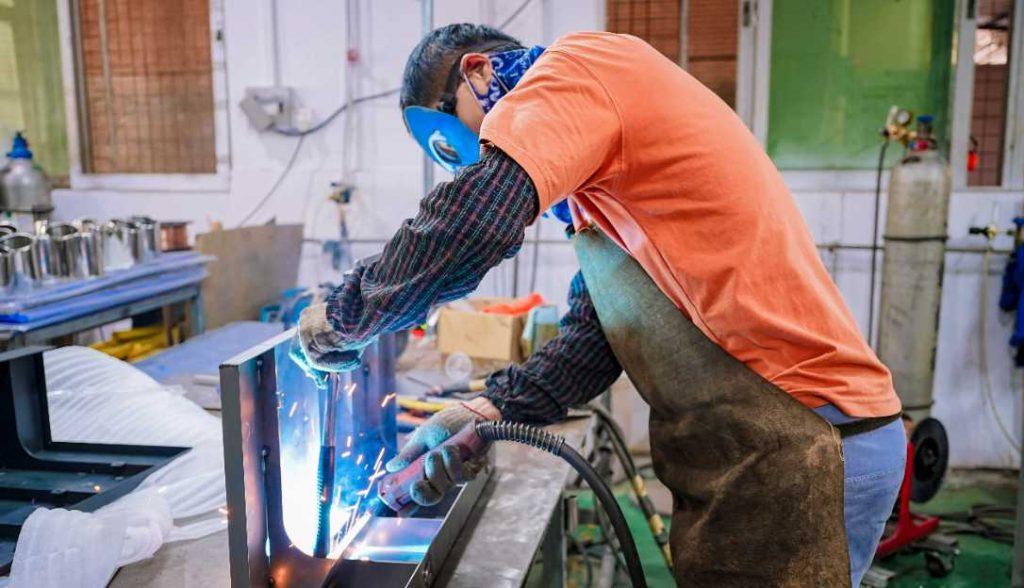
When to Use: Choose welding when you’re assembling large or complex aluminum structures—like marine frameworks, automotive chassis, or metal enclosures.
Common Methods:
- TIG welding: Offers high-quality welds and clean aesthetics; ideal for thinner sections and tight-tolerance work.
- MIG welding: Better suited for thicker material and higher-volume production.
- Resistance welding (spot or seam): Often used in automated production lines, such as for car bodies.
Tip: Post-weld heat treatment may be required to restore mechanical strength in heat-affected zones.
5. Die Casting
Die casting allows you to produce complex shapes with integrated features (like threaded holes, bosses, or thin walls) in one cycle. For high-volume runs, it significantly reduces unit cost and machining time.
When to Use: If you’re producing small- to medium-sized parts in large batches—like electronic housings or mechanical connectors—6061 die-cast parts can offer the necessary strength, dimensional accuracy, and functional integrity.
Tip: Keep in mind that die casting requires careful mold design and is generally more cost-effective than certain production volumes (e.g., 100,000 pcs/year).
8. Opciones de acabado de superficies
To enhance corrosion resistance or appearance, 6061 aluminum is often post-treated:
| Método | Objetivo |
| Anodizado | Improves corrosion resistance and aesthetics |
| Anodizado duro | Enhances wear resistance for sliding components |
| Chromate Conversion | Provides paint adhesion and corrosion resistance |
| Recubrimiento en polvo | Adds durable, decorative surface layer |
| Zinc/Nickel Plating | Enhances corrosion protection in harsh environments |
| Sandblasting and Passivation | Prepares surface for coating and removes imperfections |
Each of these methods can be tailored depending on your application’s performance or environmental requirements.
9. Limitations of 6061 Aluminum
While 6061 aluminum is highly versatile, it’s not a perfect fit for every project. Here are its key limitations, along with rational explanations:
– Lower Tensile Strength. Compared to 7075
6061-T6 offers ultimate tensile strength around 310 MPa, whereas 7075-T6 can reach over 500 MPa. For aerospace load-bearing components or performance-critical parts, 7075 is often the stronger choice.
– Cracking During High-Heat Welding (Thick Sections). Although weldable, 6061 is prone to hot cracking in thick sections or poorly controlled welding environments. Using proper filler metals (like 4043 or 5356) and preheating can help, but TIG/MIG welding of large parts still carries risks.
– Limited Castability. 6061 is not a casting alloy. Its poor fluidity and shrinkage behavior during solidification make it unsuitable for high-precision die casting. Alloys like A356 or 319 are preferred for intricate casting work.
– Unsuitable for Deep Drawing Operations. Due to its relatively low ductility compared to alloys like 3003 or 5052, 6061 tends to crack under extensive plastic deformation, especially in forming processes involving tight radii.
10. Typical Applications of 6061 Aluminum
Below are some of the most common applications of aluminum 6061 categorized by industry:
Aeroespacial
In aerospace manufacturing, 6061 aluminum is widely used for aircraft fuselages, bulkheads, connectors, and even seating structures. Its lightweight properties help reduce fuel consumption, while its corrosion resistance makes it ideal for airborne environments.
Automotor
The automotive industry relies on 6061 for parts such as suspension arms, engine blocks, and transmission casings. Its ability to be both forged and machined makes it suitable for components that require both durability and precision.

Electrónica
In electronics, 6061 is often applied to create enclosures, heatsinks, battery trays, and internal housings. Its high thermal conductivity allows for efficient heat dissipation, while its machinability supports detailed component fabrication.
Equipos industriales
Within industrial systems, 6061 is frequently used to make mounting brackets, mechanical fixtures, and load-bearing structural frames. These parts often demand a balance of rigidity, lightweight, and corrosion resistance, all of which 6061 delivers.
6061 aluminum supports a wide spectrum of manufacturing needs, from structural aerospace assemblies to compact electronic housings.
Conclusión
Aluminum 6061 remains a reliable and widely adopted material across numerous industries. Whether you’re selecting it for deep-forming operations in the O temper, structural applications in the T6 condition, or large-scale production via extrusion, 6061 provides the flexibility and performance needed for modern engineering demands.
By looking closely at the properties, temper states, and processing options of aluminum 6061, you can make better-informed decisions that align with your design goals, production efficiency, and product longevity. If you need more details about this material or a detailed quote, feel free to contacto the Beska team.
Preguntas frecuentes
Q1: Is aluminum 6061 stronger than 7075?
No, 7075 is generally stronger than 6061. However, 6061 offers better corrosion resistance, weldability, and workability.
Q2: Can aluminum 6061 be welded easily?
Yes. 6061 has good weldability, especially when using proper filler materials like 4045 or 5356. However, post-weld heat treatment may be necessary to recover mechanical strength in the heat-affected zone.
Q3: Is 6061 aluminum bendable?
Yes, 6061 aluminum can be bent, but its bendability depends on the temper. In the T6 temper, the material is relatively hard and less suitable for tight bends. Softer tempers such as 6061-O or 6061-T4 are more formable and easier to bend without cracking.
Q4: Does 6061 aluminum rust?
No, 6061 aluminum does not rust because it does not contain iron. However, it can oxidize when exposed to air. This natural oxide layer helps protect the surface and gives the alloy good corrosion resistance in many environments.
Q5: How to heat treat 6061 aluminum?
6061 aluminum can be heat treated through a solution heat treatment followed by quenching and artificial aging. The alloy is typically heated to around 530 °C (985 °F), then rapidly cooled to retain the alloying elements in solution. After that, aging at a lower temperature increases strength and hardness, producing tempers such as 6061-T6.
Q6: What is the difference between 6061-T6 and 6061-T651?
Both tempers have similar mechanical properties, but T651 undergoes additional stress relief after heat treatment (typically by stretching), which improves dimensional stability for machining applications.
Q7: When should I choose 6061 over other aluminum alloys?
If your project requires a combination of moderate strength, corrosion resistance, ease of machining, and weldability, 6061 is an ideal candidate, especially for structural parts, precision machined components, and profiles made by extrusion or forging.
Deeper into Our Resources
Para que disfrutes de lecturas interesantes, hemos preparado una lista de artículos recomendados solo para ti:
 Spanish
 English
 Hebrew
 Turkish
 French
 Russian
 German
 Portuguese