
CNC Machining Teflon
- Virgin, Glass-filled, and Carbon-filled PTFE handled with precision
- Multi-axis CNC Machining
- From 1 to 1000+ pieces
- ISO9001:2015 Certified

Beska – La mejor calidad a un precio competitivo.
Con experiencia en fabricación de chapa metálica y mecanizado CNC, estamos aquí.
Teflon (PTFE) Machining Service at Beska
Teflon (PTFE) is a unique engineering plastic valued for its non-stick surface, low friction coefficient, and exceptional resistance to heat and chemicals. However, its softness and tendency to deform under pressure make it more challenging to machine compared with other plastics. Achieving precise tolerances and clean edges requires the right strategy, tooling, and experience.

Beska – La mejor calidad a un precio competitivo.
Con experiencia en fabricación de chapa metálica y mecanizado CNC, estamos aquí.
Overview of Beska’s Capability
- Expertise in PTFE machining. Our engineers use optimized tool paths and controlled clamping methods to prevent warping or surface damage.
- High-precision multi-axis machining. Equipped with advanced 3-, 4-, and 5-axis CNC machines, we can produce complex PTFE components with precise geometry and consistency.
- Surface quality assurance. To maintain Teflon’s natural smoothness and low friction, our cutting parameters and polishing processes are carefully adjusted to achieve clean, burr-free finishes.
- Flexible production capability. We handle both prototypes and production batches.
- Comprehensive quality control. Every PTFE part undergoes dimensional inspection, surface evaluation, and visual checks before shipment.
Why Choose Teflon for CNC Machining?
Teflon, or PTFE (Polytetrafluoroethylene), is a versatile engineering plastic commonly used in precision CNC machining. Its unique properties make it suitable for demanding applications across industries. The following table highlights the key characteristics of Teflon relevant for machining:
| Propiedad | Typical Value | Descripción |
| Densidad | 2.15 – 2.20 g/cm³ | Lightweight and easy to machine |
| Resistencia a la tracción | 20–30 MPa | Moderate strength suitable for non-structural parts |
| Elongation at Break | 200–400% | Excellent flexibility and toughness |
| Punto de fusión | ~327°C | High resistance to heat deformation |
| Working Temperature | -200°C to +260°C | Stable under extreme conditions |
| Coeficiente de fricción | 0.05 – 0.10 | Very low friction, ideal for sliding surfaces |
| Resistencia química | Excelente | Withstands acids, bases, and most solvents |
| Absorción de agua | <0.01% | Almost no moisture absorption |
| Aislamiento eléctrico | Excelente | Reliable for insulating applications |
Our CNC Machining Capabilities for Teflon
Our facility is equipped to handle a wide range of PTFE machining projects, offering flexibility and precision for various part designs:
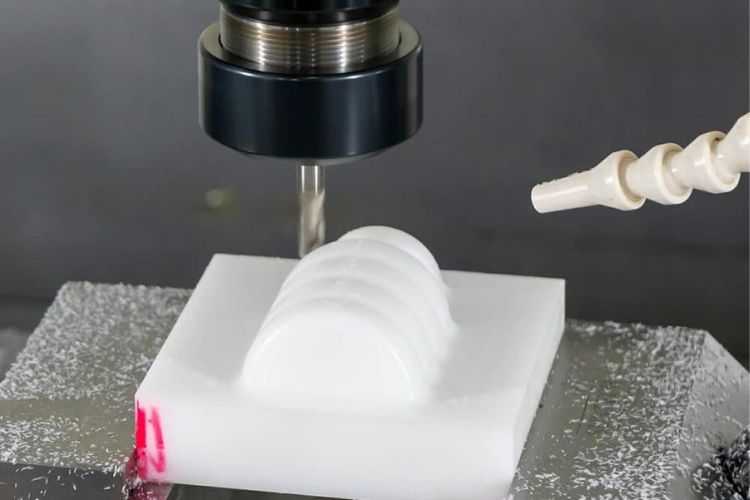
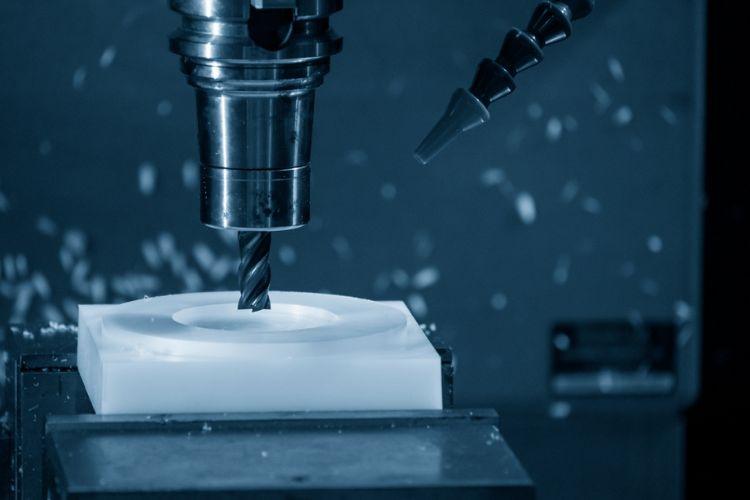
Fresado CNC
We can create complex shapes, pockets, and contours with smooth surfaces and consistent dimensions, making it suitable for custom components such as valve seats and sliding parts.
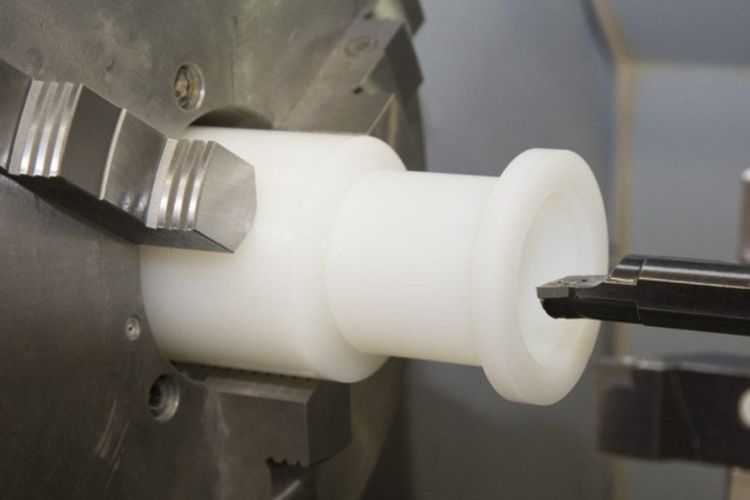
Torneado CNC
Our turning capabilities allow us to produce cylindrical and threaded parts with clean finishes, maintaining reliable concentricity and consistent diameters.
Drilling & Tapping
We perform precise holes and threaded features, ensuring proper fit for fasteners or assembly components while minimizing deformation.
Post-processing for CNC Teflon Parts
After CNC machining, PTFE parts often require additional finishing steps to achieve the desired precision, surface quality, and functional performance. These post-machining processes ensure components fit correctly and operate reliably in their applications.
| Proceso | Purpose / Benefit |
| Trimming/Deburring | Removes excess material and sharp edges to prevent interference or damage in assembly |
| Pulido | Improves surface smoothness, reduces friction, and enhances sealing performance |
| Inspección dimensional | Verifies part geometry and critical tolerances, ensuring consistency and proper fit |
| Visual Check | Confirms surface quality, absence of scratches or deformation, and overall appearance |
These finishing steps are especially important for sealing, sliding, and insulating applications, where surface condition and dimensional accuracy directly affect performance. Every part is carefully reviewed before shipment to ensure it meets design specifications and is ready for use.
Applications of CNC Machined Teflon Parts
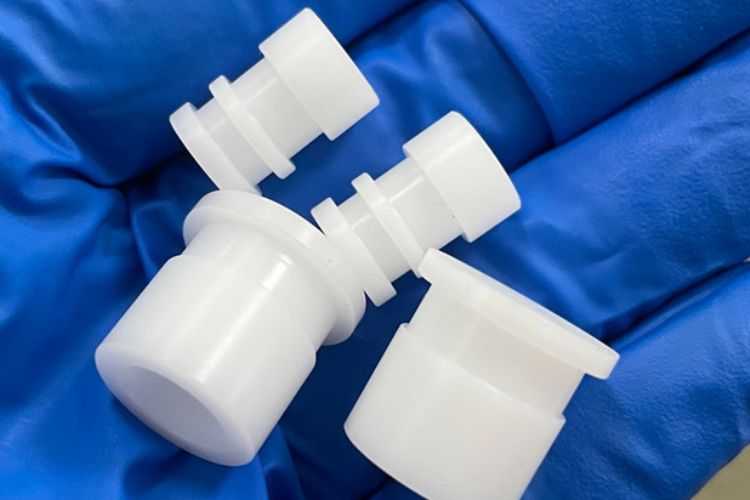
CNC machined PTFE components serve many practical functions, including sealing, insulation, and wear-resistant applications.
- Electronics & Semiconductors: electrical insulators, spacers, circuit board supports, and connector components.
- Chemical Equipment: corrosion-resistant seals, gaskets, valve seats, and tubing fittings for acids, bases, and solvents.
- Food Processing: non-toxic, heat-resistant fittings, bearings, and guide components in machinery that must meet hygiene standards.
- Medical Devices: biocompatible, sterilizable components such as tubing, valve parts, and custom fittings.
- Aerospace: lightweight insulation, anti-friction elements, sliding guides, and protective covers for sensitive equipment.
Its combination of chemical stability, low friction, and high temperature tolerance makes PTFE ideal for both functional components and safety-critical parts in demanding applications.
Beska – La mejor calidad a un precio competitivo.
Con experiencia en fabricación de chapa metálica y mecanizado CNC, estamos aquí.
Limitations of Teflon and Design Considerations
Teflon (PTFE) is a highly versatile material, but its unique properties also bring certain limitations that must be considered during design.
| Design Factor / Limitation | Guideline / Consideration |
| Espesor de la pared | Keep walls consistent to prevent deformation or warping during machining or in use |
| Expansión térmica | Allow for dimensional changes due to Teflon’s high thermal expansion, especially in high-temperature applications |
| Sharp Corners | Avoid sharp angles; use fillets or rounded corners for cleaner machining and reduced stress concentration |
| Load and Wear | Teflon has moderate tensile strength and can creep under continuous stress; avoid high-load structural components |
| Chemical Compatibility | Check for exposure to reactive fluorinating agents or molten alkali metals, which may degrade the material |
| Machining Limitations | Soft and flexible material can deform if clamping or cutting is not properly controlled; optimize tool paths and feeds |
By keeping these limitations and considerations in mind, designers can create parts that perform reliably while making CNC machining more efficient.
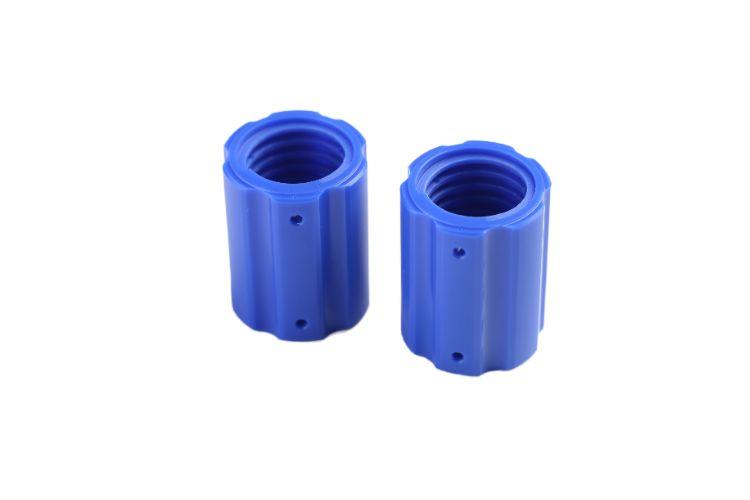
Material Alternatives
While PTFE is an excellent choice for many applications, other engineering plastics may be more suitable depending on your specific requirements. These alternatives offer different combinations of strength, wear resistance, thermal stability, and chemical compatibility.
Beska – La mejor calidad a un precio competitivo.
Con experiencia en fabricación de chapa metálica y mecanizado CNC, estamos aquí.
- Delrin (POM). Delrin is strong, rigid, and dimensionally stable, making it ideal for components that require tight tolerances and mechanical strength.
- Nylon (PA). Nylon offers toughness and wear resistance, but it is sensitive to moisture absorption, which can affect dimensional stability in humid environments.
- PEEK. PEEK provides exceptional heat and chemical resistance, making it suitable for demanding environments where high temperatures or aggressive chemicals are present.
- UHMW. Ultra-High-Molecular-Weight Polyethylene excels in impact and abrasion resistance, perfect for sliding or wear-prone parts.
- PVC. PVC is cost-effective and corrosion-resistant and commonly used in chemical setups where moderate mechanical strength is sufficient.
If you’re unsure which material is best for your project, our engineers can recommend the most suitable option based on factors such as working temperature, load, environment, and specific application requirements.
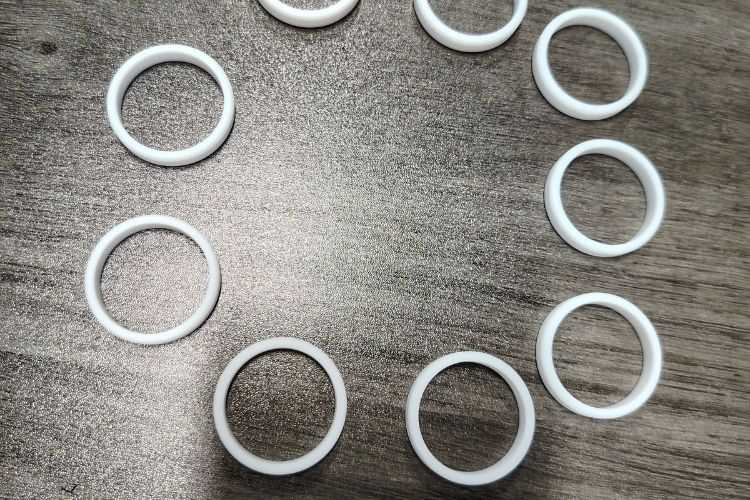
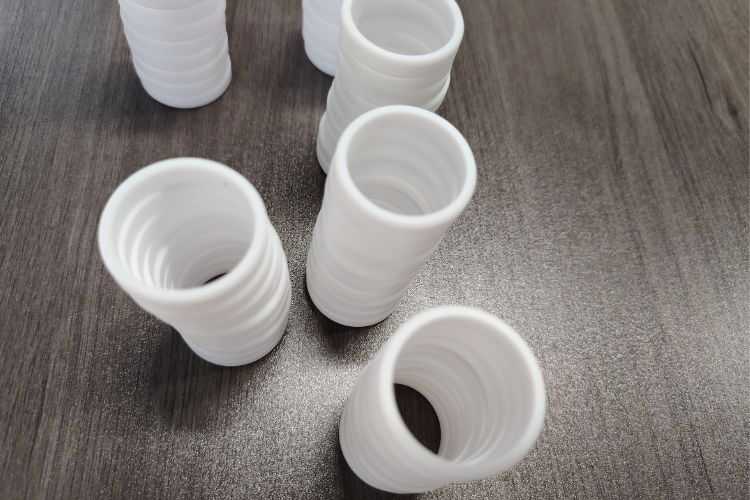
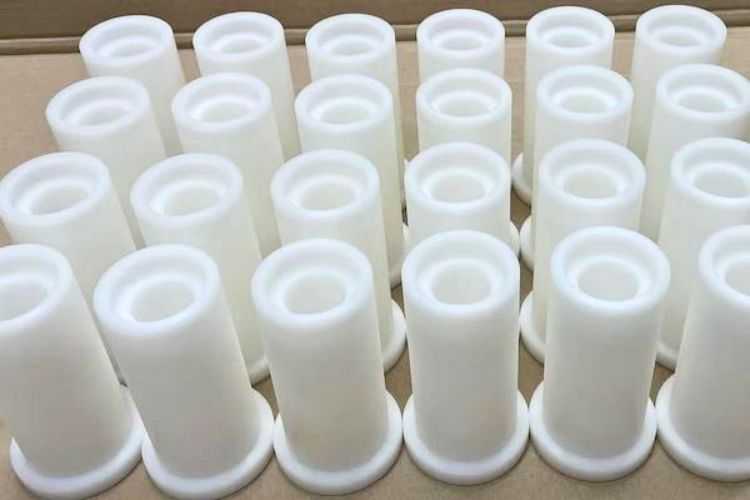
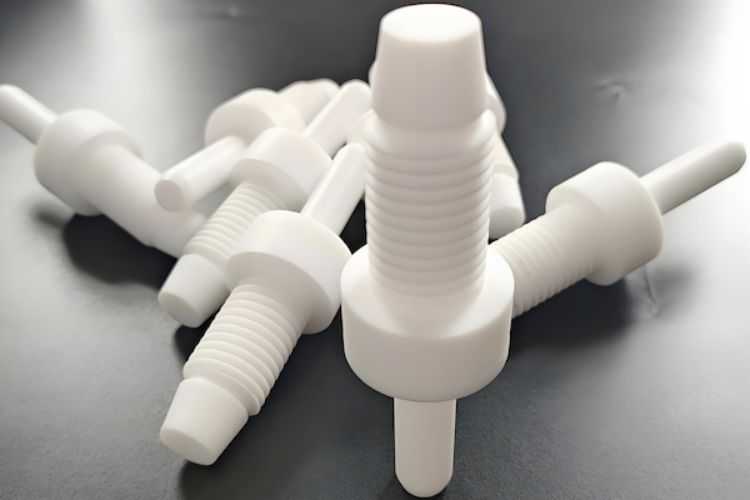
Galería de productos
Explore examples of CNC machined Teflon components we’ve produced for various applications.
Preguntas frecuentes
For most CNC machined Teflon components, tolerances of ±0.05 mm to ±0.1 mm are typical, depending on geometry, wall thickness, and part size. Tighter tolerances may be possible for small or simple features, but the material’s flexibility and thermal expansion must be considered.
Yes, polishing is commonly performed to improve surface smoothness, reduce friction, and enhance sealing performance. Careful handling ensures the part does not deform during the process.
Virgin PTFE offers excellent chemical resistance and low friction, while Glass-filled PTFE provides higher stiffness and wear resistance, and Carbon-filled PTFE improves dimensional stability and conductivity. Selection depends on application requirements.
Proper clamping, controlled cutting speeds, and appropriate tooling are critical. Designing parts with consistent wall thickness and rounded corners also helps reduce warping and tool marks.
Electronics, chemical processing, medical devices, food processing, and aerospace are common industries, using PTFE for insulating, sealing, sliding, and wear-resistant components.
Selection depends on factors such as chemical exposure, temperature, load, wear resistance, and dimensional stability. Our engineers can advise on the most suitable material for your application.
Profundice en nuestros recursos
For more details, we’ve curated a few recommended pages and articles just for you:
Get A CNC Machining Teflon Quote!
Beska – La mejor calidad a un precio competitivo.
Con experiencia en fabricación de chapa metálica y mecanizado CNC, estamos aquí.
 Spanish
 English
 Hebrew
 Turkish
 French
 Russian
 German
 Portuguese