


In modern machinery, rotating components rely on bearings to operate efficiently and reliably. By supporting shafts, guiding motion, and minimizing friction, bearings allow machines to run smoothly while maintaining precision and extending service life. They are essential in a wide range of systems, from electric motors and automotive gear assemblies to industrial equipment and aerospace mechanisms.
This guide examines eight common types of bearings used in engineering and manufacturing, detailing their design principles, material selection, precision specifications, and typical applications. Before diving into each type, it is important to understand the fundamental functions that all bearings serve.
1. The Importance of Bearings

Before delving into the various bearing types, it is essential to understand the core functions that make bearings indispensable in mechanical design. Essentially, every bearing fulfills three key missions:
1. Reducing Friction
Bearings replace sliding contact with rolling contact (using balls or rollers) between the rotating shaft and stationary components. This design minimizes friction, improving efficiency, reducing energy loss, and limiting heat generation during operation.
2. Supporting Loads
Bearings can withstand forces in different directions, primarily categorized as radial loads (perpendicular to the shaft, such as belt tension) and axial loads (parallel to the shaft, also called thrust loads, such as gear engagement forces).
3. Ensuring Rotational Accuracy
By providing precise guidance for the shaft, bearings maintain correct alignment, enabling smooth, high-speed, and low-vibration operation. Rotational precision is crucial for the stability and longevity of mechanical systems.
Different bearing types have been developed to optimize these three missions under varying operational conditions. Some are designed for high-speed rotation, others for heavy load-bearing, and some for compensating misalignment or axial positioning.
2. Deep Groove Ball Bearings—The Versatile Workhorse
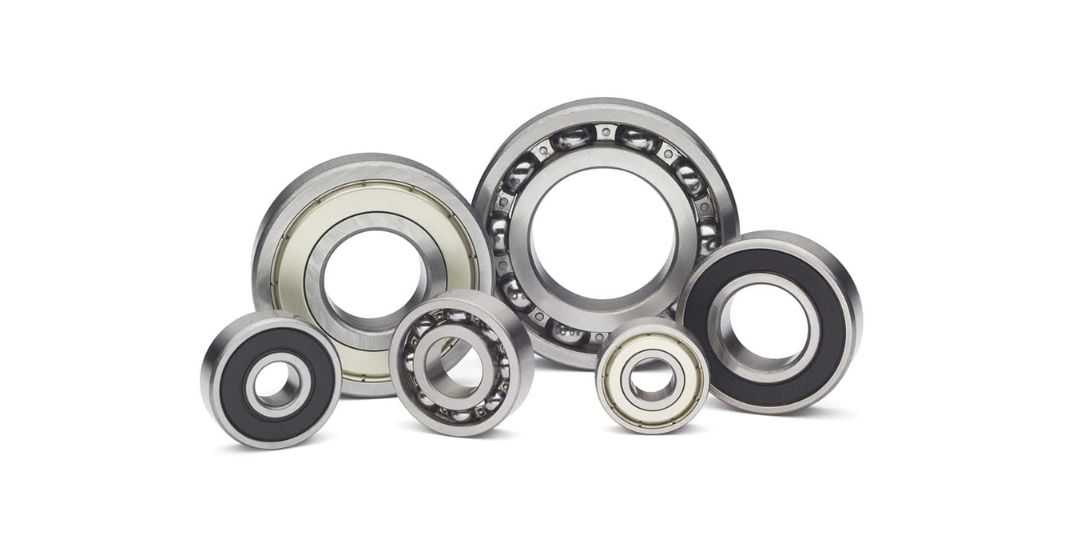
Among all bearing types, deep groove ball bearings stand out for their simplicity and versatility, forming the backbone of countless mechanical systems. They combine robust design with reliable performance, making them suitable for both high-speed and moderate-load applications.
Design Features
These bearings consist of an inner ring, an outer ring, a set of steel balls, and a cage. The raceway grooves are slightly deeper than the ball radius, which allows them to carry radial loads efficiently while also accommodating limited axial forces.
Working Principle
Steel balls roll smoothly between the inner and outer rings, replacing sliding friction with rolling contact. This design ensures consistent rotation under high-speed conditions and allows the bearing to handle combined radial and axial loads without compromising performance.
Key Manufacturing Processes
To achieve such precision, bearing steel bars are first forged to refine their grain structure, then spheroidized and annealed to facilitate machining. The rings are formed via cold rolling or hot forging, while balls are cold-headed, heat-treated, ground, and finely polished. Raceway grooves undergo double-end face grinding followed by super-finishing, reaching surface roughness levels of Ra ≤ 0.02 μm. Final assembly involves careful clearance adjustment and rotational accuracy verification to ensure low vibration and noise.
Ventajas
This design offers a compact structure, high versatility, and low friction. Its high-speed capability, precision, and smooth operation make it a dependable choice across a variety of equipment. Maintenance is straightforward, and the overall cost remains reasonable.
Aplicaciones típicas
Deep groove ball bearings are widely used in electric motors for household appliances, automotive components, and industrial machinery. They are also integral to precision instruments, gearboxes, and small agricultural machines.
Deep groove ball bearings combine simplicity and reliability, making them a universal solution for diverse mechanical challenges.
3. Cylindrical Roller Bearings—High Radial Load Capacity

Cylindrical roller bearings are designed to handle heavy radial loads where standard ball bearings might fall short. Their line-contact rolling elements provide superior load distribution, making them ideal for applications with significant radial forces.
Design Features
These bearings use cylindrical rollers instead of balls, which contact the raceways along a line rather than a point. This increases the contact area and enhances radial load capacity, though most designs cannot support axial loads unless specifically equipped with flanges.
Working Principle
The line-contact rolling elements roll between the inner and outer rings, allowing the bearing to sustain large radial loads while maintaining smooth rotation. The separable design of many cylindrical bearings also facilitates easier mounting and disassembly.
Key Manufacturing Processes
Cylindrical rollers are cold-headed, rough-end ground, heat-treated, precision-ground, and super-finished to achieve a roundness tolerance of ≤0.001 mm. Inner and outer rings undergo cut-in grinding and strict coaxiality control, typically within ≤0.003 mm. During assembly, radial clearance is fine-tuned to 0.01–0.03 mm to ensure optimal performance under load.
Ventajas
Cylindrical roller bearings excel under heavy radial loads and moderate speeds, and their separable design simplifies maintenance. They combine strength, precision, and adaptability in demanding conditions.
Aplicaciones típicas
Heavy machinery, including large motors, machine tool spindles, and rolling mills, relies on these bearings. They are also used in railway axle boxes, automotive transmissions, and wind turbine main shafts.
Cylindrical roller bearings are the go-to choice when radial load demands exceed what conventional ball bearings can handle.
4. Tapered Roller Bearings—Radial and Axial Load Specialists
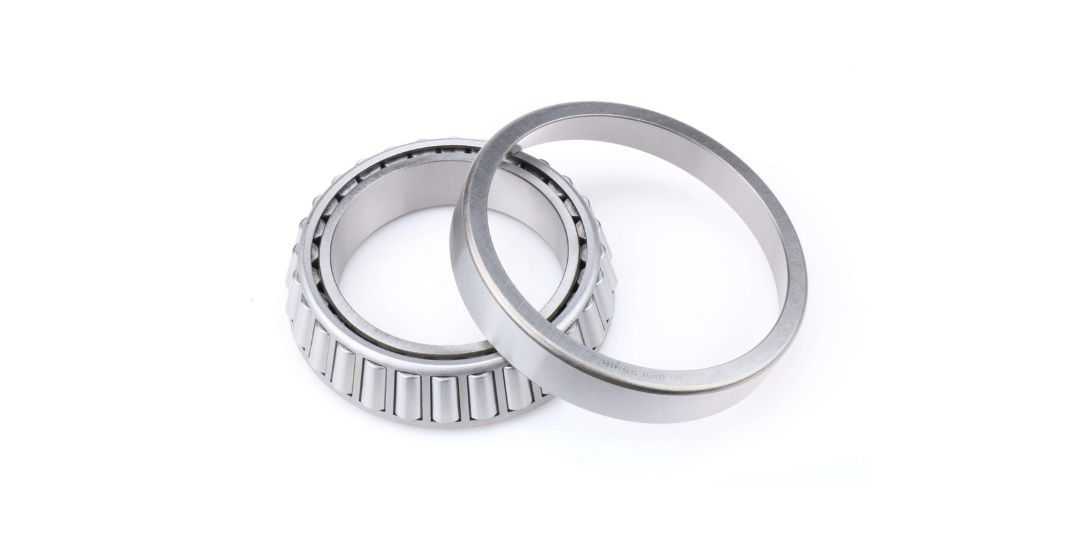
Tapered roller bearings are engineered to accommodate both radial and axial loads, making them indispensable in applications requiring combined force handling and precise axial positioning.
Design Features
Featuring conical rollers and raceways, these bearings transmit loads along the cone axis, with the apex of the inner and outer cones coinciding on the bearing axis. They are commonly used in pairs to optimize load distribution.
Working Principle
The tapered design allows simultaneous support for radial and axial loads in one direction. Adjusting the axial positioning of the inner and outer rings permits fine-tuning of bearing clearance or preloading, enhancing rotational accuracy and rigidity.
Key Manufacturing Processes
Inner and outer cone raceways are ground using specialized machines to maintain a cone angle tolerance of ≤±5′ and raceway straightness ≤0.002 mm. Rollers are precision-ground to control cone angle, large-end and small-end diameters within ±0.003 mm. Matched pairs undergo pair-grinding to ensure consistent axial height and load distribution.
Ventajas
Tapered roller bearings combine high radial and axial load capacity with excellent rigidity. Preloading allows precise control over rotation, making them suitable for medium-speed, heavy-load environments.
Aplicaciones típicas
Automotive wheel hubs, rear-axle differentials, and construction machinery such as excavators and cranes frequently employ tapered roller bearings.
Tapered roller bearings provide dependable support where combined radial and axial forces must be managed efficiently.
5. Self-Aligning Ball Bearings—Compensating Misalignment
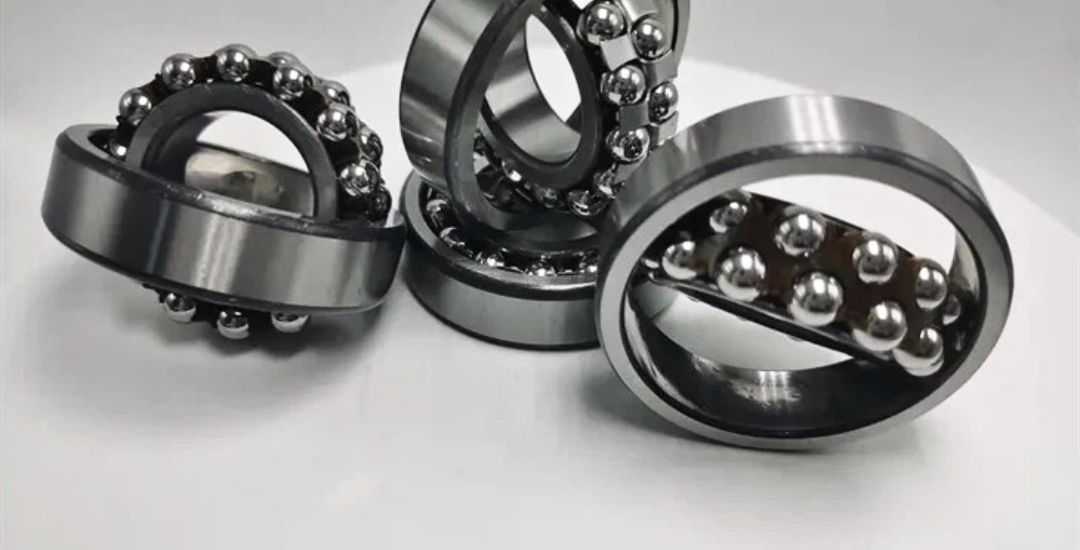
Self-aligning ball bearings excel in situations where misalignment or shaft deflection could compromise performance. Their design accommodates angular deviations without generating excessive stress.
Design Features
The outer ring has a spherical raceway, while the inner ring contains the ball set held in a cage. This allows the inner assembly to tilt slightly relative to the outer ring, typically by 1°–2.5°.
Working Principle
Balls roll along the spherical raceway, permitting the bearing to self-adjust under shaft deflection or installation misalignment. This reduces edge stresses and maintains smooth operation.
Key Manufacturing Processes
Spherical raceways are ground using rotary methods to achieve a surface accuracy of ≤0.003 mm and Ra ≤0.04 μm. Assembly ensures that tilt angles produce minimal torque variation (≤15%). Radial clearance is slightly larger (0.02–0.05 mm) than in standard ball bearings to prevent binding during misalignment.
Ventajas
This bearing type combines misalignment compensation with high radial load capacity, moderate axial load support, and strong vibration resistance.
Aplicaciones típicas
Self-aligning ball bearings are widely used in long shafts like conveyor rollers, paper machines, and vibrating equipment, as well as in heavy industrial gearboxes.
When shafts are prone to bending or installation errors, self-aligning ball bearings maintain reliable operation and protect machinery from undue stress.
6. Thrust Ball Bearings–Axial Load Specialists
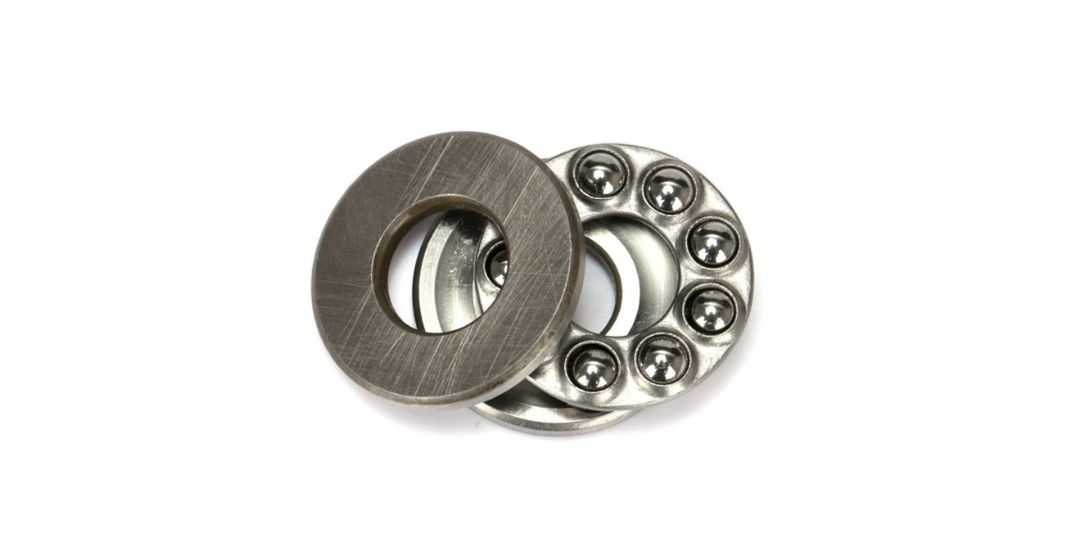
Thrust ball bearings are specifically designed for axial loads, where radial forces are minimal. Their structure ensures reliable axial positioning and load-bearing capacity.
Design Features
These bearings consist of a shaft washer, housing washer, and a cage containing steel balls. They are available in single- and double-direction configurations.
Working Principle
Single-direction thrust bearings support axial load in one direction, while double-direction types can handle loads in both directions. They are unsuitable for radial loads.
Key Manufacturing Processes
Load-bearing surfaces are precision-ground to flatness ≤0.001 mm and surface roughness Ra ≤0.02 μm. Cages are stamped with pocket clearances of 0.01–0.02 mm to prevent ball migration at high speed. Axial clearance is controlled to 0.01–0.03 mm by adjusting washer thickness within ±0.001 mm.
Ventajas
Thrust ball bearings efficiently handle axial loads, providing stable rotation under low- to medium-speed conditions.
Aplicaciones típicas
Vertical pumps, crane hooks, automotive clutch release bearings, and vertical machine tool tables.
Thrust ball bearings deliver targeted axial load support where precise positioning and stability are essential.
7. Needle Roller Bearings–Compact Load Bearers
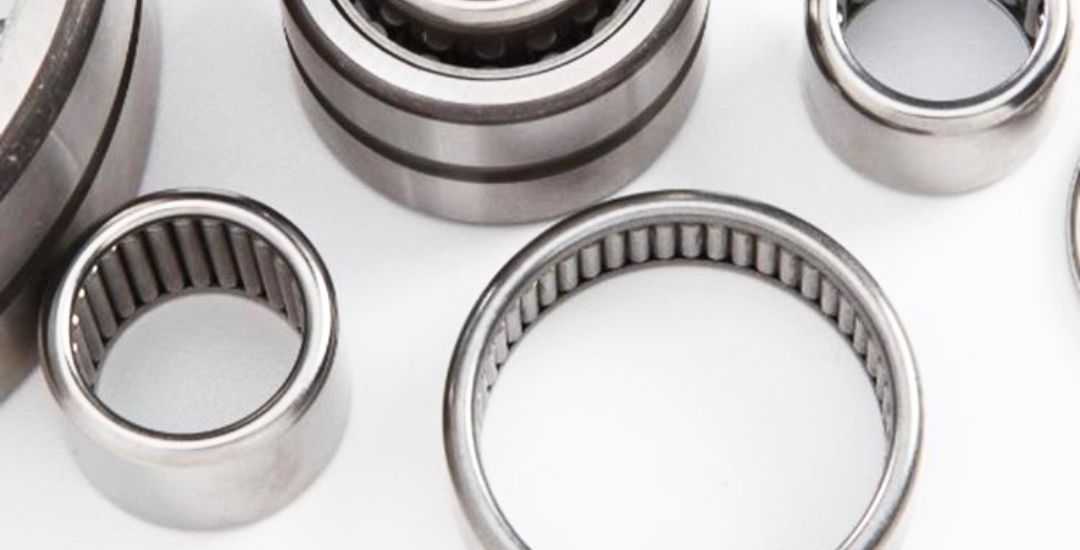
Needle roller bearings are ideal when radial space is limited but load requirements are high. Their slim profile makes them perfect for compact assemblies.
Design Features
These bearings use long, thin cylindrical rollers resembling needles, sometimes without inner or outer rings, reducing the radial cross-section by 30–50% compared to equivalent ball bearings.
Working Principle
The line-contact rollers support high radial loads in tight spaces. When an inner or outer ring is present, it guides the rollers; otherwise, the hardened surfaces of mating components serve as raceways.
Key Manufacturing Processes
Needle rollers are ground using centerless grinding and super-finishing, achieving roundness ≤0.001 mm, diameter tolerance ≤0.002 mm, and straightness ≤0.003 mm/100 mm. Assembly uses multi-station automatic fixtures to group rollers with ≤0.001 mm diameter variation for even load distribution.
Ventajas
Needle roller bearings maximize load capacity within minimal radial space and offer a lightweight solution for compact machinery.
Aplicaciones típicas
Automotive transmissions, connecting rods, pistons, motorcycle rocker arms, and compact household appliance gear systems.
When space is constrained but radial loads are substantial, needle roller bearings provide an efficient, compact solution.
8. Angular Contact Ball Bearings–High-Speed Precision
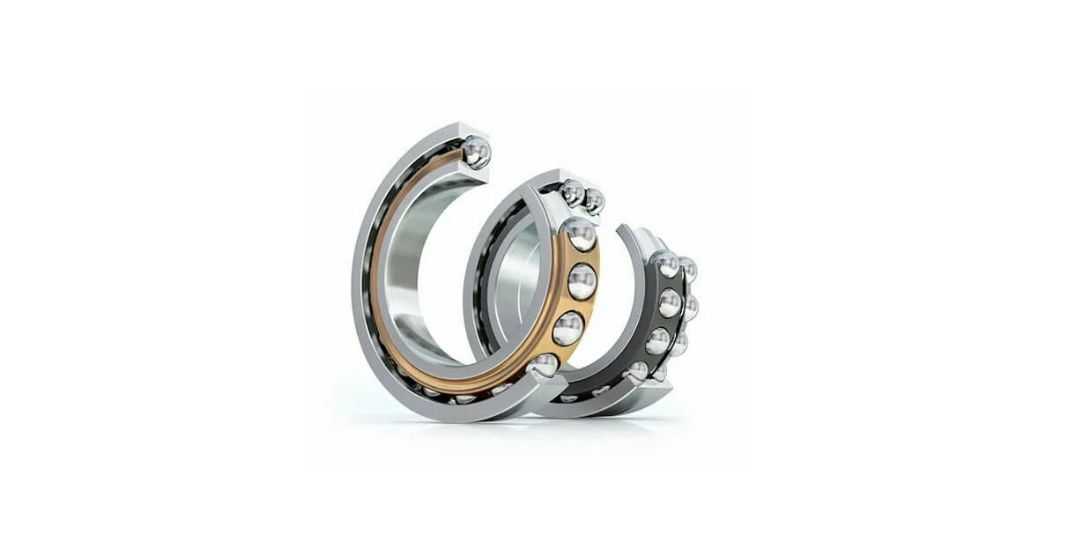
Angular contact ball bearings are optimized for high-speed applications with combined radial and axial loads, providing both accuracy and rigidity.
Design Features
These bearings feature raceways offset to create a specific contact angle (15°, 25°, or 40°) relative to the shaft, which enhances axial load capacity. They are usually installed in pairs to manage forces in both directions.
Working Principle
The contact angle allows simultaneous radial and axial load support. Proper pair orientation ensures uniform load distribution and maximum system rigidity at high rotational speeds.
Key Manufacturing Processes
Raceways are ground with angular precision ≤±1°, and surface roughness Ra ≤0.01 μm. Paired bearings are checked for height difference ≤0.002 mm and radial runout ≤0.001 mm, ensuring even load sharing.
Ventajas
These bearings maintain high rotational precision, excellent rigidity, and the ability to handle combined loads at high speeds.
Aplicaciones típicas
Machine tool spindles, high-speed motors, centrifuges, and medical equipment requiring precise, high-speed rotation.
Angular contact ball bearings combine speed, precision, and load versatility, making them indispensable for high-performance machinery.
9. Plain (Sliding) Bearings–Silent Heavy Load Support
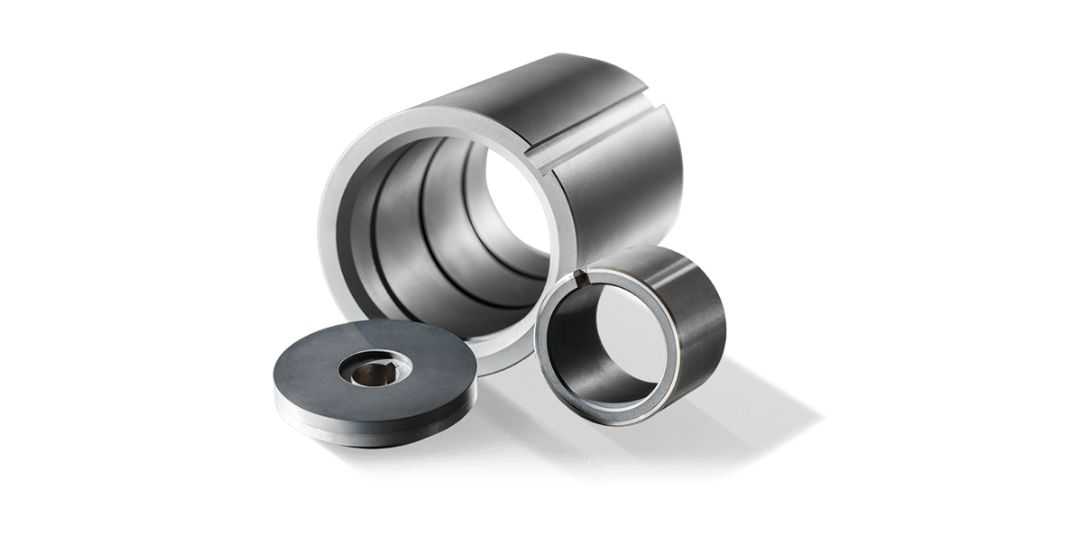
Plain bearings, also known as bushings or sleeve bearings, operate without rolling elements. They provide smooth, low-noise support under heavy loads or oscillatory motion.
Design Features
A plain bearing consists of a bearing sleeve and a shaft. Materials include bronze, graphite, PTFE, or Babbitt alloys, sometimes with external lubrication or self-lubricating properties.
Working Principle
The shaft slides within the bearing sleeve, separated by a thin lubrication film that minimizes friction and wear.
Key Manufacturing Processes
Babbitt bushings are produced via steel-backed casting and machining. Bronze sleeves are cast, rough-turned, precision-turned, and hand-scraped if required. Honing achieves roundness ≤0.002 mm and Ra ≤0.4 μm, with radial clearance adjusted to 0.001–0.002 × shaft diameter.
Ventajas
Plain bearings are simple, cost-effective, quiet, and capable of handling high shock and vibration loads. Self-lubricating materials extend usability in environments where oil is unavailable.
Aplicaciones típicas
Internal combustion engines (connecting rod and crankshaft bearings), bridge and building vibration isolation, low-speed heavy machinery, water turbines, ship propellers, and food machinery with non-lubricated plastic bushings.
Plain bearings provide reliable, low-noise support in heavy-load or low-speed applications, especially where space or lubrication constraints exist.
10. Bearing Selection Principles
Choosing the right bearing requires balancing multiple factors to match the application’s demands. The table below summarizes common selection guidelines for different load types, speeds, space constraints, and precision requirements.
| Factor | Recommended Bearing Types | Key Considerations |
| Radial load | Deep groove ball, Cylindrical roller, Needle roller | High radial capacity |
| Axial load | Thrust ball | Single or double-direction depending on application |
| Combined load | Tapered roller, Angular contact ball | Efficient distribution of radial and axial forces |
| High speed | Deep groove ball, Angular contact ball, Precision tapered roller | Smooth operation, low vibration |
| Low speed, heavy load | Plain bearing, Cylindrical roller | Robustness and durability |
| Space-limited | Needle roller | Compact design |
| Misalignment/long shaft | Self-aligning ball, Plain bearing | Compensates for shaft deflection |
| High-precision | P4/P2 angular contact, Deep groove ball | Tight tolerances, high rigidity |
| Shock/vibration | Sliding, Self-aligning | Absorbs transient forces |
| Lubrication constraints | Self-lubricating plain bearings | PTFE, Babbitt, bronze options |
Selecting the most suitable bearing is ultimately about understanding the specific demands of the system rather than chasing a universal “best”. The right choice balances load, speed, space, and durability effectively.
Conclusión
Each bearing type represents a careful balance of performance characteristics and limitations that influence overall machine behavior. High-speed spindles require precision and low vibration, heavy industrial loads demand robust roller designs, and space-constrained assemblies benefit from compact solutions like needle bearings. Bearing selection goes beyond specifications, encompassing operational context, maintenance considerations, and long-term reliability.
Are you seeking optimal outcomes? You can consult an experienced partner like the Beska team to ensure bearing choices deliver custom bearings with efficiency, durability, and consistent performance through precision CNC machining.
Profundice en nuestros recursos
Para que disfrutes de lecturas interesantes, hemos preparado una lista de artículos recomendados solo para ti:
 Spanish
 English
 Hebrew
 Turkish
 French
 Russian
 German
 Portuguese