


Have you ever checked a finished metal part and wondered why its surface feels so smooth and uniform? Or why some components still show visible marks even after machining? These differences often come down to two key finishing processes: grinding and polishing.
Both are vital in modern manufacturing to achieve precise dimensions, refined surfaces, and the desired appearance of metal or plastic parts. From the smooth finish of a smartphone casing to the flawless edges of turbine blades in aerospace engines, they ensure quality you can see and feel. However, grinding and polishing are not the same. They vary in purpose, working principles, and tool selection.
This article explains their differences in detail, including their definitions, mechanisms, materials, and typical applications, so you can better understand how each process contributes to high-quality production.
1. Grinding and Polishing: Not the Same Process

To understand the difference between grinding and polishing, it’s important to clarify their objectives. Grinding is considered a rough machining process that focuses on correcting shape and dimension, while polishing is a fine finishing process aimed at improving texture and appearance.
Objetivo
- Grinding removes excess material from a workpiece to achieve the desired geometry, flatness, and dimensional accuracy.
- Polishing further refines the surface by reducing roughness and enhancing gloss, often following grinding.
Principle
Grinding is a mechanical cutting process using abrasive particles bonded to tools such as grinding wheels or belts. These abrasives cut away microscopic portions of material to achieve flatness or shape correction.
Polishing, however, can involve both mechanical and chemical mechanisms. Mechanical polishing uses fine abrasives to smooth micro peaks, while chemical polishing employs solutions that react with the surface to remove oxides and produce a dense, reflective layer.
Acabado de la superficie
The main measurable indicator is surface roughness (Ra).
- After grinding, roughness typically ranges from Ra 0.8–6.3 μm, with visible marks or a matte texture.
- After polishing, it can reach Ra 0.01–0.2 μm, producing a smooth, mirror-like appearance.
Grinding shapes and prepares the surface, while polishing perfects it for both function and aesthetics.
2. Grinding and Polishing: Abrasives, Tools, and Workflow

Achieving a flawless transition from coarse to mirror finish depends on three essential elements—the abrasives, the tools, and the process. Each plays a unique role in determining precision, consistency, and surface quality.
1. Abrasives—The Cutting Teeth
Abrasives are microscopic cutting agents, and their hardness must exceed that of the workpiece material. They can be either natural or synthetic, with synthetic abrasives offering better uniformity and control.
| Type | Examples | Aplicaciones típicas | Remarks |
| Natural | Garnet, Quartz, Diamond | Traditional uses | Inconsistent grain size and quality |
| Synthetic | Aluminum oxide (Al₂O₃) | Steel, general-purpose | Widely used and cost-effective |
| Silicon carbide (SiC) | Cast iron, ceramics, glass | Extremely hard and sharp | |
| Cubic boron nitride (CBN) | Hardened steels | Nearly as hard as diamond | |
| Diamond | Carbide, ceramics, semiconductors | Hardest known material, for ultra-precision use |
2. Tools—Adapting to Requirements
The right tool depends on geometry, material, and the target surface finish.
| Categoría | Tool Type | Typical Use |
| Grinding Tools | Grinding wheels | Flat, internal, or external cylindrical surfaces |
| Abrasive belts | Curved or irregular parts (e.g., automotive bumpers, guitar bodies) | |
| Mounted points | Fine grinding for narrow or deep areas (molds, holes) | |
| Polishing Tools | Buffing wheels (cotton, linen, wool, sponge) | Different polishing stages |
| Polishing pads/discs | Handheld operations like scratch removal | |
| Polishing brushes | Cleaning and finishing edges or grooves |
3. Process—From Coarse to Fine
Surface finishing should follow a gradual approach to ensure accuracy and consistency.
| Stage | Abrasive Grit Size | Objetivo |
| Rough Grinding | 80–120 | Rapid material removal |
| Intermediate/Finish Grinding | 180–400 | Eliminate deeper marks |
| Pulido | 600+ (micron or nanometer diamond paste) | Achieve high gloss and precision |
A well-designed process combines the right abrasive, the proper tool, and a step-by-step grit sequence, ensuring smooth, defect-free results for both functional and aesthetic requirements.
3. Materials and Their Finishing Characteristics

The performance of grinding and polishing depends largely on material properties such as hardness, toughness, and heat sensitivity. Different materials require distinct abrasives, tools, and parameters.
The performance of grinding and polishing largely depends on material properties such as hardness, toughness, and heat sensitivity. Each material category requires distinct abrasives, tools, and process parameters to achieve optimal surface quality.
| Material Category | Examples | Finishing Characteristics | Typical Techniques / Notes |
| Rieles | Steel, Alloy Steel | Excellent grindability and dimensional stability | Use aluminum oxide or CBN abrasives. Control heat and pressure for stainless steel to avoid oxidation. |
| Aluminum Alloys | Soft, prone to scratches | Apply sharp abrasives with effective cooling; chemical or electrolytic polishing for high reflectivity. | |
| Copper Alloys (Brass, Bronze) | Easy to polish but oxidize quickly | Use fine abrasives and apply wax or sealant to protect the finish. | |
| Titanium Alloys | Chemically reactive and smear-prone | Use dedicated abrasives with constant cooling to prevent surface damage. | |
| Non-Metallic Inorganic Materials | Vaso | Requires high precision for transparency | Ground with diamond tools; polished with cerium oxide. |
| Ceramics (Al₂O₃, ZrO₂, SiC) | Hard and brittle | Use diamond abrasives for controlled removal and improved fracture strength. | |
| Semiconductors (Silicon) | Extremely flat surfaces required | Chemical-mechanical polishing (CMP) achieves atomic-level smoothness. | |
| Natural Stones (Granite, Marble) | Decorative, high hardness | Sequential diamond grinding and polishing create glossy finishes. | |
| Polymers and Composites | Plastics (PMMA, PC) | Heat-sensitive, easily deformed | Gentle polishing or flame/paste polishing restores clarity. |
| Resins, Coatings | Thin surface layers | Use waterproof sandpaper and polishing compounds for smooth gloss. | |
| Carbon Fiber Composites | Fiber-reinforced resin matrix | Controlled grinding removes resin without damaging fibers. |
Every material behaves differently under grinding and polishing. Selecting suitable abrasives, cooling methods, and polishing compounds ensures both performance and visual quality.
4. Grinding vs Polishing: Applications Across Industries
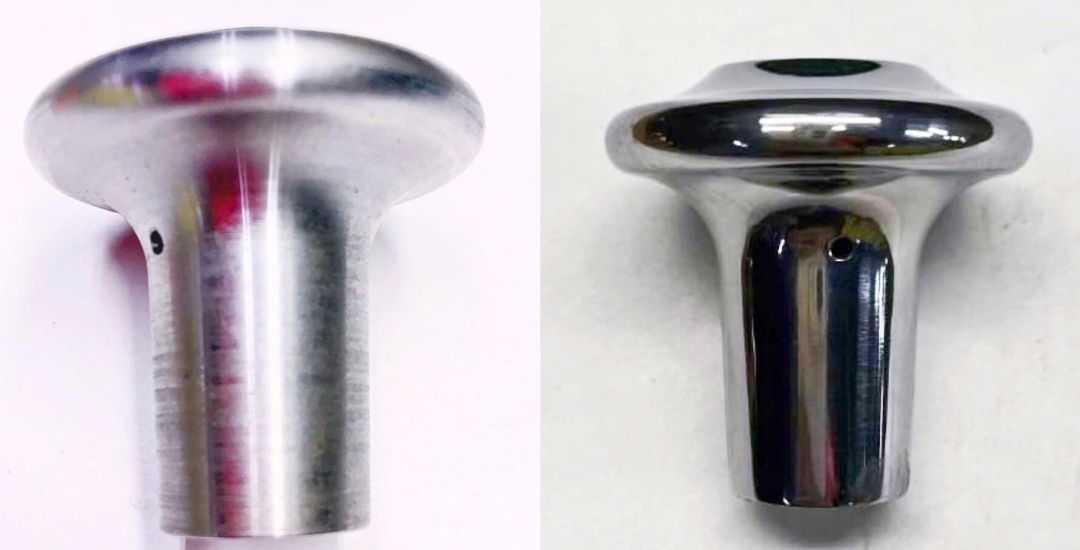
Grinding and polishing technologies are widely applied in modern manufacturing and product design:
- Automotive and aerospace. These processes ensure dimensional accuracy, surface smoothness, and fatigue resistance in engine components, crankshafts, and turbine blades.
- Electronics and optics. Grinding and polishing achieve ultra-smooth surfaces for semiconductor wafers, optical lenses, and data storage devices, which are critical for device performance.
- Jewelry and art. Polishing enhances the brightness, texture, and visual appeal of precious metals and gemstones, creating high-quality aesthetic finishes.
- Medical and biomedical engineering. Implants and medical devices benefit from polished surfaces that improve wear resistance, biocompatibility, and longevity.
- Everyday products. Polished surfaces define the quality and usability of items such as smartphone glass, consumer electronics, and stainless-steel sinks.
Grinding and polishing are essential processes that combine precision, durability, and aesthetics across industries.
5. Common Issues and Solutions in Grinding and Polishing

Even with careful preparation, grinding and polishing can sometimes produce unexpected results depending on the material and method used.
- Scratches after polishing. Metals, glass, or stones can show fine scratches if the grit sequence is skipped, if coarse abrasive remains on the tools, or if dust contaminates the workspace. Following proper grit progression and keeping tools clean helps avoid these marks.
- Dull or cloudy surfaces. Soft metals and plastics may appear hazy when the abrasive is too hard or polishing speed generates excess heat. Choosing the right abrasive and compound while controlling speed restores a smooth, reflective finish.
- Cracks or chipping. Brittle materials like glass or ceramics are prone to chipping when excessive pressure is applied, tools are too rigid, or the grinding path starts at edges rather than the center.Using appropriate pressure, flexible tools, and careful paths reduces the risk of damage.
Paying attention to these common challenges ensures that both functional performance and visual quality are preserved during finishing.
Conclusión
Grinding and polishing are distinct yet complementary finishing processes. Grinding focuses on achieving dimensional accuracy and shaping, while polishing enhances surface smoothness, gloss, and overall aesthetics. Being aware of the specific role each technique plays ensures components achieve both precision and desired surface quality.
Whether you are working with metals, plastics, or brittle materials, choosing the right combination of tools, abrasives, and workflow ensures both functional performance and visual appeal.
For those seeking high-quality manufacturing solutions, it is important to consult a supplier like the Beska team, who is experienced in CNC machining, sheet metal fabrication, and post-processing techniques like grinding and polishing. The right partner can help translate design intent into precise, visually refined components.
Profundice en nuestros recursos
Para que disfrutes de lecturas interesantes, hemos preparado una lista de artículos recomendados solo para ti:
- What Is A Reamer?
- How to Polish Bronze?
- What Is Deburring?
- Servicio de mecanizado CNC
- Acabado de superficies
 Spanish
 English
 Hebrew
 Turkish
 French
 Russian
 German
 Portuguese