


Parts like household appliances, automotive components, and outdoor machinery all need protective coatings, but not all coatings perform the same.
Wet painting applies liquid paint that dries or cures on the surface, offering flexibility in color and finish. Powder coating uses solid powder that melts and crosslinks under heat, creating a thicker, tougher layer with superior durability. Choosing between these two methods affects corrosion resistance, wear performance, and production efficiency.
This article compares their engineering principles, process implications, and ideal applications to guide coating selection.
1. Wet Painting: How It Works and Where It Excels

Wet painting, also called liquid coating, involves spraying liquid paint onto a part surface, where it forms a continuous film through solvent evaporation, chemical reaction, or heat curing. This process is widely used when appearance, color flexibility, or small-batch production is important.
Key steps in wet painting:
- Paint preparation. Resins, pigments, solvents, and additives are blended and adjusted to achieve the target viscosity. Proper mixing affects flow, adhesion, and final gloss.
- Atomization. Compressed air, high-pressure pumps, or electrostatic forces break the paint into fine droplets that deposit uniformly on the surface. Spray pattern, nozzle type, and distance influence coverage consistency.
- Film formation and curing. Droplets merge and cure to form a uniform coating. Curing conditions determine hardness, adhesion, and appearance.
Common wet painting methods:
- Conventional air spray uses compressed air to atomize the paint.
- High-pressure airless spray pumps paint at 150–300 kg/cm², where rapid pressure drop causes atomization.
- Electrostatic liquid spray charges droplets (30–90 kV) to adhere efficiently to grounded parts.
Wet painting adapts to complex geometries and allows flexible color matching. It is suitable for small batches or frequent color changes. Coating thickness typically ranges from 15 to 40 µm. Quality depends on viscosity, spray technique, and environmental control, making process management critical for consistent results.
2. Powder Coating: High-Performance Finishing
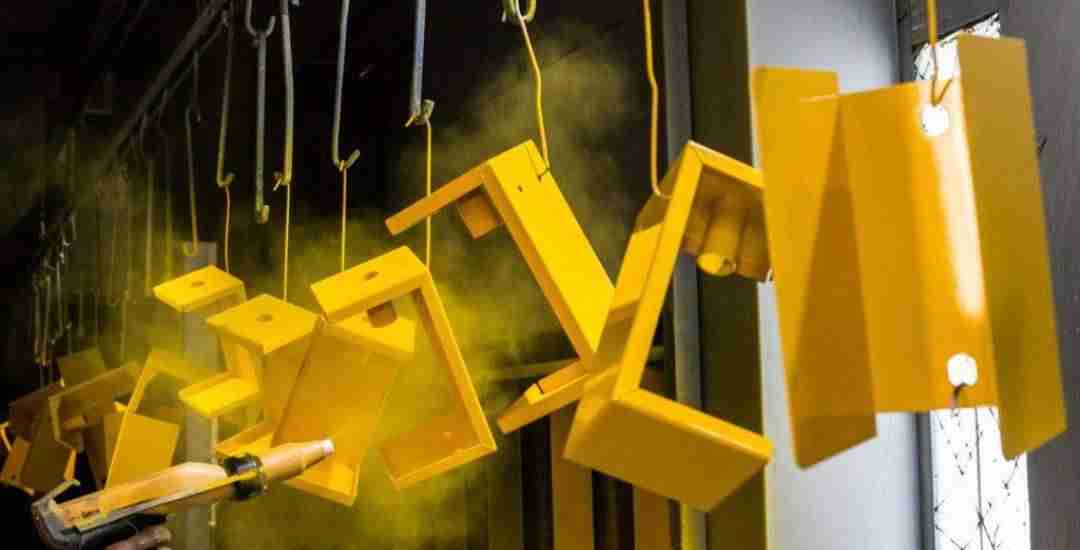
Powder coating applies solid powder to a part surface, which then melts and crosslinks under heat to form a continuous, durable layer. This method is commonly used when thicker, tougher coatings and high-volume production are required.
Key steps in powder coating:
- Powder charging. The powder particles gain an electrostatic charge, typically 30–100 kV, as they pass through the spray gun. Charging uniformity affects adhesion and coating consistency.
- Electrostatic deposition. Charged particles move toward grounded surfaces and adhere evenly. Spray angle, distance, and particle size determine coverage quality.
- Curing. Parts are heated in an oven, causing the powder to melt, flow, and crosslink into a solid film. Temperature and dwell time control final hardness and chemical resistance.
Common powder coating characteristics:
- Coating thickness is typically 60–120 µm, providing superior mechanical strength compared to wet painting.
- Material efficiency is high, usually 95–99%, with minimal overspray waste.
- Coatings resist corrosion, abrasion, and weathering, making them ideal for outdoor or high-stress applications.
Powder coating delivers highly uniform, durable coatings suitable for large batches. Its main limitations are fewer color options and higher initial investment due to the need for curing ovens and recovery systems. Proper surface preparation and curing control are critical to achieving consistent quality.
3. Core Comparison: Wet Painting vs Powder Coating

Different parts and production goals demand different coating characteristics. The table below compares wet painting and powder coating in terms of thickness, durability, material use, and substrate compatibility.
| Dimension | Wet Painting | Recubrimiento en polvo |
| Material Form | Liquid (resin + solvent + pigment + additives) | Solid powder (resin + pigment + additives) |
| Deposition Mechanism | Atomization ± electrostatic | Electrostatic adhesion |
| Curing | Solvent evaporation / chemical / heat | Heat melt & crosslink |
| Typical Thickness | 15–40 µm | 60–120 µm |
| Eficiencia del material | 30–85% | 95–99% |
| VOC Emission | Alto | Nearly zero |
| Curing Temperature | Room–150°C | 180–200°C |
| Color Flexibility | Alto | Limited |
| Appearance | Excellent gloss & smoothness | Good, gloss limited |
| Mechanical Strength | Bien | Excellent (thicker & tougher) |
| Resistencia a la corrosión | Depends on system | Generally excellent |
| Inversión inicial | Moderado | High (oven, recovery system) |
| Running Cost | High solvent & environmental cost | Material cost high but efficient |
| Suitable Substrate | Almost all | Primarily metals, high-temp resistant |
Wet painting allows flexibility in color and works on almost any substrate, while powder coating prioritizes uniformity, durability, and environmental compliance. For applications where surface protection, batch consistency, and low VOC emissions are critical, powder coating often offers the most reliable solution.
4. Wet Painting vs Powder Coating: Achieving Consistent Coating Thickness
Uniform coating thickness is a key factor in part performance and reliability. In high-volume production, differences in deposition and curing mechanisms directly affect consistency, rework, and overall yield.
Powder coating:
- Electrostatic deposition and dry film formation produce highly uniform coverage, even on complex geometries.
- Oven curing ensures consistent melting and crosslinking, resulting in tight thickness tolerances, typically ±5 µm.
- Environmental conditions such as humidity and minor temperature fluctuations have minimal impact on film quality.
- High repeatability makes powder coating well-suited for standardized, mass-produced components.
Wet painting:
- Atomization and liquid flow make coating sensitive to paint viscosity, ambient temperature, and spray technique.
- Operator skill, nozzle selection, and overlap patterns strongly influence uniformity and surface smoothness.
- Solvent evaporation or chemical curing can cause minor variations in thickness; typical tolerance is ±10 µm with a pass rate around 95–98%.
- Close monitoring and process control are required to maintain consistency across batches.
For large-scale production prioritizing minimal variation and high durability, powder coating consistently outperforms wet painting. Wet painting remains valuable for small batches or intricate parts where appearance and flexibility are critical.
5. Wet Painting vs Powder Coating: Process Compatibility and Post-Treatment
Coating selection depends on surface compatibility and post-treatment needs. Differences between wet painting and powder coating affect production efficiency, handling, and assembly quality:
| Aspecto | Wet Painting | Recubrimiento en polvo |
| Surface Requirements | Can be applied on slightly moist surfaces; compatible with metals, plastics, wood | Requires clean, dry, and conductive surfaces; non-metals may need primers |
| Post-Treatment | Often needed: sanding, polishing, or buffing to remove drips or particles | Minimal: cured coating is hard and uniform, no further finishing required |
| Material Hardness | Water-based or low-temperature coatings are softer; susceptible to scratches during transport and assembly | High hardness; resists scratches and damage in handling and assembly |
| Process Implications | Flexible substrate application; extra finishing steps increase labor and cycle time | High surface prep standards simplify post-processing but increase pre-coating effort |
Powder coating is ideal when durability and minimal post-treatment are critical. Wet painting is preferred for complex shapes or temperature-sensitive substrates, but it requires precise process control and additional finishing to ensure consistent quality.
6. Application Scenarios: Wet Painting vs Powder Coating

Selecting the right coating depends on part type, production volume, and performance requirements. Different materials and environments favor one process over the other, as summarized below:
| Solicitud | Recommended Process | Engineering Rationale |
| Automotive body | Wet painting (e-coat + topcoat) | Multi-layer corrosion protection, high gloss, color variety |
| Piezas de automóvil | Both | Chassis: powder for corrosion; interiors: wet paint for appearance |
| Home appliance | Powder | Durable, cost-effective, high-volume production |
| Architectural aluminum | Powder | Weather resistance, color variety, eco-friendly |
| Steel structures | Both | Heavy anti-corrosion: wet paint; standard protection: powder |
| Wood furniture | Wet paint | Low-temp cure, versatile finishes, small batches |
| Plastic products | Wet paint | Low-temp cure, substrate adaptability; low-temp powder possible |
| Electrónica | Powder increasing | Low-temp powder expanding applications, driven by regulations |
| Aeroespacial | Specialized wet | Extreme conditions, multi-functional coatings |
| Artistic projects | Wet | Unlimited color and effects, creative flexibility |
Powder coating is best for standardized, high-volume metal parts where durability is critical. Wet painting excels for visual finish, complex geometries, or low-volume custom components, with hybrid processes providing optimal balance in premium applications.
7. Wet Painting vs Powder Coating: A Practical Decision Framework
In practice, coating selection is a trade-off between appearance, performance, and production reality. This framework reflects how coating choices are typically made on the shop floor and during early design reviews.
Product-driven considerations
- Appearance requirements. Wet painting is preferred when high gloss, metallic effects, or color accuracy are critical. Powder coating fits matte or standard finishes where visual tolerance is wider.
- Performance requirements. Powder coating is often specified for corrosion, chemical exposure, or outdoor environments. Wet painting remains necessary for multi-layer systems or functional coatings with tight thickness control.
- Part geometry. Deep cavities, internal features, or complex contours are easier to coat uniformly with wet painting. Powder coating performs best on open, simple geometries.
Production-driven considerations
- Production volume. Powder coating favors large, stable batches with limited color variation. Wet painting supports small batches and frequent color changes with less setup cost.
- Substrate and temperature limits. Metals are compatible with both processes. Heat-sensitive plastics, wood, or assemblies with seals typically require wet painting, unless low-temperature powder systems are qualified.
- Facility and compliance constraints. Powder coating demands ovens and recovery systems but minimizes VOC compliance. Wet painting requires ventilation and emission control but offers broader process flexibility.
The most reliable decisions come from prioritizing constraints rather than preferences. If durability, consistency, and regulatory pressure dominate, powder coating is usually the right choice. If visual precision, geometry complexity, or substrate limitations lead the discussion, wet painting remains the practical solution.
Conclusión
There is no universally superior coating process. The right solution is defined by real constraints such as part geometry, performance targets, production volume, and regulatory limits. When surface finishing is treated as an integrated manufacturing step rather than a final cosmetic operation, coating decisions become clearer and more predictable.
In practical manufacturing, coating performance is closely tied to upstream processes such as CNC machining accuracy, material selection, and sheet metal fabrication quality. Surface finishing can only perform as intended when it is planned together with machining tolerances, edge conditions, and assembly requirements.
For this reason, consulting a manufacturing partner like the Beska team who understands how wet painting and powder coating interact with CNC machining and sheet metal fabrication is often more critical than the coating method itself.
Profundice en nuestros recursos
Para que disfrutes de lecturas interesantes, hemos preparado una lista de artículos recomendados solo para ti:
 Spanish
 English
 Hebrew
 Turkish
 French
 Russian
 German
 Portuguese