


High-precision aluminum CNC parts can wear out quickly when subjected to friction or repeated contact. Sliding components may fail earlier than expected, and corrosion can compromise even well-designed parts. In many cases, the underlying issue comes from the surface treatment rather than the design itself.
Hard coat anodizing, also known as Type III anodizing, forms a thick, dense oxide layer on aluminum surfaces. This layer significantly increases hardness, enhances wear resistance, and improves corrosion protection. Correctly applied, it helps maintain dimensional accuracy and extends the service life of critical components.
This article examines the practical aspects of hard coat anodized aluminum, covering key properties, design and machining considerations, limitations, and real-world applications. It provides guidance for achieving durable and reliable CNC aluminum parts.
1. Why Hard Coat Anodizing Matters in Manufacturing

Aluminum CNC parts are widely used for their light weight and corrosion resistance, but in demanding applications, they often face early wear or surface damage. Components that slide, rotate, or bear repeated contact can develop scratches, galling, or reduced surface hardness. Even minor surface imperfections can affect part performance, lead to assembly issues, or shorten the overall service life.
Standard anodizing offers basic corrosion protection, but it is often too thin to prevent abrasion in high-stress environments. Hard coat anodizing provides a much thicker and denser oxide layer, significantly increasing surface hardness and wear resistance. By applying hard coat anodizing, manufacturers can maintain dimensional accuracy, reduce maintenance frequency, and improve the long-term reliability of aluminum parts.
This process is especially important for precision components in industrial machinery, automation equipment, and other applications where part failure could result in costly downtime or product defects.
2. Key Properties of Hard Coat Anodized Aluminum Parts
Hard coat anodizing enhances aluminum parts in several critical ways, making them more durable and reliable for demanding applications.
Surface Hardness and Wear Resistance
The anodized layer significantly increases surface hardness, often reaching 60–70 HRC, which is several times higher than standard anodizing. This improvement helps parts resist abrasion and sliding wear, extending the lifespan of moving or load-bearing components.
Coating Thickness and Dimensional Impact
Hard coat anodizing produces a thick oxide layer ranging from 25 to 125 microns. While this thickness improves protection, it also slightly increases part dimensions. Designers need to account for this growth when specifying tolerances, especially for precision CNC components. The layer forms predictably on both external and internal surfaces, allowing for accurate design adjustments.
עמידות בפני קורוזיה
The dense anodic layer improves resistance to corrosion in humid, marine, or chemically aggressive environments. Although it does not make aluminum completely impervious, it slows the corrosion process, reducing maintenance requirements and improving long-term reliability.
Overall, these properties make hard coat anodized aluminum particularly suited for components that face heavy wear, repeated contact, or exposure to harsh environments. Applying this surface treatment ensures parts maintain performance and precision over an extended service life.
3. Hard Coat Anodizing vs Standard Anodizing
For CNC aluminum parts that face wear, sliding contact, or corrosive environments, the choice between hard coat and standard anodizing affects performance and longevity. Their differences are clear when comparing key properties:
| נֶכֶס | Hard Coat Anodizing (Type III) | Standard Anodizing (Type II) |
| קשיות פני השטח | 60–70 HRC, excellent for wear-resistant components | 15–25 HRC, suitable for light-duty parts |
| Oxide Layer Thickness | 25–125 microns, may require tolerance adjustments | 5–25 microns, minimal impact on dimensions |
| Wear and Abrasion Resistance | High resistance, suitable for sliding or rotating parts | Moderate, wears quickly under repeated friction |
| עמידות בפני קורוזיה | Strong in humid, marine, and chemically aggressive environments | Basic corrosion protection for less demanding conditions |
| יציבות מימדית | Maintains tolerances under mechanical stress | Minor improvement, may be insufficient for precision parts |
| Appearance | Darker, matte finish; functional | Can be decorative with color options |
| Cost vs Longevity | Higher upfront cost but reduces long-term maintenance | Lower cost but shorter service life |
For high-wear or precision CNC components, hard coat anodizing delivers superior durability, dimensional stability, and corrosion resistance. Standard anodizing works for light-duty parts or where appearance is the primary concern.
4. When to Choose Hard Coat Anodizing for Aluminum CNC Parts?

Hard coat anodizing is applied when aluminum parts must withstand demanding mechanical or environmental conditions rather than for decorative purposes. Typical conditions include:
- High surface stress or friction: Sliding, rotating, or impact-loaded components experience less wear and longer service life with a harder anodized layer.
- Tight dimensional tolerances: The dense oxide layer maintains part precision under repeated mechanical stress, as long as its predictable thickness is accounted for in design.
- Exposure to corrosive or abrasive environments: Humid, marine, or chemically aggressive conditions are better resisted by the thick, dense oxide layer of hard coat anodizing.
- High durability requirements: Parts that must maintain performance over long periods benefit from reduced surface degradation and lower maintenance needs.
Parts with minimal wear, low stress, or primarily decorative surfaces do not require hard coat anodizing. Applying the treatment under the conditions above improves performance and extends the usable life of aluminum components without adding unnecessary processing.
5. Design & Machining Considerations Before Hard Coat Anodizing
Hard coat anodizing affects both the surface and dimensions of aluminum parts, so certain design and machining factors influence the final performance:
- Tolerance allowance: The oxide layer grows between 25 and 125 microns. Critical dimensions, especially in fits or sliding assemblies, must be offset to maintain proper clearance after anodizing.
- Sharp corners and threads: Anodizing tends to be thinner on edges and internal threads. Chamfering corners, rounding edges, or applying masking to threaded holes helps achieve uniform layer thickness and prevents premature wear.
- Surface roughness: A smoother machined surface promotes consistent oxide growth. For parts exposed to sliding contact or friction, finishing with low Ra values improves hardness distribution and wear resistance.
- Masking of functional areas: Areas such as bearing seats, threaded holes, or electrical contact surfaces may need to remain free of anodizing. Using masking tapes, plugs, or liquid masks prevents interference with assembly or functionality.
Accounting for these factors during CNC machining ensures that hard coat anodized parts maintain dimensional accuracy, achieve uniform surface properties, and perform reliably in service.
6. Limitations and Trade-Offs of Hard Coat Anodized Aluminum
Hard coat anodizing improves wear resistance, corrosion protection, and surface hardness, but it introduces certain constraints that affect design and manufacturing:
- Cost: The process requires longer immersion times and specialized equipment, making it 30–50% more expensive than standard anodizing for similar batch sizes. For high-volume or low-stress parts, this can impact overall production cost.
- Appearance: The anodized layer is typically limited to natural metallic gray or dark matte finishes. Color customization is minimal compared with standard decorative anodizing.
- Material compatibility: Not all aluminum alloys achieve uniform hard coat thickness. 6061 and 7075 perform consistently, while alloys like 5052 may show thinner layers or reduced hardness. Designers must verify alloy suitability before specifying the process.
- Thin-walled or intricate parts: Sections thinner than 1–2 mm may develop uneven coatings or slight dimensional distortions. Features such as sharp internal corners or small holes can be affected, requiring chamfering, masking, or adjusted tolerances.
Considering these factors during design and process planning ensures that hard coat anodizing delivers its benefits without introducing unexpected issues. Proper alloy selection, part geometry adjustments, and realistic cost assessment allow for durable, high-performance aluminum components while minimizing trade-offs.
7. Typical Applications of Hard Coat Anodizing Aluminum Parts
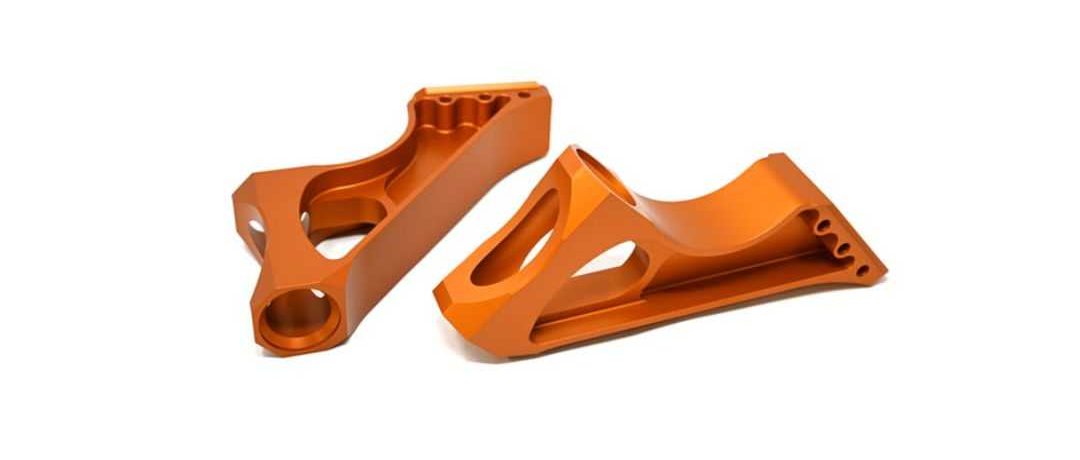
Hard coat anodized aluminum is widely used in industries where both durability and environmental resistance are critical:
- Industrial machinery: Linear rails, gear housings, and precision fixtures undergo repeated movement and contact. The hard anodized surface reduces wear and extends service intervals.
- Automation and robotics: Actuators, conveyor components, and pivot joints maintain smooth operation under continuous motion and mechanical stress.
- Aerospace and defense: Structural brackets, control linkages, and housings are exposed to vibration, temperature changes, and challenging operational conditions. Hard coat anodizing preserves their integrity.
- Marine and chemical processing: Aluminum components in pumps, valves, and enclosures resist corrosion from saltwater, humidity, and chemicals, reducing maintenance frequency.
- High-performance consumer and automotive products: Lightweight parts in bikes, electronic devices, and sports equipment maintain surface hardness and aesthetic stability despite repeated handling or exposure to outdoor conditions.
Across these industries, hard coat anodizing provides a combination of long-term wear resistance, corrosion protection, and dimensional stability, making aluminum components reliable even in the most demanding environments.
8. Working with a Manufacturer for Hard Coat Anodized Aluminum Parts
Hard coat anodizing requires precise process control and coordination with CNC machining to achieve the desired surface properties and dimensional accuracy. Key considerations when working with a manufacturer include:
- Design and tolerance planning: Manufacturers can provide guidance on compensating for oxide layer growth, ensuring critical fits, sliding surfaces, and threaded holes remain within tolerance after anodizing.
- CNC process integration: Sequencing machining and anodizing properly prevents surface defects and maintains part geometry. Some features, such as sharp corners or small holes, may need chamfering or masking before anodizing.
- Quality verification: Experienced manufacturers measure hardness, layer thickness, and uniformity using standardized methods such as microhardness testing or eddy current gauges, ensuring the coating meets specifications.
- Masking and functional surfaces: Areas that must remain free of anodizing, such as bearing seats or electrical contact points, are masked precisely to prevent interference with assembly.
- Minimizing rework: By anticipating challenges such as uneven coating on thin walls or edges, manufacturers reduce the risk of rejected parts and avoid costly reprocessing.
Working with a manufacturer familiar with hard coat anodizing ensures aluminum components achieve consistent wear resistance, corrosion protection, and dimensional stability, while minimizing production issues and maintaining high-quality standards.
מַסְקָנָה
Hard coat anodizing delivers maximum value when aluminum CNC parts must withstand wear, friction, or corrosive environments while maintaining precise dimensions. Its benefits depend on alloy choice, part geometry, and careful integration with machining processes.
For reliable, long-lasting components, consulting a manufacturer like the Beska team experienced in hard coat anodizing ensures proper coating thickness, uniformity, and functional performance. Partnering with the right supplier can prevent common issues and extend the service life of critical aluminum parts.
צלול עמוק יותר לתוך המשאבים שלנו
לקריאה מעמיקה, אספנו עבורך רשימה של מאמרים מומלצים:
 Hebrew
 English
 Turkish
 French
 Russian
 German
 Spanish
 Portuguese