
CNC Machining Brass Service
- ±0.005 mm achievable tolerances
- 3-axis, 4-axis, and 5-axis machining centers
- The MOQ is one piece

Beska - האיכות הטובה ביותר עם מחיר תחרותי.
עם מומחיות בייצור מתכת ועיבוד CNC, אנחנו כאן.
CNC Machining Brass at Beska
At Beska, we specialize in precision CNC machining of brass parts for demanding applications. Our combination of advanced equipment and skilled engineers ensures every project is optimized for performance, cost, and lead time. When you work with Beska, you benefit from:

Beska - האיכות הטובה ביותר עם מחיר תחרותי.
עם מומחיות בייצור מתכת ועיבוד CNC, אנחנו כאן.
Advanced multi-axis equipment
3-, 4-, and 5-axis CNC milling centers, Mazak turning machines, and Swiss-type lathes handle complex geometries and tight tolerances
Design-for-manufacturing (DFM) support
Engineers review your drawings to prevent costly changes and ensure stable quality from the start
Integrated finishing
Deburring, polishing, and plating so you receive ready-to-use parts from one source
End-to-end partnership
From prototype through mass production with clear communication and consistent quality
Common Brass Alloys for CNC Machining
Here are the brass alloys we commonly use for CNC machining, along with essential properties to guide your material choice.
| Alloy/Grade | מאפייני מפתח | Typical Tensile Strength (MPa) | Yield Strength (MPa) | Hardness (HB) | יכולת עיבוד |
| C260 (מחסנית פליז) | Excellent ductility, corrosion resistance | 345 | 170 | 90 | מְעוּלֶה |
| C360 (Free-Cutting Brass) | Superior machinability, good strength | 360 | 210 | 95 | מְעוּלֶה |
| C464 (Naval Brass) | High corrosion resistance, strength | 410 | 250 | 105 | טוֹב |
| C345 (Lead-Free Brass) | Environmental compliance, good machinability | 345 | 200 | 90 | טוֹב |
| C280 (Muntz Metal) | High strength, wear resistance | 400 | 240 | 100 | טוֹב |
CNC Machining Processes for Brass
To produce high-precision brass components, Beska applies a combination of advanced machining methods tailored to each part’s geometry and function.


כרסום וחריטה CNC
רב צירים כרסום CNC centers, Mazak turning machines, and Swiss-type lathes handle complex geometries, small diameters, thin walls, and intricate contours.
Secondary Operations
At Beska, we can also perform threading, knurling, slotting, tapping, and reaming in-house, reducing the need for external suppliers.
אבטחת איכות
Each brass component undergoes strict dimensional checks using CMM and visual inspections to guarantee specifications are met.
The Advantages of CNC Machining Brass
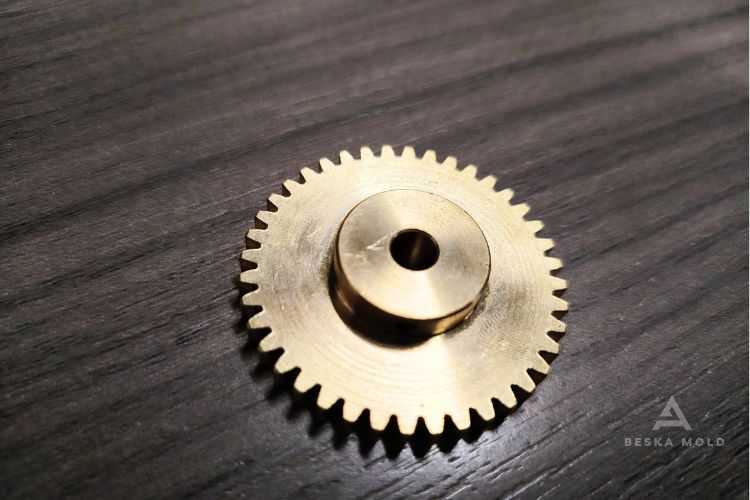
Brass is widely used in CNC machining due to its stable cutting behavior and balanced material properties. Key advantages include:
Beska - האיכות הטובה ביותר עם מחיר תחרותי.
עם מומחיות בייצור מתכת ועיבוד CNC, אנחנו כאן.
- Excellent machinability. Brass allows high cutting speeds with minimal tool wear, which helps improve machining efficiency and reduce production cost.
- Good dimensional stability. The material maintains consistent geometry during machining, making it suitable for parts requiring tight tolerances and fine details.
- Reliable corrosion resistance. Brass performs well in various environments, making it suitable for components exposed to moisture or mild chemicals.
- Strong electrical conductivity. This property makes brass a preferred choice for electrical connectors, terminals, and conductive components.
- Clean surface finish. Brass can achieve smooth surfaces directly after machining, reducing the need for extensive post-processing.
These characteristics make brass a practical choice for projects that require efficient machining, stable tolerances, and reliable performance across different applications.
The Applications of Custom Brass Parts
At Beska, we machine a wide range of custom brass parts for various industries, with attention to material selection, achievable tolerances, and machining complexity.
- Valve bodies and pump housings: Typically machined from C360 or C464 brass for good corrosion resistance and machinability.
- Electrical connectors, terminals, and contact pins: Often made from free-cutting brass like C360 for easy machining and plating compatibility.
- Decorative and architectural fittings: Materials such as C260 or C360 are common.
- Gears, bushings, and precision mechanical parts: Usually produced from C360 or lead-free brass for wear resistance.
- Custom prototypes and low-volume runs: Can be produced in various brass alloys depending on functional requirements.
Each part is produced with consideration of machinability, material properties, and functional requirements, ensuring components are precise, durable, and fit for their intended application.

Beska - האיכות הטובה ביותר עם מחיר תחרותי.
עם מומחיות בייצור מתכת ועיבוד CNC, אנחנו כאן.
Challenges in CNC Machining Brass
Although brass is considered easy to machine, several factors can still affect part quality and consistency:

- Burr formation. Fine burrs may form along edges during high-speed machining, requiring proper deburring to ensure clean and consistent results.
- Tool wear in extended runs. Over long production cycles, tool condition can influence dimensional accuracy, making regular monitoring necessary.
- Surface finish variation. Differences in alloy composition and cutting parameters can lead to inconsistent surface appearance if not properly controlled.
- Oxidation and discoloration. Brass surfaces can oxidize and darken when exposed to air and humidity, which may affect appearance and long-term performance. Protective treatments such as passivation, coating, or controlled storage conditions are often used to maintain surface quality.
- Chip accumulation in complex geometries. In certain part designs, chip evacuation can affect machining stability and efficiency, requiring optimized cutting strategies.
Proper control of machining conditions and surface protection measures is essential to maintain consistent quality and appearance in brass components.
גלריית מוצרים
Explore some of the precision brass components we have manufactured for our clients.


Beska - האיכות הטובה ביותר עם מחיר תחרותי.
עם מומחיות בייצור מתכת ועיבוד CNC, אנחנו כאן.
שאלות נפוצות
For highest machinability and cost efficiency, C360 Free-Cutting Brass is ideal. For marine or outdoor use, C464 Naval Brass resists corrosion. For drinking water or lead-free compliance, C345 or C693 Eco Brass are recommended.
Brass offers better machinability, superior electrical conductivity, and an attractive natural finish, while aluminum is lighter and often less expensive. We can advise on the best material based on your application’s strength, weight, and cost targets.
Yes. We provide in-house deburring and polishing and can coordinate nickel, chrome, or gold plating as well as protective coatings. This ensures your parts meet both functional and aesthetic requirements.
We typically achieve ±0.01 mm depending on geometry and part size. For critical areas, we’ll confirm feasibility during quoting and may offer sample runs to validate dimensions.
Yes. Our flexible setup and multiple CNC machines allow us to produce one-off prototypes and scale up to large-volume runs with consistent quality and repeatability.
צלול עמוק יותר לתוך המשאבים שלנו
For more details, we’ve curated a few recommended pages and articles just for you:
Get A CNC Machining Brass Quote!
Beska - האיכות הטובה ביותר עם מחיר תחרותי.
עם מומחיות בייצור מתכת ועיבוד CNC, אנחנו כאן.
 Hebrew
 English
 Turkish
 French
 Russian
 German
 Spanish
 Portuguese