


Tapping and thread milling are two common methods for producing internal threads on CNC-machined parts. Both can produce accurate thread geometry, but they use very different cutting mechanics and therefore behave differently in terms of cutting load, chip control, tool breakage, and cycle time.
Tapping is often faster for repetitive standard threads, while thread milling provides more control over pitch diameter, requires less spindle torque, and can be easier to manage when full thread depth is needed close to the bottom of a blind hole.
This article compares thread milling with conventional cutting taps and explains where each method becomes more practical from a machining and DFM perspective.
1. How Tapping and Thread Milling Work
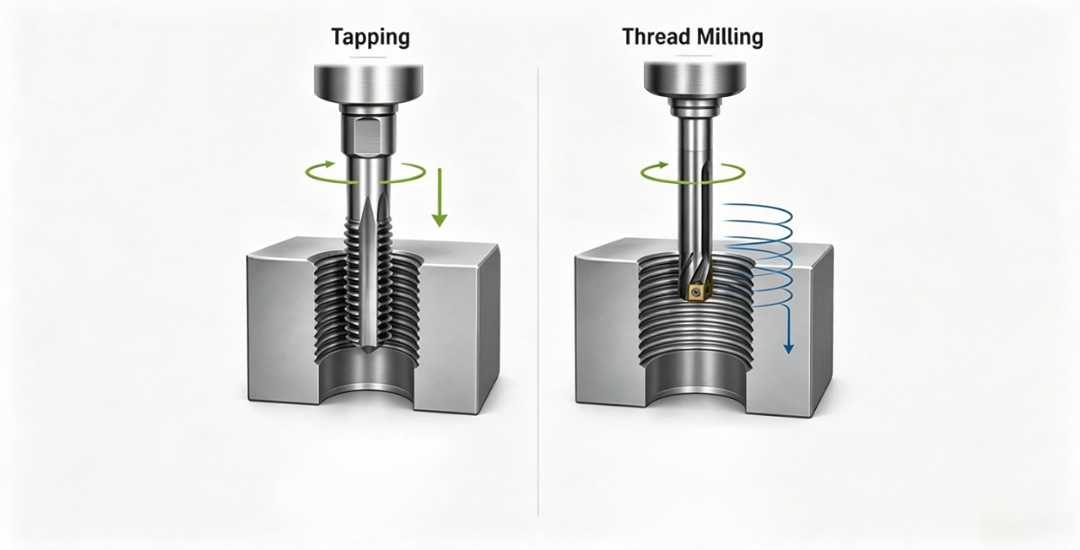
Tapping and thread milling can produce the same finished thread geometry, but they create it in different ways. That difference affects how the tool engages the material, how chips are controlled, and how much of the thread geometry is determined by the tool itself.
How Cutting Taps Work
A cutting tap enters a pre-drilled hole axially while its rotation and feed follow the thread pitch. The cutting edges progressively remove material until the full thread profile is formed.
The tap geometry largely determines the thread form, pitch, and cutting behavior. Chip flow also depends on the type of tap being used. Spiral-point taps are commonly used for through holes because they direct chips forward, while spiral-flute taps are often selected for blind holes because they carry chips back toward the hole entrance.
Unless otherwise noted, the tapping comparisons in this article refer to conventional cutting taps rather than form taps.
How Thread Milling Works
Thread milling uses a cutter smaller than the finished thread diameter. The tool follows a helical path, combining circular interpolation with axial movement to generate the thread progressively.
Unlike tapping, the finished pitch diameter can be adjusted through the programmed toolpath and cutter compensation. Tool flexibility depends on the thread mill design: single-form cutters can cover a wider range of pitches and thread diameters, while multi-form cutters use several cutting profiles simultaneously and are generally tied more closely to a specific pitch or thread form.
2. Thread Milling vs Tapping: Key Differences
The different cutting mechanics of tapping and thread milling affect how each process handles cutting load, chips, blind holes, thread adjustment, and production time.
Cutting Load and Tool-Breakage Risk
Tapping forms the thread while the tool is fully engaged with the hole, which generally creates higher spindle torque than thread milling. If a tap breaks inside the part, removing it can be difficult, particularly when the thread is machined late in the production sequence.
Thread milling uses intermittent cutter engagement and typically requires less spindle torque. Because the cutter is smaller than the finished thread diameter, a broken thread mill is often easier to remove without damaging the surrounding feature.
Chip Control
Chip evacuation during tapping depends on the tap design and hole geometry. Spiral-point taps commonly direct chips forward through a through hole, while spiral-flute taps are designed to carry chips back toward the entrance of a blind hole.
Thread milling produces shorter interrupted chips as the cutter follows the helical path. Chip control is often easier to manage, although thread depth, material, coolant delivery, and available space still affect evacuation.
Blind-Hole Threading
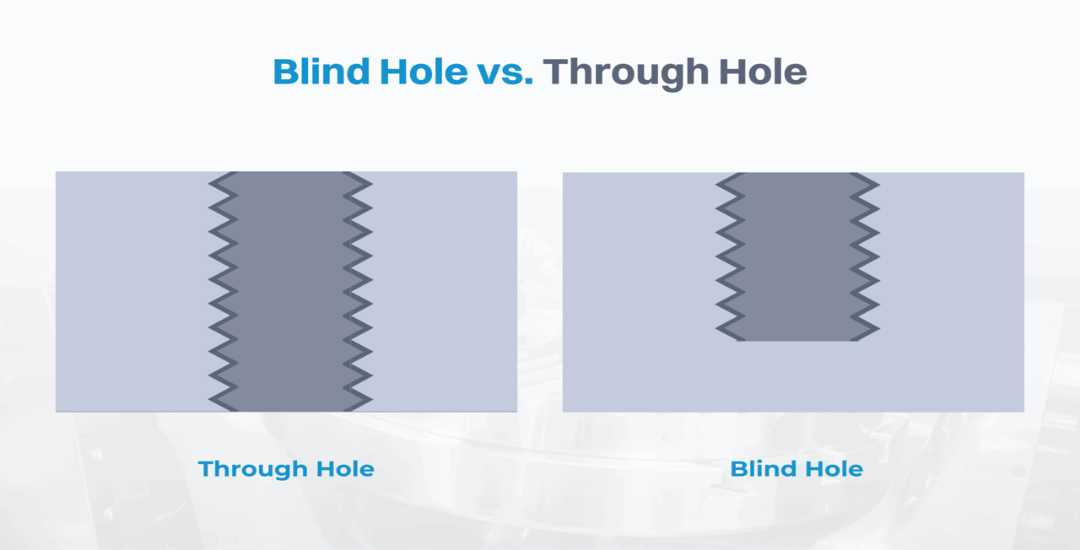
Blind holes require enough depth for the specified full thread as well as clearance for the threading process.
With tapping, the chamfered lead section of the tap does not produce a complete thread profile, so the drilled hole normally extends beyond the required full-thread depth. Chip management also becomes more important as available bottom space decreases.
Thread milling can produce the full thread form closer to the bottom because it does not rely on the same tap lead geometry. Clearance is still required for safe cutter movement, so thread depth and hole depth must be considered together.
Pitch-Diameter Adjustment
The finished size of a tapped thread is largely influenced by the tap geometry, tap tolerance, wear, runout, and machining conditions. There is limited opportunity to correct pitch diameter through CNC offset alone.
With thread milling, pitch diameter can be adjusted through radial cutter compensation. This makes it easier to compensate for tool wear or fine-tune thread fit without changing the programmed pitch.
Cycle Time
Tapping is generally faster for repetitive standard threads because the thread is produced during a direct axial cycle.
Thread milling requires a helical toolpath and usually involves more cutter travel per hole. The actual cycle-time difference depends on thread diameter, depth, cutter type, and the number of threaded features on the part.
Tool Flexibility
A tap is normally dedicated to a specific thread size, pitch, and thread form.
Thread-mill flexibility depends on cutter design. Some multi-form cutters can machine several thread diameters that share the same compatible pitch, while single-form cutters can provide broader flexibility across different thread sizes and pitches within their operating range.
This can reduce the number of dedicated threading tools required when several thread specifications are produced on the same equipment.
Machine Requirements
Tapping can be performed with suitable tapping cycles or rigid tapping capability, depending on the machine and tooling system.
Thread milling requires CNC control capable of helical interpolation, combining circular motion with axial movement to generate the thread path. This capability should be confirmed before thread milling is selected as the production method.
3. When Tapping Makes More Sense
Tapping is often the more efficient choice when the thread geometry is standard, the selected tap matches the hole condition, and the process can run repeatedly with stable results.
Standard and Repetitive Threads
Tapping is well suited to standard thread sizes that appear repeatedly across the same part or production run. The direct axial cutting cycle is simple and usually provides a short machining time when a suitable tap is available.
Suitable Hole Geometry
Through holes are generally straightforward when the tap geometry provides effective chip evacuation. Blind holes can also be tapped reliably when the tap type, required full-thread depth, and bottom clearance are properly matched.
The presence of a blind hole alone is therefore not a reason to avoid tapping.
Stable Tapping Setup
Tapping becomes particularly practical when the machine supports rigid or controlled tapping and the material, hole preparation, coolant strategy, and tap geometry form a stable process.
In these conditions, tapping can provide an efficient production method without the additional helical toolpath required for thread milling.
4. When Thread Milling Makes More Sense
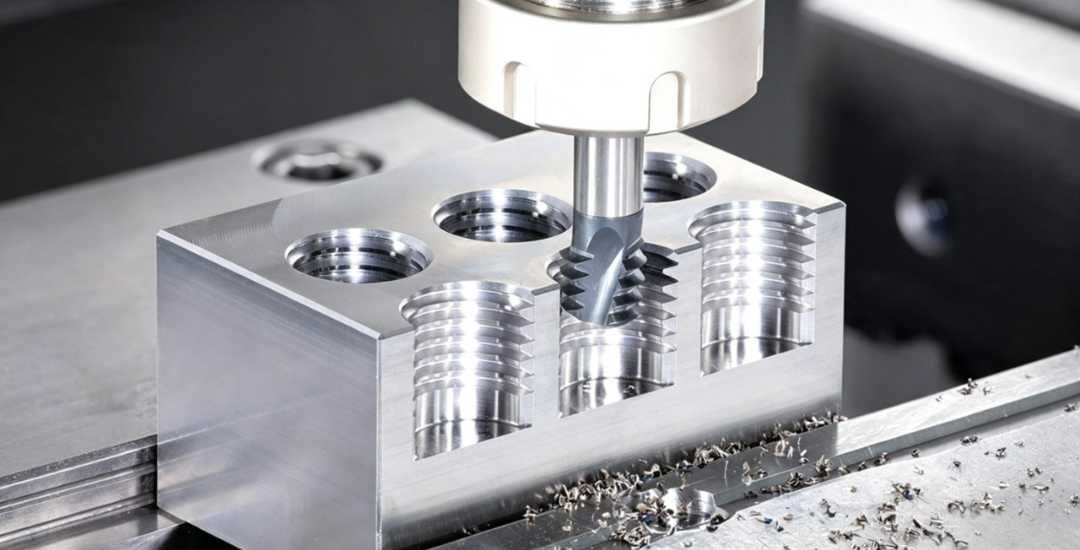
Thread milling becomes especially useful when thread geometry, material, machine torque, or tool-breakage risk makes tapping less flexible or less robust.
Difficult-to-Machine Materials
Thread milling can be a strong option for titanium alloys, nickel-based alloys, high-strength stainless steels, and other difficult materials because the cutter engages only part of the thread profile at a time.
This can reduce cutting load compared with tapping, although tool wear, heat generation, and suitable cutting conditions still need to be managed carefully.
Large-Diameter Internal Threads
As thread diameter increases, tapping can require substantial spindle torque because the tap cuts the full thread profile simultaneously.
Thread milling reduces this torque demand by removing material through smaller intermittent engagements. This can make it more practical when the required thread is large relative to the machine’s available torque.
Blind Holes with Limited Bottom Clearance
When a full thread is required close to the bottom of a blind hole, the lead section of a tap can limit the usable thread depth.
Thread milling can generate a complete thread profile closer to the bottom of the hole. Clearance is still required for the cutter path, so the required full-thread depth and drilled-hole depth should be reviewed together.f
High-Value and Thin-Wall Parts
Thread milling can reduce the consequence of tool failure on expensive components because the cutter is smaller than the finished thread diameter and is often easier to remove if it breaks.
Lower torque can also help when threading near thin or lightly supported sections, but thread milling still generates radial cutting forces. Wall stiffness, workholding, and cutter engagement therefore remain important.
Mixed or Customized Thread Requirements
Thread milling can reduce tool changes when several compatible thread diameters or special thread requirements are produced on the same machine.
The amount of flexibility depends on the cutter design. Multi-form cutters are generally more closely tied to a specific pitch or thread form, while single-form cutters can provide broader flexibility across different thread sizes and pitches within their operating range.
5. DFM Considerations for Threaded Features
Thread design affects more than the final thread size. Hole depth, bottom clearance, wall thickness, tolerance class, and unnecessary process restrictions can all influence how reliably the feature can be machined.
Specify the Thread Requirement, Not an Unnecessary Process
Where possible, the drawing should define the required thread size, pitch, tolerance class, depth, and applicable standard rather than prescribing how the thread must be produced.
Calling out a “tapped hole” can unnecessarily restrict the manufacturing method if thread milling would also satisfy the finished-part requirement. The process should only be locked when tapping itself is functionally or contractually required.
Distinguish Thread Depth from Hole Depth
For blind holes, the required full-thread depth and the drilled-hole depth are not the same.
Tapping needs additional space for the tap lead and chip control, while thread milling also requires clearance for safe cutter movement. These allowances should be considered before the final hole depth is defined.
Allow Adequate Bottom Clearance
Insufficient bottom clearance can make blind-hole threading difficult regardless of the process.
For tapping, limited space can interfere with the tap lead and chip evacuation. For thread milling, the cutter still needs enough clearance to complete the helical path without contacting the bottom of the hole.
There is no single bottom-clearance value that applies to every thread, so the required allowance should be reviewed against the tool and thread depth.
Avoid Unnecessary Thread Tolerances
A tighter thread tolerance reduces the acceptable process window and may require more frequent compensation, tool replacement, and inspection.
If the thread only provides general fastening, specifying a tighter fit than the assembly requires can add manufacturing control without improving part function.
Check Wall Thickness and Nearby Geometry
Threads positioned close to thin walls, pockets, edges, or lightly supported sections may cause local deformation during machining.
Both tapping and thread milling generate cutting forces, so wall stiffness, feature location, workholding, and remaining material should be reviewed rather than assuming one threading method automatically eliminates distortion risk.
Do Not Lock the Pre-Hole Size Without a Functional Reason
The optimum pre-hole can differ between cutting taps, form taps, and thread milling. For this reason, the drawing does not always need to prescribe a specific pre-drill diameter when the finished thread requirement already defines the functional feature.
A pre-hole or minor diameter should be dimensioned separately when it has its own functional requirement, not simply as a default manufacturing instruction.
Confirm Machine Capability for Thread Milling
Thread milling requires CNC control capable of helical interpolation, combining circular movement with simultaneous axial feed.
When thread milling is being considered, this capability should be confirmed before the manufacturing method is fixed.
6. How to Choose Between Thread Milling and Tapping
The better process depends on which requirement matters most for the specific thread. Geometry and machine capability determine what is feasible first; cycle time, tool flexibility, and process risk then help refine the choice.
| Decision Factor | Tapping Often Fits Better | Thread Milling Often Fits Better |
| Standard repetitive threads | Fast, direct threading cycle | Less advantage unless flexibility is needed |
| Blind holes near the bottom | Suitable when tap lead and clearance are available | More flexibility when full thread depth is close to the hole bottom |
| Pitch-diameter adjustment | Limited adjustment after tool selection | Can be adjusted through cutter compensation |
| Large thread diameters | May require higher spindle torque | Lower torque demand can make machining easier |
| Tool-breakage consequence | Broken taps can be difficult to remove | Broken cutters are often easier to recover |
| Multiple thread sizes | Separate taps are usually required | Some thread mills can cover several compatible sizes |
| Cycle time | Often shorter for repetitive standard threads | Longer helical toolpath is usually required |
| Machine capability | Requires suitable tapping capability | Requires helical interpolation |
| Process flexibility | Strong when the thread specification is stable | Useful for mixed, customized, or adjustable thread requirements |
No single factor should determine the process by itself. A standard thread in a stable repetitive setup may strongly favor tapping, while a blind hole, large diameter, high-value part, or adjustable thread fit may make thread milling more practical.
The final decision should be based on the finished thread requirement and the most reliable way to produce it, rather than treating either process as the default for every threaded feature.
מַסְקָנָה
Tapping and thread milling can both produce reliable internal threads, but they solve the machining task differently. Tapping is often the more efficient choice for standard repetitive threads, while thread milling becomes more valuable when pitch-diameter adjustment, lower torque, deeper blind-hole threading, or easier broken-tool recovery matters.
Neither advantage is universal. A fast tapping cycle has little value if the tap cannot produce the required full thread reliably, while thread milling adds unnecessary toolpath time when a stable tapping process already works well.
For custom CNC parts, Beska can review thread depth, tolerance, wall geometry, and process requirements during DFM before the threading method is finalized.
 Hebrew
 English
 Turkish
 French
 Russian
 German
 Spanish
 Portuguese