


A machinist finishes five parts. Each one measures within its tolerance. The inspection report shows all green. But when the assembly team puts them together, the shaft won’t go through the hole. Or the gap between two faces is twice what the drawing allows. The parts are good. The assembly is bad.
This is tolerance stacking. Each part’s individual tolerance is acceptable, but when they add up in the same direction, the total deviation exceeds the assembly requirement. The result: rework, scrap, delays, or field failures.
This article explains what tolerance stacking is, how it causes assembly problems, and how to prevent it. It covers two common analysis methods, real design examples, manufacturing risks, and the cost trade‑offs between tighter tolerances and higher quality.
1. What Is Tolerance Stacking
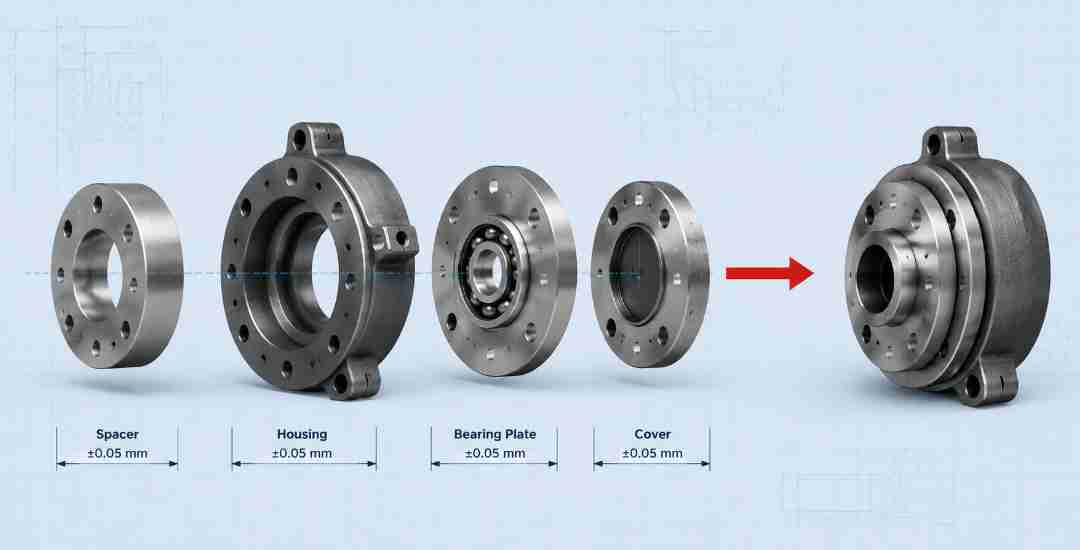
Tolerance stacking occurs when the dimensional variations of individual parts accumulate and affect the final assembly. This accumulation typically happens along a dimension chain, where multiple dimensions collectively determine the position, clearance, or alignment of a feature within an assembly. Each component may be manufactured within its specified tolerance, but the combined variation can still cause the assembly to exceed its functional requirements.
Engineers often refer to this phenomenon as tolerance stacking, tolerance stack-up, or tolerance accumulation. Regardless of the term used, the principle is the same: small dimensional deviations from multiple components combine and influence the final fit, alignment, or performance of an assembly.
Consider three blocks, each measuring 10 mm ± 0.1 mm. The drawing specifies a total length of 30 mm ± 0.15 mm. If all three blocks are produced at the lower limit of 9.9 mm, the final length becomes 29.7 mm. Although every block meets its individual specification, the assembly falls outside the allowable tolerance range.
This is the essence of tolerance stacking. Individual parts are acceptable on their own, but the accumulated variation can create problems once those parts are assembled together.
2. How Tolerance Stacking Creates Assembly Problems
Tolerance stacking becomes a problem when dimensional variation affects how components fit and function together. A single part that is within tolerance rarely causes concern. The risk appears when multiple parts contribute to the same assembly dimension.
For example, a housing, spacer, bearing, and retaining plate may all be manufactured within their specified tolerances. However, if the variation of each component accumulates in the same direction, the final assembly may no longer meet its design requirements.
This can create several common problems:
- Interference: Components that should slide or rotate freely become difficult to assemble or bind during operation.
- Excessive Clearance: Gaps become larger than intended, leading to vibration, noise, leakage, or reduced positioning accuracy.
- Functional Failure: The assembly may lose preload, fail to maintain alignment, or be unable to transmit loads as designed.
These issues often appear during assembly, even though every individual part has passed inspection. In production, the result can be rework, scrap, delayed shipments, or field failures. Identifying potential stack-up problems during the design stage is usually far less expensive than correcting them after parts have been manufactured.
3. How to Check for Tolerance Stacking Before Production
Once a potential tolerance stack has been identified, the next step is to determine whether it can affect assembly performance. Engineers typically evaluate this using one of two analysis methods.
Worst-Case Analysis
Worst-case analysis assumes that every dimension reaches its maximum or minimum limit at the same time. This approach provides the highest level of confidence but often requires tighter tolerances and higher manufacturing costs.
Statistical (RSS) Analysis
RSS (Root Sum Square) analysis assumes that dimensional variation is random and unlikely to accumulate in the same direction across every part. This method is less conservative and is often used in high-volume production where a small amount of risk is acceptable.
| אַספֶּקט | Worst-Case | Statistical (RSS) |
| Core Assumption | All parts at their extreme limits at the same time | Variations are random and tend to cancel out |
| תוֹצָאָה | Maximum possible variation | Probable variation |
| Risk Level | Lowest | Small risk remains |
| Cost Impact | גבוה יותר | לְהוֹרִיד |
| הטוב ביותר לשימוש עבור | Critical assemblies | ייצור בנפח גבוה |
Many engineers use worst-case analysis for critical features and RSS analysis for less critical dimensions to balance reliability and manufacturing cost.
4. Common Problems Caused by Tolerance Stacking
Tolerance stacking cannot be eliminated completely, but good design decisions can significantly reduce its impact. In most cases, the goal is not to make every dimension tighter. It is to prevent variation from accumulating critical assembly features.
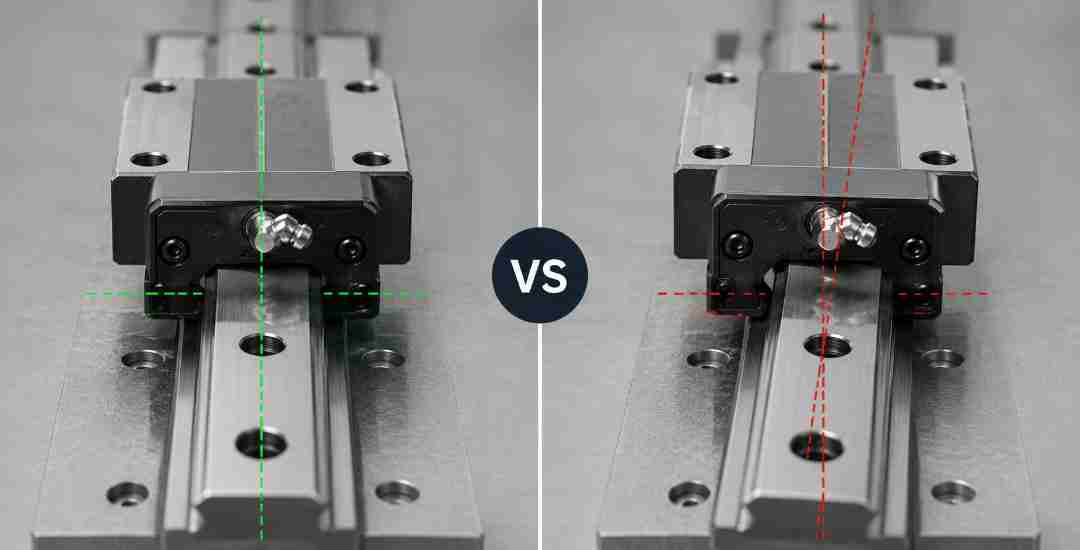
Use a Common Datum
One of the most effective ways to reduce tolerance stacking is to reference dimensions from a common datum. When multiple features are measured from the same surface or axis, dimensional variation is less likely to accumulate. In contrast, daisy-chained dimensions allow small deviations to build up across the assembly.
Tighten Only Critical Tolerances
Not every dimension affects assembly performance. Focus tighter tolerances on features that directly influence fit, alignment, or function, while leaving non-critical dimensions at standard machining tolerances. This approach improves assembly reliability without unnecessarily increasing manufacturing cost.
Reduce the Number of Parts
Every additional component introduces another source of variation. Where practical, combining multiple functions into a single part can simplify the dimension chain and reduce the risk of tolerance accumulation.
Use Self-Locating Features
Features such as pilot diameters, tapered fits, and locating bosses help guide components into position during assembly. Because alignment relies on geometry rather than extremely tight tolerances, these features can make assemblies less sensitive to dimensional variation.
Add Adjustment Features
Shims, threaded adjusters, and eccentric bushings allow variation to be compensated for during assembly. While they increase assembly complexity, they can be an effective solution when tight machining tolerances are impractical or too costly.
5. Manufacturing Factors That Affect Tolerance Stacking
Tolerance stacking is often discussed during the design stage, but manufacturing also plays an important role. Even a well-designed dimension chain can create assembly problems if parts are machined, located, measured, or assembled inconsistently.
The following manufacturing factors can influence how dimensional variation accumulates throughout an assembly.
| Manufacturing Factor | Effect on Stacking | Risk Reminder |
| Machining Sequence | Deviations may accumulate in the same direction | Ensure machining operations follow the intended datum structure |
| Fixture and Locating | Additional variation can be introduced during setup | Use consistent reference points for machining and assembly |
| Measurement Method | Inaccurate measurements can hide stack-up issues | Use inspection equipment appropriate for the required tolerance |
| Temperature Variation | Material expansion and contraction affect dimensions | Maintain consistent conditions during machining and inspection |
Even the best tolerance analysis cannot compensate for poor execution on the shop floor. Consistent machining, inspection, and assembly practices are essential to ensure that a dimension chain performs as intended.
6. Balancing Tolerance Control and Manufacturing Cost
When tolerance stacking becomes a concern, the first reaction is often to tighten every tolerance in the assembly. While this can reduce dimensional variation, it also increases machining time, inspection requirements, and overall manufacturing cost.
In most cases, tightening every dimension is unnecessary. A more effective approach is to identify the dimensions that directly affect assembly fit, alignment, or function and apply tighter controls only where they provide real value.
For example, a bearing seat, locating feature, or critical mounting interface may require tighter tolerances, while non-critical dimensions can remain at standard machining tolerances. This approach improves assembly performance without adding unnecessary cost throughout the entire design.
The goal is not to eliminate variation completely. The goal is to control variation where it matters most.
7. What Beska Has Learned About Tolerance Stacking
At Beska, tolerance stacking issues are most often discovered during prototype assembly rather than during machining. In many projects, every individual component passes inspection, but the assembly still requires adjustment because variation has accumulated across multiple parts.
This is particularly common in assemblies that contain brackets, spacers, bearing housings, locating features, or linear rail systems. As the number of components increases, so does the likelihood that dimensional variation will affect alignment, clearance, or positioning accuracy.
For this reason, our engineering team reviews critical dimension chains before production begins. In many cases, the issue is not the overall machining tolerance but one or two dimensions that have a disproportionate influence on assembly performance. Identifying those features early is often more effective than tightening tolerances across the entire assembly.
Whether the project involves aluminum, stainless steel, engineering plastics, or multi-part assemblies, considering tolerance stack-up during the design stage is usually far less expensive than addressing assembly problems after parts have been manufactured.
מַסְקָנָה
Tolerance stacking is one of the most overlooked problems in assembly. Every part can be in spec, and the assembly can still fail. The root cause is almost always the same: tolerances are specified without checking how they combine.
The fix is not to tighten everything. The fix is to check the stack during design, use the worst case for critical features, and tighten only what matters. Most stack problems can be caught with a simple spreadsheet before any metal is cut.
At Beska, we check every design for tolerance stacking before machining starts. Our engineering team reviews dimension chains, identifies assembly risks, and suggests practical fixes. צור איתנו קשר for a design review or a quote.
Deeper into Our Resources
לקריאה מעמיקה, אספנו עבורך רשימה של מאמרים מומלצים:
 Hebrew
 English
 Turkish
 French
 Russian
 German
 Spanish
 Portuguese