


A CAD model can confirm dimensions and assembly relationships, but it cannot fully show how a medical device will behave as a physical part. Fit, ergonomics, material response, surface condition, and mechanical performance often become clearer only after the first prototype is built and tested.
For medical device development, the prototype method should match what needs to be evaluated. An early concept model may only need to verify geometry or mechanism, while a functional prototype may require production-representative materials, tighter tolerances, or compatibility with the intended cleaning or sterilization process.
This article examines rapid prototyping for medical devices from a manufacturing perspective, including prototype stages, manufacturing methods, material selection, testing considerations, and the transition from prototype to production.
1. Prototype Levels: Concept, Functional, and Pre-Production
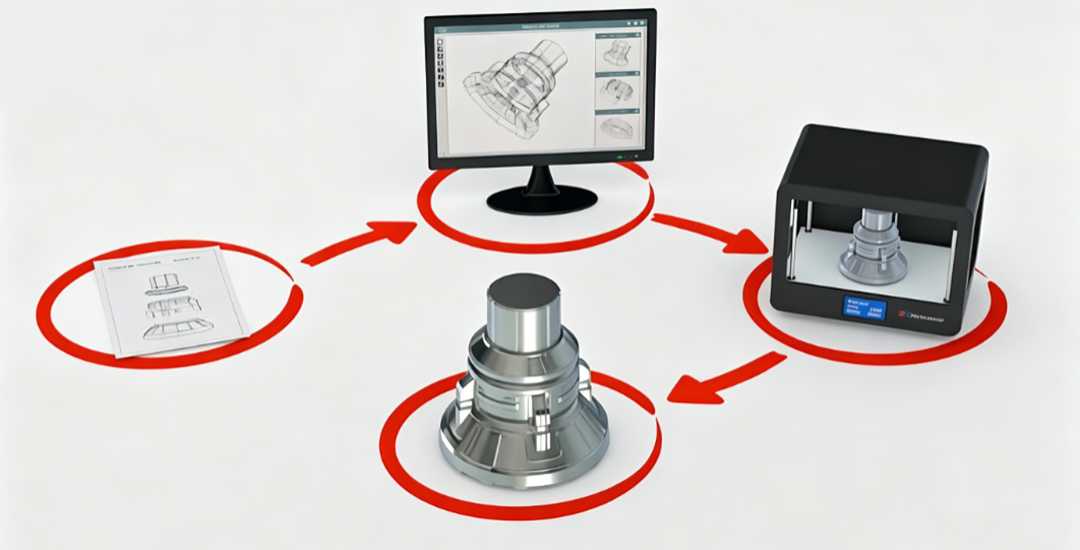
Medical device prototypes serve different purposes at different stages of development. An early prototype may only need to confirm geometry or mechanism, while later versions may need to evaluate material performance, tolerances, sterilization compatibility, or manufacturability. The prototype level should therefore match what needs to be tested.
Concept Proof Prototype
A concept proof prototype is used to verify whether the basic design works. At this stage, the design may still change, so speed and flexibility matter more than final material, surface finish, or tight tolerances.
SLA, FDM, SLS, machined materials, or off-the-shelf components can all be used depending on the design. The purpose is to identify basic problems with geometry, fit, movement, or mechanism before investing in more expensive prototypes.
Functional Prototype
A functional prototype is built to evaluate how the design performs under conditions closer to actual use. Geometry and tolerances become more important, and the material should reproduce the properties that matter for the test.
Depending on the device, testing may involve mechanical loads, repeated operation, ergonomics, cleaning, or sterilization. If material behavior is critical, the prototype should use the intended production material or a suitable equivalent.
Pre-Production Prototype
A pre-production prototype shifts the focus from design validation to manufacturing. By this stage, the design and material are largely finalized, and the prototype should represent the intended production process as closely as practical.
These parts are used to verify dimensions, assembly, process consistency, inspection requirements, and other production-related factors before larger-volume manufacturing begins. Usinagem CNC, injection molding, or other production-representative processes may be used depending on the final product.
The three levels answer different questions: concept prototypes verify the idea, functional prototypes evaluate the design, and pre-production prototypes help verify the manufacturing process.
2. Rapid Prototyping Technologies for Medical Devices
Once the prototype level is defined, the next step is selecting a manufacturing process. The main differences are material availability, dimensional accuracy, geometry, lead time, and how closely the prototype needs to represent the final device.
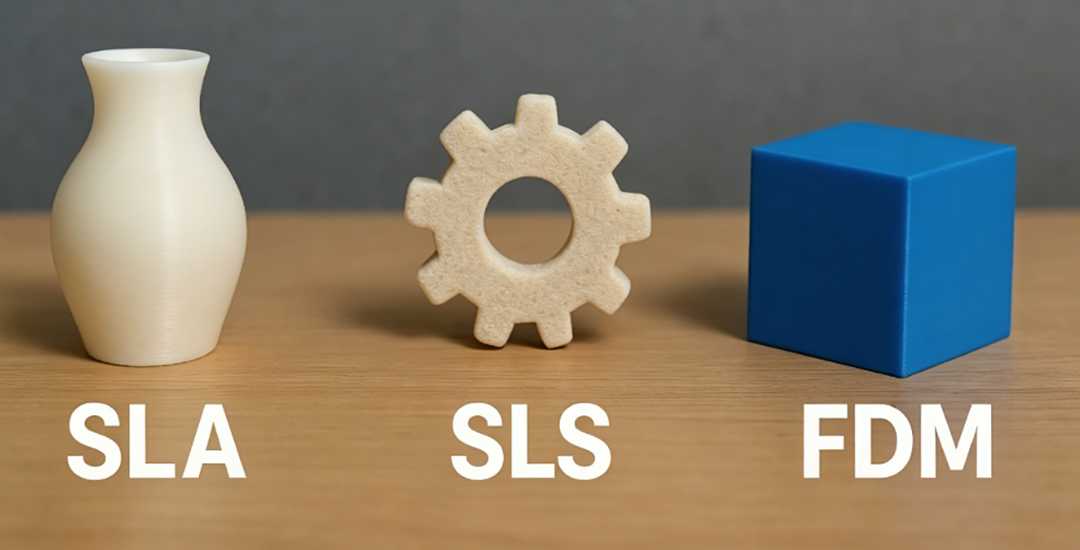
SLA (Estereolitografia)
SLA produces detailed resin parts with smooth surfaces and good dimensional accuracy. It is commonly used for concept models, fit checks, surgical guides, and prototypes where fine features or appearance are important.
Standard SLA resins are less suitable for demanding mechanical testing, although specialized tough, high-temperature, and biocompatible resins are available for specific applications.
SLS (Sinterização Seletiva a Laser)
SLS produces nylon parts without support structures, making it useful for complex geometries, internal features, and functional assemblies. PA12 is commonly used because it provides better toughness and durability than standard photopolymer resins.
The main limitation is surface texture. SLS parts have a relatively rough, powder-based finish and may require additional finishing or cleaning depending on the application.
FDM (Modelagem de Deposição Fundida)
FDM is a practical option for early concept models, large prototypes, fixtures, and basic form or assembly checks. It supports common thermoplastics such as ABS and PC and is generally economical for early design iterations.
Visible layer lines, lower dimensional accuracy, and anisotropic mechanical properties limit its use for precision or highly representative functional prototypes.
Usinagem CNC
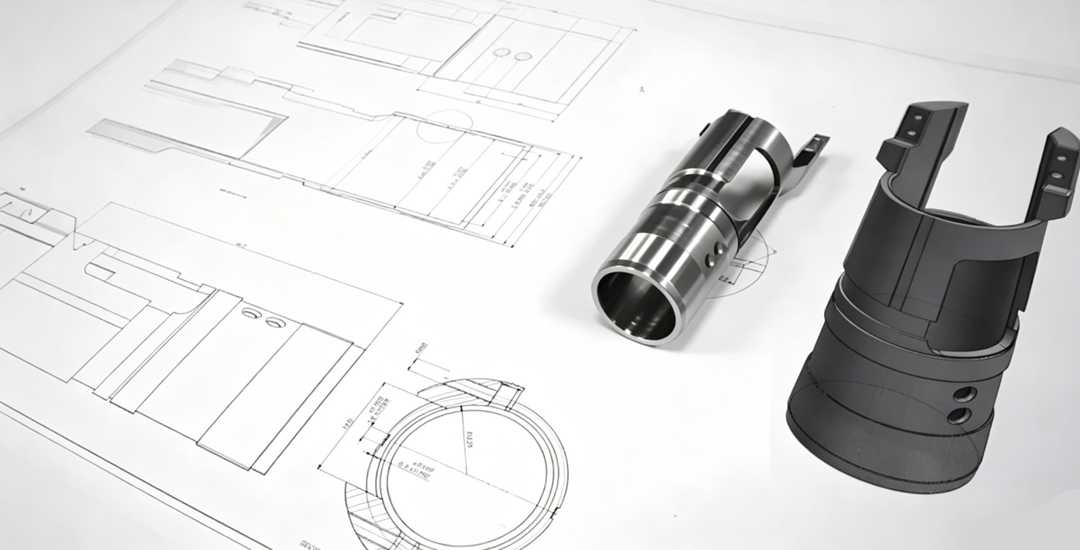
CNC machining is particularly useful when the prototype must be made from engineering materials close to or identical to those intended for production. Materials such as PEEK, PMMA, titanium, alumínio, and stainless steel can be machined directly from solid stock.
It also provides tighter dimensional control than most additive methods, making it suitable for functional prototypes, precision interfaces, and low-volume pre-production parts. Cost and machining time increase with part complexity, material difficulty, and tolerance requirements.
Silicone Molding / Vacuum Casting
Vacuum casting uses a master pattern to create a silicone mold, followed by casting polyurethane or similar resins. It is well suited to small batches of plastic prototypes that need more consistent appearance and material behavior than basic 3D-printed models.
It is useful when several functional or presentation prototypes are needed without investing in injection molding tooling, although the available materials do not fully reproduce every production thermoplastic.
Rapid Injection Molding
Rapid injection molding uses simplified tooling, often made from aluminum or soft steel, to produce low-volume injection-molded parts. It allows prototypes to be made from production-grade thermoplastics and provides a closer representation of the intended molding process.
The higher tooling cost and longer preparation time make it more suitable for later-stage validation and pre-production rather than early concept development.
3. Material Selection for Medical Prototypes
Material selection should follow the purpose of the prototype. Early concept models can often use standard prototyping materials, while functional testing may require materials that reproduce the mechanical, thermal, chemical, or optical properties of the intended device. As the design approaches production, material selection should increasingly reflect the final specification.
Common Materials by Prototype Stage
| Material | Common Prototype Stage | Typical Use |
| Standard SLA resin | Concept | Visual models, geometry and fit checks |
| PA12 (SLS) | Concept / Functional | Housings, clips, functional assemblies |
| PEEK (CNC) | Functional / Pre-production | High-strength, heat- and chemical-resistant components |
| PMMA (CNC) | Functional / Pre-production | Transparent housings and optical components |
| Medical-grade silicone | Functional / Pre-production | Seals, grips, flexible components |
| Titanium / Stainless Steel (CNC) | Functional / Pre-production | Surgical instruments and precision metal components |
These are typical applications rather than fixed rules. The material should be selected according to what the prototype is intended to verify.
Mechanical and Functional Requirements
A functional prototype does not always need the exact production material, but it should reproduce the properties relevant to the test. Stiffness, strength, wear resistance, transparency, chemical resistance, and temperature performance may all affect prototype results.
For example, a material suitable for checking geometry may not provide meaningful results for load or wear testing. The closer the test is to final device performance, the more important representative material properties become.
Sterilization Compatibility
If sterilization is part of the intended validation, material compatibility should be considered before the prototype is built. Steam sterilization typically operates at elevated temperatures, while ethylene oxide and radiation-based methods create different material constraints.
Photopolymers and thermoplastics can respond differently to heat, chemicals, or radiation, so the prototype material should be checked against the intended sterilization method before testing.
4. Manufacturing Considerations for Medical Device Prototypes
Building the part is only one stage of medical device prototyping. Tolerance control, post-processing, and cleanliness can all affect whether the prototype is suitable for assembly and functional testing.
Tolerance Control
Tolerance requirements should be based on the features that affect function and assembly. Mating surfaces, locating features, holes, sealing interfaces, and other critical dimensions may require tighter control, while non-critical features can often use the normal capability of the selected process.
Different prototyping methods also provide different levels of dimensional control. CNC machining is generally better suited to precision interfaces, while additive processes may be sufficient for geometry checks, housings, and assemblies with larger clearances. Specifying tolerances beyond the practical capability of the process can increase rework and cost without improving the prototype.
Pós-processamento
Post-processing varies significantly between prototyping methods. SLA parts require washing, support removal, and post-curing. SLS parts require removal of residual powder, particularly from holes and internal channels. FDM parts may require support removal and surface finishing, while CNC-machined components typically require deburring, edge finishing, and cleaning.
For complex prototypes, these operations can add significant time and cost to the overall build. Internal channels, fine features, and difficult-to-access surfaces should therefore be considered when selecting both the prototyping process and part geometry.
Cleanliness
Cleanliness requirements should match the intended use of the prototype. Residual SLS powder, uncured SLA resin, machining chips, or cutting fluids can interfere with assembly, inspection, or functional testing if they are not properly removed.
For later-stage prototypes, cleaning requirements may need to more closely represent the intended production process, particularly when cleanliness can affect testing or device performance. This should be defined as part of the prototype requirements rather than treated as an afterthought.
5. Testing and Validation Considerations for Medical Device Prototypes
Testing requirements become more important as a medical device prototype moves from concept evaluation toward functional and pre-production validation. What needs to be tested depends on the purpose of the prototype, the intended use of the device, and the risks being evaluated.
Mechanical Testing
Mechanical testing evaluates how the prototype behaves under the loads and operating conditions relevant to its function. Depending on the device, this may include repeated operation, torque, compression, impact, assembly cycles, or other mechanical loads.
Functional testing should reproduce the conditions relevant to the feature being evaluated. The results can reveal deformation, wear, loosening, fracture, or other failure modes that may not be apparent from the CAD model alone.
Sterilization Compatibility
Sterilization becomes relevant when the prototype is intended to evaluate material or dimensional performance after the sterilization process. Different methods, including steam, ethylene oxide, and radiation, can affect polymers, adhesives, coatings, and other materials differently.
When sterilization compatibility is part of the validation plan, the prototype material and geometry should be evaluated under conditions representative of the intended process. Changes in dimensions, appearance, mechanical properties, or function should then be assessed.
Biocompatibility Considerations
Biocompatibility requirements depend on the intended use of the device and the nature and duration of patient contact. Concept models and prototypes used only for dimensional or bench testing may not require the same material considerations as prototypes intended for contact-related evaluation.
Material certifications and supplier test data can support early material screening, but they should not be treated as evidence that the complete device meets applicable biocompatibility requirements. Later-stage prototypes should increasingly reflect the intended production materials and processes where these factors affect validation.
Documentation and Design Changes
Prototype iterations should have a defined purpose and a record of what was evaluated. Test results, identified failures, dimensional changes, material changes, and design revisions should be documented so that each iteration can be traced to the engineering decision it supports.
As the design approaches production, this documentation becomes increasingly important for formal design review, manufacturing planning, and applicable quality or regulatory requirements.
6. Choosing the Right Rapid Prototyping Method for Medical Devices
The appropriate prototyping method depends on what the prototype needs to verify. Geometry, material behavior, dimensional accuracy, surface condition, quantity, and the intended test should all be considered before selecting a process.
Selection Quick Reference
| Prototype Level | Primary Goal | Suitable Processes | Key Selection Factor |
| Concept Proof | Geometry, fit, basic mechanism | SLA, FDM, SLS | Speed and design flexibility |
| Funcional | Mechanical or functional performance | SLS, CNC, Vacuum Casting | Representative material and required accuracy |
| Pre-Production | Manufacturing and assembly validation | CNC, Rapid Injection Molding | Production-representative material and process |
These are typical starting points rather than fixed process rules. The appropriate method depends on part geometry, material requirements, tolerance, quantity, and validation objectives.
What Should Drive the Process Choice?
For early prototypes, speed and design flexibility usually matter most. SLA, FDM, or SLS can be appropriate when the main purpose is to evaluate geometry, fit, or basic mechanisms without investing in tooling.
As testing moves toward functional performance, material behavior and dimensional accuracy become more important. CNC machining is often preferred when the prototype requires production-grade metals or engineering plastics, while SLS or vacuum casting may be suitable when geometry, quantity, or plastic-part behavior is more important.
For pre-production parts, the process should represent the intended production conditions as closely as required by the validation plan. CNC machining may remain appropriate for machined components, while rapid injection molding can provide production-representative molded parts before full-scale tooling.
Not every project follows the same sequence. The process should be selected according to the question each prototype needs to answer rather than following a fixed prototyping route.
Conclusão
A medical device prototype should answer a specific question at a specific stage of development. That question determines the required manufacturing process, material, dimensional accuracy, and level of testing. A prototype built for geometry and fit does not need the same material or process as one intended for functional or pre-production validation.
The most effective approach is to define what needs to be verified before selecting the prototyping method. As the design moves closer to production, the material, manufacturing process, tolerances, and testing conditions should increasingly represent the final device.
At Beska, we support medical device prototyping with precision CNC machining, sheet metal fabrication, surface finishing, and mechanical assembly, from early functional parts to low-volume pre-production builds. If you have a prototype ready for manufacturing, send us your drawings and requirements for a manufacturability review and quotation.
 Portuguese
 English
 Hebrew
 Turkish
 French
 Russian
 German
 Spanish