


Plastics are used in countless applications, from structural components to precision parts, yet one factor often dictates their performance and processability: their melting point. Selecting a plastic without considering its melting temperature can lead to warping, dimensional inaccuracies, or even complete material failure during processing.
This article examines the melting points of common plastics, explores how these temperatures influence different manufacturing processes, and provides practical guidance for choosing and handling materials to maintain quality and reliability.
1. Basics of Plastics and Melting Point

Plastics are generally categorized into thermoplastics and thermosets. Thermoplastics can soften or melt when heated and solidify again upon cooling, allowing them to be reshaped multiple times. In contrast, thermosets undergo a chemical curing process that forms permanent cross-links, which prevents them from melting once set.
The melting point (Tm) indicates the temperature at which a thermoplastic transitions from a solid to a liquid state. For thermosets, which lack a distinct melting point, the glass transition temperature (Tg) or decomposition temperature is used to assess heat resistance.
These thermal characteristics are critical because exceeding the material’s Tm or Tg can cause structural deformation, dimensional changes, or chemical breakdown. Accurate knowledge of these temperatures ensures that plastics maintain their mechanical properties and stability under heat exposure.
2. Key Factors That Affect the Melting Point of Plastics
The melting point of a plastic is influenced by several intrinsic and extrinsic factors, which determine its thermal behavior during processing and in service.
Polymer Structure
The degree of crystallinity significantly affects the melting point. Highly crystalline polymers, such as polyethylene or polyoxymethylene, have well-ordered molecular regions that require higher energy to disrupt, whereas amorphous plastics like polystyrene soften gradually without a distinct melting point. Chain length and branching also influence intermolecular forces, altering the temperature at which the material transitions to a fluid state.
Additives and Fillers.
Reinforcements, plasticizers, pigments, and stabilizers can shift melting behavior. For example, glass fiber or carbon fiber fillers can raise the heat resistance, while certain plasticizers reduce the effective melting point and improve processability. These modifications also affect viscosity and flow during molding or extrusion.
Molecular Weight.
Polymers with higher molecular weight typically exhibit stronger van der Waals forces between chains, resulting in higher melting temperatures. Variations in molecular weight distribution within a batch can cause slight differences in thermal behavior.
Impurities and Copolymers
Blends and copolymers display multiple softening or melting points depending on the proportion and compatibility of components. Minor impurities can create nucleation sites that influence crystallization and thermal stability.
Processing History
Cooling rates, prior thermal exposure, and annealing treatments affect the size and perfection of crystalline regions, which in turn modify the observed melting temperature. Rapid cooling can result in smaller or imperfect crystals, lowering the effective melting point, while controlled thermal treatments can increase thermal stability.
These factors collectively determine the melting characteristics of a plastic. Accurate knowledge of them is essential when specifying materials for high-temperature applications or when precise dimensional and mechanical stability is required during processing.
3. Melting Points of Common Thermoplastics
Different thermoplastics exhibit a wide range of melting points, which directly influences their thermal performance and suitability for specific applications. The table below presents typical thermoplastics along with their melting point, glass transition temperature (Tg), and additional material properties for reference:
| Plástico | Type | Melting Point / Tg (°C) | Heat Deflection Temperature (HDT, °C) | Densidade (g/cm³) | Aplicações típicas |
| abdômen | Termoplástico | 210 | 100 | 1.04 | Enclosures, consumer products, automotive parts |
| PLA | Termoplástico | 180 | 60 | 1.25 | 3D printing, prototypes, packaging |
| Nylon 6 | Termoplástico | 220 | 180 | 1.14 | Gears, bearings, mechanical components |
| ESPIADA | Termoplástico | 343 | 250 | 1.3 | Aerospace, medical implants, high-performance parts |
| BICHO DE ESTIMAÇÃO | Termoplástico | 250 | 70 | 1.38 | Bottles, mechanical components, electrical insulation |
| PC | Termoplástico | 267 | 138 | 1.2 | Optical components, safety helmets, electronics |
These values provide more than simple references; they allow engineers and designers to assess how plastics will respond under thermal stress, estimate dimensional stability, and compare potential candidates for high-temperature or structural applications. For example, high-performance plastics like PEEK offer superior thermal stability and mechanical strength, while lower-melting-point materials like PLA are suitable for applications where moderate heat resistance is sufficient.
4. Thermosets and Glass Transition Temperature (Tg)
Thermosets differ fundamentally from thermoplastics because they cannot be remelted once cured. During curing, chemical reactions form permanent cross-links, creating a rigid and stable structure. Common thermosets include epoxy, phenolic, and polyurethane resins, often used in applications requiring high strength or heat resistance.
Two thermal properties are critical for understanding thermoset behavior:
- Glass Transition Temperature (Tg): the temperature at which a material transitions from a rigid, glassy state to a softer, rubbery state. Tg indicates the point above which the material may lose dimensional stability.
- Decomposition Temperature: the temperature at which chemical bonds start breaking, marking the onset of thermal degradation.
Tg and decomposition temperature define the practical thermal limits of thermosets. Materials operating above Tg may experience softening or creep, while exceeding the decomposition temperature can lead to permanent chemical breakdown. These properties therefore provide clear guidance for selecting thermosets in applications where heat resistance and structural integrity are essential.
5. How Melting Point Affects CNC Machining
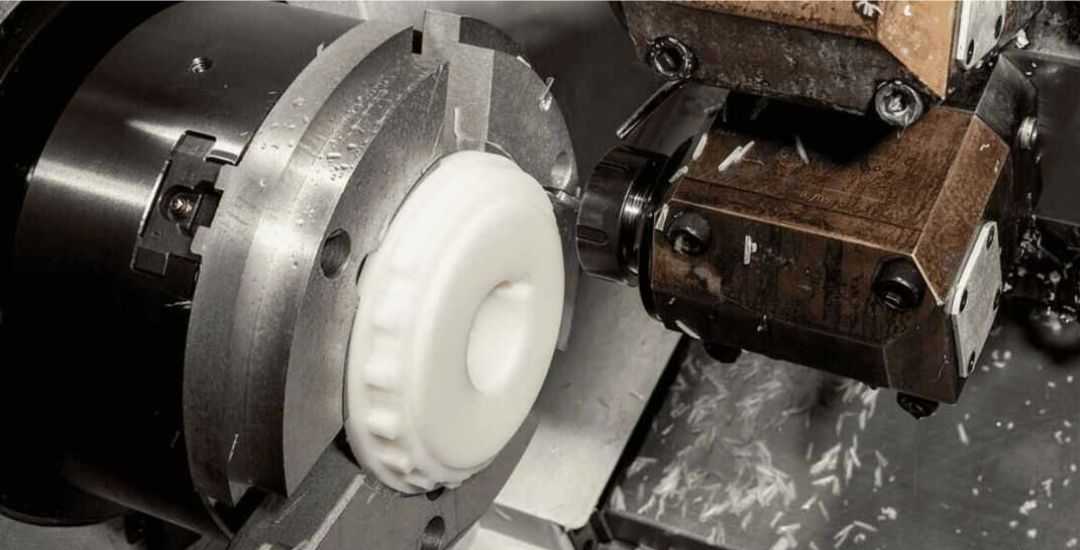
The thermal properties of a plastic, particularly its melting point, play a critical role in CNC machining. Unlike metals, plastics are sensitive to localized heat, which can build up rapidly during cutting, leading to deformation, surface melting, or dimensional changes.
High-melting-point plastics, such as PEEK or Nylon, can tolerate higher cutting temperatures without softening, allowing deeper cuts or faster feed rates. However, these materials are typically harder and more abrasive, which increases tool wear. Specialized cutting tools with coatings such as carbide or diamond-like carbon (DLC) are often necessary to maintain precision and prolong tool life.
Low-melting-point plastics, including PLA or polyethylene (PE), are prone to softening even under moderate heat. Friction from cutting can quickly raise the local temperature above the material’s melting point, causing smearing, burring, or warping. Shallow cuts, slower spindle speeds, and minimal feed pressure are generally required to prevent these issues.
Additional strategies to manage heat include:
- Sharp, properly coated tools reduce friction and cutting forces.
- Controlled spindle speed and feed rate: optimize the balance between cutting efficiency and heat generation.
- Cooling techniques: air blasts, compressed air, or liquid coolants can help dissipate heat from the cutting zone, especially for low-melting-point plastics.
Machining parameters aligned with a plastic’s melting point and mechanical properties help maintain dimensional accuracy and prevent surface defects.
6. How Melting Point Affects Injection Molding
In injection molding, a plastic’s melting point determines the temperatures required for both the melt and the mold, directly influencing part quality and dimensional stability.
- Insufficient melt temperature prevents the plastic from fully flowing into the mold, leading to incomplete filling, surface roughness, or weak spots in the part.
- Excessive melt temperature can degrade the polymer chains, causing discoloration, voids, or brittleness in the finished component.
Plastics with higher melting points, such as PEEK or nylon, require more energy to reach the proper melt temperature. Precise control is essential to avoid thermal degradation while achieving complete mold filling. In contrast, lower-melting-point plastics, like PLA or ABS, need careful cooling to prevent premature solidification inside the mold, which can lead to warping or sink marks.
Properly matching melt and mold temperatures to a material’s melting point ensures uniform flow, minimal internal stresses, and consistent surface quality. These considerations are particularly critical when producing parts with tight tolerances or complex geometries.
7. Melting Point and 3D Printing Applications
In FDM/FFF 3D printing, a plastic’s melting point defines the temperature range for proper extrusion. The nozzle temperature must be high enough to fully melt the filament but remain below its decomposition temperature to avoid material degradation.
- Low-melting-point plastics, such as PLA, require lower extrusion temperatures and are easier to print. However, they are more sensitive to ambient heat, which can cause warping, poor layer adhesion, or dimensional shrinkage if the build environment is not properly controlled.
- High-melting-point plastics, including PEEK and Ultem, offer superior mechanical strength and thermal resistance. Printing these materials demands specialized high-temperature printers, heated build chambers, and precise control of extrusion and bed temperatures to prevent uneven cooling and delamination.
Careful alignment of extrusion temperature with the plastic’s melting point ensures consistent filament flow, strong layer bonding, and stable mechanical properties in the finished part. Selecting the correct temperature range is therefore essential to achieve reliable 3D prints and maintain dimensional accuracy.
8. Material Selection Guide Based on Melting Point

Plastic selection depends on thermal requirements and application conditions. The melting point indicates heat resistance and dimensional stability:
- High-temperature applications: Plastics like PEEK (≈343 °C), PTFE (≈327 °C), PPS (≈285 °C) maintain strength and stability under heat, suitable for aerospace, automotive, or chemical-resistant parts. They also offer good creep resistance but require high-temperature processing equipment.
- General-purpose or cost-sensitive parts: Plastics such as ABS (≈210 °C), PLA (≈180 °C), and PE (≈120–135 °C) are easier to process and economical and are commonly used in consumer products, prototypes, and non-load-bearing components. They have limited thermal resistance and may warp or shrink if exposed to heat.
Considering mechanical properties, thermal stability, and processing compatibility alongside melting point helps prevent warping, incomplete filling, or thermal degradation, ensuring reliable and dimensionally stable parts.
9. Practical Processing Tips Related to Melting Point
Processing plastics effectively requires precise control of temperature and awareness of how each material responds to heat.
1. CNC Machining
Low-melting plastics such as PLA and PE soften quickly under friction, causing smearing or dimensional changes. Sharp-coated tools and directed air or liquid cooling prevent excessive heat buildup. High-melting plastics such as PEEK and nylon tolerate higher cutting temperatures but need slower feed rates to avoid localized overheating and tool wear.
2. Injection Molding
Melt temperature must slightly exceed the plastic’s melting point for complete mold filling while remaining below the decomposition temperature to avoid degradation, discoloration, or void formation. High-melting plastics require heated molds around 180 to 200 degrees Celsius, while low-melting plastics require lower mold temperatures, typically 60 to 80 degrees Celsius. Cooling rates affect warping, shrinkage, and residual stress, and even small geometry changes can impact the final part.
3. 3D Printing (FDM/FFF)
Extrusion temperature should match the filament’s melting behavior. Low-melting plastics print easily but can warp without heated beds or enclosures. High-performance filaments such as PEEK or Ultem require controlled ambient temperatures and gradual cooling to prevent layer separation and cracking.
The melting point determines flow, solidification, and thermal response of plastics. Aligning processing conditions with melting point, glass transition temperature, and decomposition temperature minimizes defects and ensures dimensional stability in the final part.
Conclusão
The melting point and glass transition temperature of plastics shape their behavior under heat, influencing mechanical stability, dimensional accuracy, and long-term performance. Selecting a material without considering these thermal properties can lead to deformation, reduced lifespan, or functional failure in demanding applications. Evaluating Tm and Tg alongside mechanical requirements and environmental conditions provides a more complete picture of material suitability.
For projects that demand precise results and reliable material performance, consulting an experienced supplier like the Beska team is crucial. A knowledgeable supplier can offer guidance on selecting the right plastic, anticipate thermal challenges, and ensure consistent quality throughout production.
Mergulhe mais fundo em nossos recursos
For some insightful reads, we’ve curated a list of recommended articles just for you:
 Portuguese
 English
 Hebrew
 Turkish
 French
 Russian
 German
 Spanish