


When a CNC machined part needs better wear resistance, improved hardness, or a decorative finish, PVD coating is often a practical choice. One of its biggest advantages is that it provides these benefits while adding only a very thin coating layer.
PVD is widely used on cutting tools, medical devices, consumer electronics, and decorative hardware. However, choosing PVD isn’t only about appearance. The coating can affect machining allowances, assembly fits, and surface preparation, all of which should be considered before production begins.
In this article, we’ll explain how PVD coating works, compare it with other coating methods, discuss its impact on machined part tolerances, and highlight the practical considerations engineers and buyers should understand before specifying it.
1. What Is PVD Coating


PVD (Physical Vapor Deposition) is a vacuum coating process that deposits an extremely thin, hard film onto a component by vaporizing a solid coating material and allowing it to condense on the part surface. Unlike thicker finishes such as electroplating or painting, PVD typically adds only 1–5 μm of coating, making it well suited for precision components where dimensional accuracy is important.
PVD is most commonly applied to metals such as stainless steel, titanium, aluminum, and tool steel, although some non-metallic materials can also be coated using specialized preparation methods. Its combination of high hardness, excellent wear resistance, and minimal dimensional change makes it a popular choice for cutting tools, medical devices, consumer electronics, and many precision-machined parts.
For engineers, one of PVD’s biggest advantages is that it improves surface performance without significantly altering part dimensions. This makes it particularly valuable for components with tight tolerances or closely fitting features, where thicker coatings could interfere with assembly or function.
2. How the PVD Process Works
Although several PVD technologies exist, they all follow the same basic principle inside a vacuum chamber. The coating material is converted into vapor, the vapor travels to the part surface, and it condenses into a thin, solid film. The main difference between PVD methods lies in how the coating material is vaporized, which affects coating quality, adhesion, and the applications each process is best suited for.
Sputtering
In sputtering, energetic ions strike a target made of the coating material, knocking atoms from its surface. These atoms then deposit onto the part to form a uniform coating. Sputtering provides good coverage on complex geometries and is widely used in semiconductor, optical, and decorative applications where surface consistency is important.
Cathodic Arc Deposition
Cathodic arc deposition uses an electric arc to vaporize the coating material, producing a highly energetic plasma. Compared with sputtering, it creates denser, harder coatings with stronger adhesion, making it the preferred choice for wear-resistant coatings such as TiN and TiAlN on cutting tools. The trade-off is that small droplets may form during deposition, which can slightly affect the appearance of decorative parts.
Thermal Evaporation
In thermal evaporation, the coating material is heated until it evaporates and then condenses onto the part surface. It is the simplest and most economical PVD method, but it produces coatings with lower density and adhesion than sputtering or cathodic arc deposition. It is commonly used for optical coatings and decorative finishes rather than heavy wear applications.
Although all three methods use vacuum deposition, each offers different advantages. The right process depends on the required coating performance, appearance, and application rather than the coating material alone.
3. PVD vs Other Coating Methods
PVD is only one of several surface treatment options available for machined parts. Comparing it with other common coating methods helps illustrate where it performs best and when another process may be a more suitable choice.
| Свойство | PVD | CVD | Гальваника | Твердое анодирование |
| Typical thickness | 1–5 μm | 5–50 μm | 5–50 μm | 25–50 μm |
| Processing temperature | Low (typically below 500°C) | High (700–1000°C) | Room temp to 60°C | Room temp |
| Dimensional impact | Minimal | Noticeable | Noticeable | Significant |
| Твёрдость | High (up to ~3000 HV for some films) | Высокий | Умеренный | High (~400–600 HV) |
| Environmental concern | Low (no chemical bath) | Moderate (chemical precursors) | High (heavy metal baths) | Низкий |
| Suitable substrates | Metals, some ceramics | Metals, ceramics | Металлы | Aluminum only |
For precision-machined parts, coating thickness and dimensional impact are often just as important as hardness. A thicker coating can affect part fit and may require machining allowances, while higher processing temperatures can limit the materials that can be coated. One of PVD’s biggest advantages is that it provides excellent wear resistance with minimal dimensional change, making it well suited for components with tight tolerances.
Despite its advantages, PVD isn’t always the most economical option. The equipment is expensive, batch capacity is limited by chamber size, and the process requires a clean, well-prepared substrate. For applications where appearance or high wear resistance is not a priority, electroplating or hard anodizing may provide a more cost-effective solution.
4. What PVD Does to Machined Part Dimensions
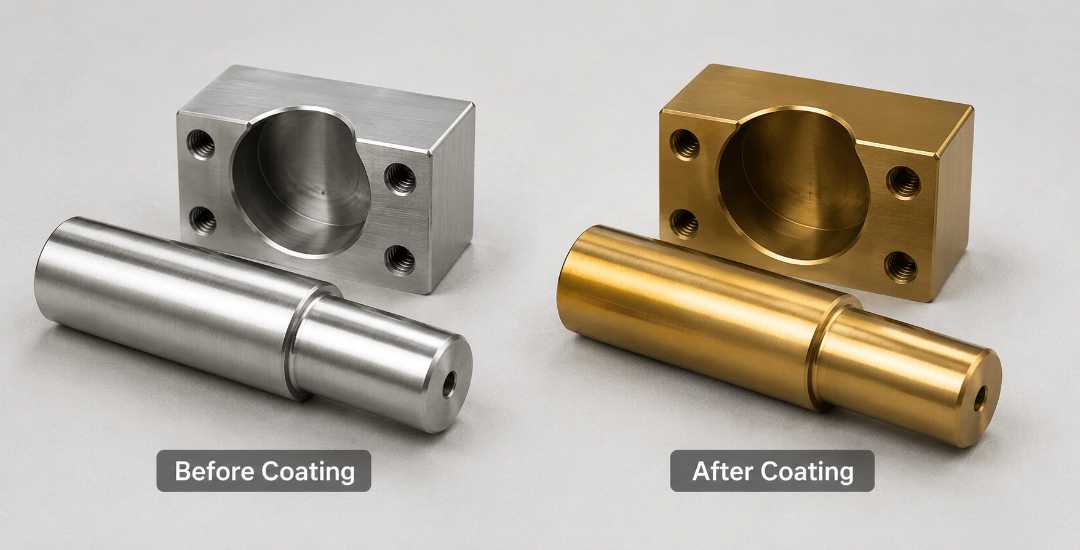
One aspect that’s often overlooked is how PVD coating affects part dimensions. Although the coating is only a few microns thick, it can still influence part fit and assembly if it isn’t considered during machining.
Coating Thickness and Fit
A PVD film adds its full thickness to every coated surface. On a shaft that fits into a bore, the OD grows and the bore shrinks, reducing the available clearance. On tight slip fits, coating both mating surfaces can significantly reduce the working clearance. For interference fits, the result may be a tighter fit than intended.
For tight-tolerance parts, coating thickness should be considered when defining pre-coating machining dimensions rather than after machining is complete.
Masking Strategy
Not every surface on a part needs to be coated. Threaded features, sealing surfaces, and assembly interfaces often need to stay uncoated. Masking these areas before PVD is common practice, but masks or plugs can shift during the coating process.
When masking fails, the result is usually functional rather than cosmetic. A coated thread may no longer assemble properly, or a coated sealing surface may no longer seal effectively. For critical features, it’s good practice to specify masking requirements on the drawing and confirm them with the coating supplier before production.
Watch out: Even a coating that’s only a few microns thick can affect tight-fit assemblies. For critical parts, always account for coating thickness and identify surfaces that should remain uncoated before machining begins.
5. Preparing Parts for PVD Coating
PVD only works well when the substrate surface is clean and properly finished. The vacuum chamber doesn’t forgive surface contamination.
Surface Cleanliness
Oil, cutting fluid residue, fingerprints, and dust all prevent the coating from bonding. Parts must go through a multi-step cleaning process, typically including ultrasonic degreasing, rinsing, and sometimes plasma cleaning inside the PVD chamber itself. Any contaminant left on the surface creates a localized adhesion failure that shows up as flaking or blistering after the part goes into service.
Surface Finish Requirements
PVD replicates the underlying surface texture. A polished part gets a polished coating. A matte part gets a matte coating. The film doesn’t fill scratches or smooth out roughness. If the surface finish before coating isn’t acceptable, the surface finish after coating won’t be either.
This is why engineers often specify a finer surface finish on PVD-coated parts than they would on uncoated ones. The coating amplifies surface defects rather than hiding them.
Handling and Packaging
Parts should be handled with clean gloves after final cleaning. Contact with bare skin leaves oils that the vacuum process won’t fully remove. Packaging should prevent parts from rubbing against each other, because surface damage before coating shows through the finished film.
Watch out: Parts sent to PVD with cutting fluid residue or fingerprints on critical surfaces will have adhesion failures. Cleaning must be verified before coating begins.
6. Common PVD Coating Materials and Colors
Different PVD coating materials are designed for different performance requirements. The table below compares some of the most widely used PVD films in machining and hardware applications.
| Покрытие | Typical Color | Key Property | Common Use |
| TiN (Titanium Nitride) | Gold | Hardness, moderate wear resistance | Cutting tools, decorative hardware |
| CrN (Chromium Nitride) | Silver-gray | Corrosion resistance, low friction | Medical instruments, food-contact parts |
| TiAlN (Titanium Aluminum Nitride) | Dark gray / purple | High-temperature stability, oxidation resistance | High-speed cutting tools, engine components |
| DLC (Diamond-Like Carbon) | Black | Very low friction, high hardness | Automotive sliding parts, watch cases |
| ZrN (Zirconium Nitride) | Light gold | Moderate hardness, decorative appeal | Consumer electronics housings |
Each coating is designed to solve a different engineering problem. TiN and TiAlN are commonly selected where wear resistance and hardness are the priority. CrN performs better in corrosive environments, while DLC is often chosen for applications that require low friction and excellent surface durability.
Although color is the most visible difference between these coatings, it should not be the primary factor when making a selection. The coating properties should always match the part’s working environment, performance requirements, and expected service life.
7. Applications: Real Parts That Use PVD
PVD is typically selected to improve specific surface properties rather than simply change a part’s appearance. Below are three common applications where it provides clear performance advantages.
Surgical Instrument Handles
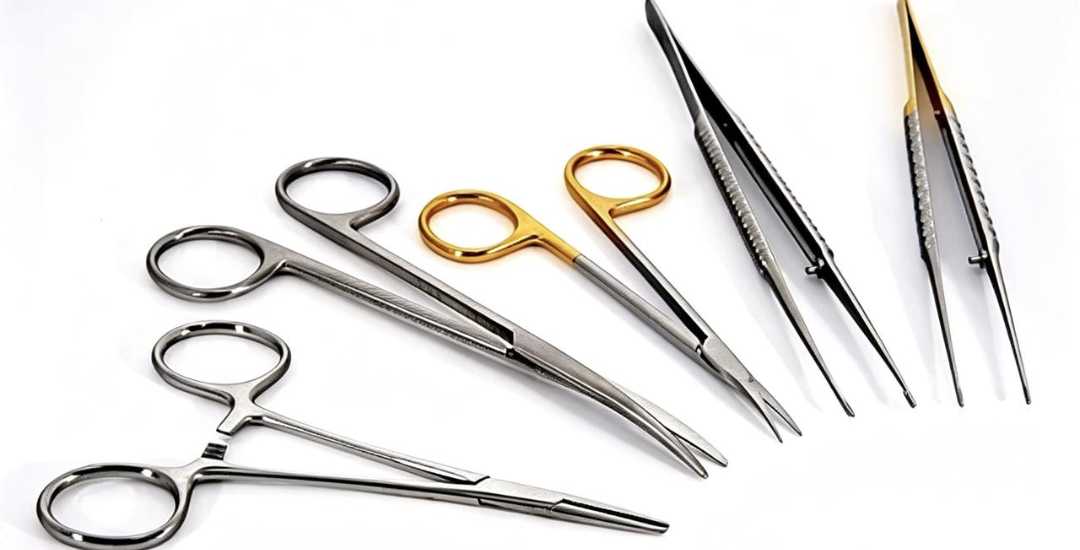
Medical-grade stainless steel instruments commonly receive CrN PVD coating because it improves corrosion resistance in saline and sterilization environments. One key consideration is the substrate surface finish. A rough surface can reduce coating adhesion and increase the risk of coating failure after repeated autoclave cycles.
CNC Cutting Tool Inserts
TiAlN is widely used on carbide and HSS cutting tools operating at high speeds and temperatures. The coating improves oxidation resistance and reduces tool wear. Another important consideration is edge preparation. Coating thickness affects cutting-edge geometry, so manufacturers account for it during tool design.
Consumer Electronics Enclosures
Aluminum and titanium housings for watches, phones, and laptops often receive TiN, ZrN, or DLC coatings to improve scratch resistance and appearance. One manufacturing challenge is maintaining consistent color between production batches, as small changes in process parameters can produce visible differences.
Although these applications are very different, they all rely on PVD to improve surface performance without significantly affecting part dimensions.
Заключение
PVD coating does more than improve the appearance of a machined part. When coating thickness, surface preparation, and masking are considered early, it can enhance wear resistance and durability without compromising part fit or function.
At Beska, we take coating requirements into account during DFM review and adjust machining dimensions before coating when needed. This helps ensure the finished part meets both functional and dimensional requirements. If your project includes PVD coating, we’re happy to discuss the most suitable machining and finishing approach before production begins.
 Russian
 English
 Hebrew
 Turkish
 French
 German
 Spanish
 Portuguese