


A production manager orders a batch of coated cutting tools. He sees two options with similar prices. One is labeled PVD, the other DLC. Both appear black. Both promise longer life. He picks the cheaper one and later finds out that the tools do not perform as expected. The coating choice was wrong, but the manager did not know why.
This confusion is common in the industry. Many engineers and procurement professionals treat PVD and DLC as two competing coating options. They are not. PVD is a deposition process. DLC is a type of coating material. In fact, DLC is often deposited using PVD equipment. The real question is not whether one is better than the other, but which coating best matches the application requirements.
This article explains the difference between PVD and DLC coatings, their respective advantages and limitations, and how to select the right coating for specific applications. It also covers common misconceptions and cost considerations for practical decision-making.
1. What Is PVD Coating?

PVD is a vacuum deposition process that produces thin, hard coatings on cutting tools and wear parts. The coating improves wear resistance, reduces friction, and protects the tool from heat. Common PVD coatings include TiN (gold), CrN (silver-gray), and AlTiN (dark/purple). Each type offers different properties for different applications.
The coating is not just decoration. It reduces friction, resists wear, and protects the tool from heat. Different coating materials provide different properties. TiN is the standard gold coating. AlTiN is dark and handles high temperatures. CrN is silver-gray and resists corrosion.
PVD works on many materials including carbide, high-speed steel, and some stainless steels. It is widely used for cutting tools, forming tools, and wear parts.
2. What Is DLC Coating?
In aluminum and copper machining, built-up edge is a common problem. The material sticks to the cutting edge, which degrades surface finish and reduces tool life. DLC coatings are often selected because their low friction and anti‑adhesion properties help reduce material sticking on the cutting edge.
This combination is unusual. Diamond gives hardness. Graphite gives lubrication. Most hard coatings are not slippery. Most slippery coatings are not hard. DLC has both.
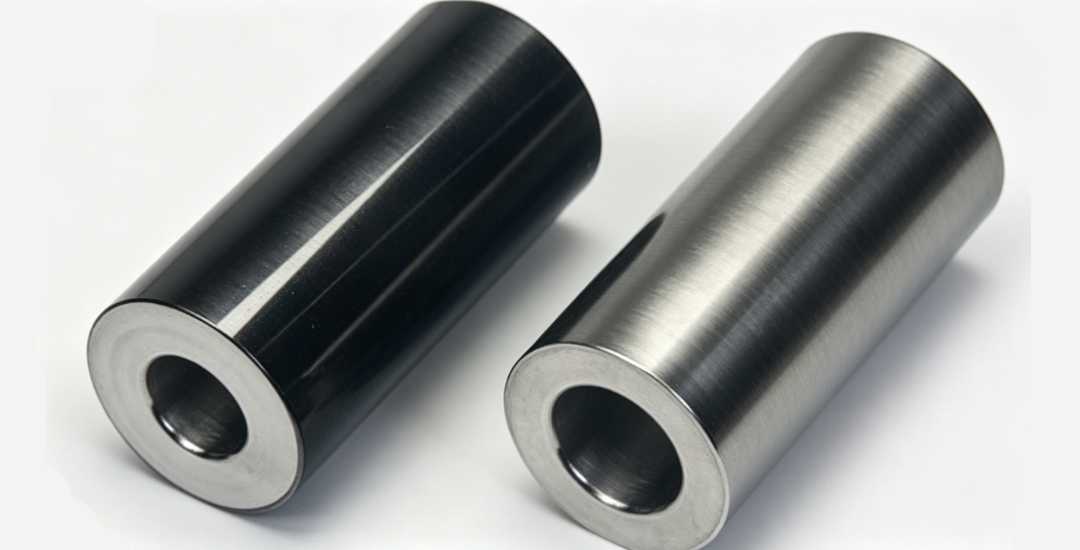
The coating is typically black or dark gray. It is applied in a vacuum chamber using PVD or CVD equipment. The thickness is usually one to four microns, thicker than most PVD coatings. DLC is used on cutting tools for aluminum and copper, on forming tools, and on precision components that need low friction.
3. Key Differences: PVD vs DLC
PVD is a process. DLC is a material. A PVD machine can deposit DLC. A DLC coating is often applied using PVD equipment. They are not competing technologies. PVD is the tool that makes many coatings, including DLC. The easiest way to understand the difference is to compare their purpose, performance, and typical applications side by side.
Фактор | PVD (TiN, CrN, AlTiN) | DLC |
|---|---|---|
What it is | A deposition process | A carbon-based coating material |
Common types | TiN (gold), CrN (silver-gray), AlTiN (dark) | Black or dark gray only |
Твёрдость | Varies widely by type (TiN ~2300 HV, AlTiN up to ~3200 HV) | Very high (~1000-3000+ HV) |
Friction coefficient | Varies by type; TiN ~0.5, AlTiN ~0.3–0.4 | Very low (0.04-0.15) |
Maximum service temperature | 400–800°C depending on type | often around 300–400°C depending on coating type |
Typical thickness | Less than 1 micron | 1–4 microns |
Typical cost per part | Ниже | Выше |
The biggest difference is temperature. PVD coatings like AlTiN withstand heat up to 800°C. DLC degrades above 400°C. In practice, temperature limits often decide the choice. If the tool runs dry, PVD is the safe bet. If it runs with coolant and low friction is the priority, DLC may be worth the extra cost. For a single tool, the difference may seem small. For a production run of a thousand tools, it changes the budget significantly.
Sources: Manufacturer technical data; published PVD and DLC coating specifications.
Note: Values shown are typical industry ranges. Actual hardness, coating thickness, friction coefficient, and service temperature vary depending on coating chemistry, deposition process, substrate material, and test method.
4. Advantages and Limitations of PVD and DLC Coatings

PVD and DLC coatings are designed to solve different engineering problems rather than compete with each other. The most suitable choice depends on operating temperature, friction requirements, wear conditions, and overall manufacturing cost.
PVD Coating: Strengths and Weaknesses
One of PVD’s biggest advantages is versatility. Different coating materials can be selected to balance wear resistance, heat resistance, corrosion resistance, and appearance for specific applications. This flexibility makes PVD suitable for cutting tools, forming tools, molds, medical components, and general wear parts.
PVD is often preferred when high operating temperatures or dry machining conditions are expected. Coatings such as AlTiN maintain their performance at elevated temperatures, making them well suited for high-speed machining. PVD coatings are also available in multiple colors, which can be useful for product identification or decorative applications.
The main limitation is friction. Although PVD coatings improve wear resistance, they generally cannot match the ultra-low friction and anti-adhesion performance of DLC. For applications dominated by sliding contact, PVD is not always the optimal solution.
DLC Coating: Strengths and Weaknesses
DLC is designed for applications where minimizing friction is the primary objective. Its extremely low coefficient of friction and excellent anti-adhesion properties make it particularly effective for sliding components, precision mechanisms, and machining aluminum or copper, where built-up edge is a common problem.
Despite its excellent low-friction performance, DLC also has practical limitations. Most DLC coatings begin to lose performance above approximately 400°C, making them unsuitable for many high-temperature machining operations. DLC coatings are also more expensive than standard PVD coatings because of their more specialized deposition process and tighter process control. In addition, DLC is typically available only in black or dark gray, and although it is extremely hard, it can crack or chip if the substrate deforms under heavy loading.
The additional cost of DLC is usually justified only when reducing friction or preventing material adhesion has a direct impact on component performance or tool life.
5. Selection Guide: Which Coating Is Right for Your Application
A coating that works well on one tool may fail on another. The same coating can be excellent for a milling cutter but useless for a sliding component. This is why general statements like “DLC is better” or “PVD is better” are misleading. The right choice depends on the application. Four factors determine which coating makes sense: temperature, friction, color, and cost.
In practice, the selection should follow a priority order. Temperature comes first. If the operating temperature exceeds 400°C, DLC is not an option. Friction and adhesion come next. If low friction is critical, DLC is the better choice. Substrate hardness and cost are the final considerations. This order helps eliminate unsuitable coatings early in the decision process.
Choose PVD When
Temperature is high. AlTiN PVD coatings withstand up to 800°C. DLC degrades above 400°C. For dry machining, high-speed cutting, and operations where heat is unavoidable, PVD is the safe choice.
Color matters. PVD offers gold, silver, blue, purple, and black. This is useful for decorative parts, brand identification, or tool color-coding. DLC is only black.
Cost is a constraint. PVD is less expensive than DLC. For standard wear protection without extreme friction requirements, PVD provides good value.
Choose DLC When
Friction must be low. DLC has a friction coefficient of 0.04 to 0.15. It is the standard choice for sliding components, bearings, and moving assemblies where energy loss and heat generation are concerns.
The part cuts aluminum or copper. DLC prevents material from sticking to the cutting edge. It eliminates built-up edge and improves surface finish.
The part runs against a mating surface. DLC reduces wear on both the coated part and its counterpart. This is important in pumps, valves, and precision mechanisms.
6. Common Misconceptions About PVD and DLC Coatings
PVD and DLC coatings are often misunderstood. Some claims come from marketing. Others come from confusion between similar-looking products. Here are five common misconceptions.
Myth: PVD and DLC Are Two Competing Coating Types
PVD is not a coating type. It is a deposition process. DLC is a coating material that is often deposited using PVD equipment. Comparing PVD and DLC as if they are competitors is like comparing a printing press to the ink it prints.
Myth: DLC Is Completely Scratch‑Proof
DLC is extremely hard and scratch‑resistant, but it is not unbreakable. If the substrate underneath bends or deforms, the DLC layer can crack or chip. The coating resists scratches, but it cannot prevent damage from impact or substrate deformation. This is why DLC is not recommended for heavy-impact applications. The coating itself is hard, but it will not stop the tool from breaking if the impact is severe enough.
Myth: Black PVD and DLC Are the Same Thing
Black PVD and DLC both look dark, but they are different. Some black PVD coatings are primarily decorative and may wear off over time. DLC is typically selected for functional wear and friction performance. The price difference usually reflects this performance gap. If a coating is cheap and looks black, it is probably not DLC.
Myth: DLC Is Always Better Than PVD
DLC is not better. It is different. PVD handles high temperatures. DLC does not. PVD offers color options. DLC does not. For a high‑speed milling operation generating significant heat, PVD is the better choice. For a sliding component with low friction requirements, DLC is the better choice.
Myth: Harder Coating Is Always Better
Hardness is one factor, not the only factor. A coating that is too hard may be brittle and crack under impact or flexing. Adhesion, thickness, and toughness also matter. A slightly softer coating with better adhesion can outperform a harder coating that flakes off.
Most coating selection mistakes come from confusing the deposition process with the coating material itself.
7. Cost Comparison: PVD vs DLC
A common question from procurement teams is simple: How much does this coating cost? The answer depends on several factors. Part size, batch quantity, and coating type all affect the final price.
Фактор стоимости | PVD | DLC |
|---|---|---|
Equipment investment | Умеренный | Выше |
Deposition time | Shorter | Longer |
Material cost | Ниже | Выше |
Process complexity | Ниже | Выше |
Coating cost per part | Ниже | Выше |
Batch size economy | Хороший | Умеренный |
PVD is less expensive and easier to scale. The process is mature, and many shops offer it. DLC costs more because it requires tighter process control, longer deposition times, and more expensive materials. DLC is usually more expensive than standard PVD coatings because of longer process time, tighter control requirements, and more specialized coating structures. Whether DLC justifies the additional cost depends on the performance benefit it provides in the specific application rather than coating price alone.
Sources: Manufacturer technical data; published PVD and DLC coating specifications.
Note: Values shown are typical industry ranges. Actual costs vary depending on part geometry, batch size, coating thickness, and service provider.
Заключение
Coating selection in engineering is rarely based on hardness alone. Operating temperature, friction requirements, substrate material, and manufacturing cost should all be considered together. A practical approach is to check temperature first. If the application exceeds 400°C, DLC is not an option. Then look at friction. If low friction is critical, DLC is the better choice. For everything else, PVD is often the more practical and cost‑effective solution.
If your project involves coated machining parts or wear‑resistant components, coating selection should be considered together with material choice, machining requirements, and operating conditions during the design stage. If you are evaluating coated CNC components for your application, our engineering team is happy to discuss practical manufacturing options.
Deeper into Our Resources
Для вашего содержательного чтения мы составили список рекомендуемых статей:
 Russian
 English
 Hebrew
 Turkish
 French
 German
 Spanish
 Portuguese