


Different nylon grades solve different engineering problems. PA6 offers good wear resistance and relatively low cost. PA66 provides higher strength and heat resistance, while PA11 and PA12 absorb less moisture and can offer better dimensional stability in changing environments. The right grade depends on which properties matter most for the part.
This guide compares PA6, PA66, PA11, PA12, стеклонаполненный нейлон, and other common nylon grades across moisture absorption, strength, temperature performance, chemical resistance, machinability, and cost. It also explains how these differences affect Обработка на станках с ЧПУ, molding, and material selection.
1. Types of Nylon at a Glance
The table below gives a quick overview of the main nylon grades covered in this article, highlighting their key advantages and the trade-offs that most often affect material selection.
| Nylon Type / Grade | Ключевое преимущество | Main Consideration |
| PA6 | Good wear resistance and relatively low cost | Higher moisture absorption can affect dimensional stability |
| PA66 | Higher strength and heat resistance | More expensive than PA6 and still moisture-sensitive |
| PA11 | Flexibility and good resistance to fuels and chemicals | Higher material cost |
| PA12 | Low moisture absorption and good dimensional stability | Lower strength and stiffness than PA66 |
| Glass-Filled PA66 | Higher stiffness for structural components | Glass fibers increase tool wear during machining |
2. Why Nylon Grade Selection Matters in Manufacturing
Nylon grades can behave very differently during machining, molding, and service. Differences in moisture absorption, stiffness, heat resistance, and reinforcement can affect dimensional stability, tooling, and the manufacturing process itself.
For example, PA6 absorbs more moisture than long-chain nylons such as PA11 and PA12. For parts with close fits or critical dimensions, changes in moisture content can therefore influence final size and dimensional stability. PA12 absorbs much less moisture, making it useful where humidity-related dimensional change is a concern, although its mechanical properties may not suit every highly loaded application.
Glass-filled nylons create a different manufacturing challenge. The added glass fibers increase stiffness but are also abrasive, which can accelerate cutting-tool wear and make machining more demanding than with unfilled nylon.
These differences mean that nylon selection should consider not only the required mechanical properties, but also tolerance requirements, service environment, manufacturing method, and production cost.
3. Key Performance Dimensions for Comparing Nylon Types
Several properties help distinguish one nylon grade from another. The most important things are moisture absorption, thermal performance, mechanical properties, and chemical resistance.
Moisture absorption is especially important for dimensionally sensitive parts. Absorbed moisture acts as a plasticizer, reducing stiffness and strength while increasing elongation. It can also change part dimensions. PA6 generally absorbs more moisture than PA66, while PA11 and PA12 absorb considerably less.
Thermal performance also varies by grade. Typical melting temperatures range from around 180°C for PA12 to 260°C for PA66, but melting point should not be treated as the allowable service temperature. Actual thermal capability depends on the grade, load, reinforcement, and material condition.
Mechanical properties influence whether a nylon is suitable for structural or flexible parts. PA66 generally offers higher strength and stiffness than PA6, while PA11 is known for greater flexibility and impact resistance.
Chemical resistance becomes important in contact with fuels, oils, solvents, or other media. PA11 and PA12 are often considered where resistance to fuels and hydrocarbons is a priority.
For tight-tolerance parts, moisture-related dimensional stability can become the deciding factor. In other applications, strength, temperature, or chemical exposure may carry more weight.
4. Common Nylon Grades Compared
PA6, PA66, PA11, and PA12 are among the most widely used engineering nylons, but each serves different design priorities. PA6 and PA66 are commonly used for general mechanical and structural parts, while PA11 and PA12 are often considered where lower moisture absorption, flexibility, chemical resistance, or dimensional stability is more important.
PA6 (Nylon 6)
PA6 is a widely used engineering nylon that offers a practical balance of wear resistance, toughness, processability, and cost. Its melting temperature is typically around 220°C, although actual temperature capability depends on the specific grade and operating conditions.
Its main consideration is moisture absorption. Changes in moisture content can affect stiffness and part dimensions, which is particularly important for close fits and precision components. PA6 is commonly used for gears, bushings, bearings, wear pads, electrical parts, and general mechanical components.
PA66 (Nylon 66)
PA66 generally provides higher strength, stiffness, and thermal capability than PA6. Its melting temperature is typically around 260°C, making it useful for structural and mechanical parts exposed to greater loads or higher temperatures.
PA66 still absorbs moisture, so dimensional change should be considered for tolerance-sensitive parts. Typical applications include gears, pulleys, brackets, fasteners, electrical connectors, housings, and automotive components. Compared with PA6, it generally offers greater mechanical performance at a higher material and processing cost.
PA11 (Nylon 11)
PA11 is a long-chain nylon valued for flexibility, impact resistance, relatively low moisture absorption, and resistance to fuels and oils. These characteristics make it useful for components exposed to repeated flexing, changing environments, or chemical contact.
Compared with PA6 and PA66, PA11 generally provides lower stiffness but better flexibility and moisture resistance. It is commonly used for fuel and pneumatic tubing, flexible connectors, clips, protective components, and other parts requiring toughness and repeated deformation.
PA12 (Nylon 12)
PA12 combines low moisture absorption, good chemical resistance, and good dimensional stability. Its melting temperature is typically around 180°C, lower than PA6 and PA66.
Because moisture has a smaller effect on its dimensions than on PA6 or PA66, PA12 is often considered for precision bushings, tubing, connectors, enclosures, and components used in changing humidity. Its strength and stiffness are generally lower than PA66, so dimensional stability must be balanced against structural requirements.
Стеклонаполненный нейлон
Glass fibers can be added to nylon grades such as PA6 and PA66 to increase stiffness, strength, creep resistance, and dimensional stability. Different reinforcement levels are commercially available, with glass-filled grades commonly used where unfilled nylon does not provide sufficient structural rigidity.
The main trade-off is manufacturing difficulty. Glass fibers are abrasive, which can increase cutting-tool wear and make surface-finish control more demanding during CNC machining. Higher reinforcement levels can also reduce ductility and impact performance.
Glass-filled nylons are commonly used for structural brackets, pump housings, automotive components, power-tool housings, gears, and other stiffness-critical parts.
PA6/12 Copolymer
PA6/12 is a copolymer that provides a balance between the characteristics of shorter-chain nylons and PA12. It generally offers lower moisture sensitivity than PA6 while maintaining useful strength, toughness, and processability.
This makes PA6/12 useful when neither maximum strength nor minimum moisture absorption is the only priority. Its exact performance depends strongly on the formulation, so supplier data should be checked when dimensional stability, chemical resistance, or thermal performance is critical.
5. Performance Comparison: PA6, PA66, PA11, PA12
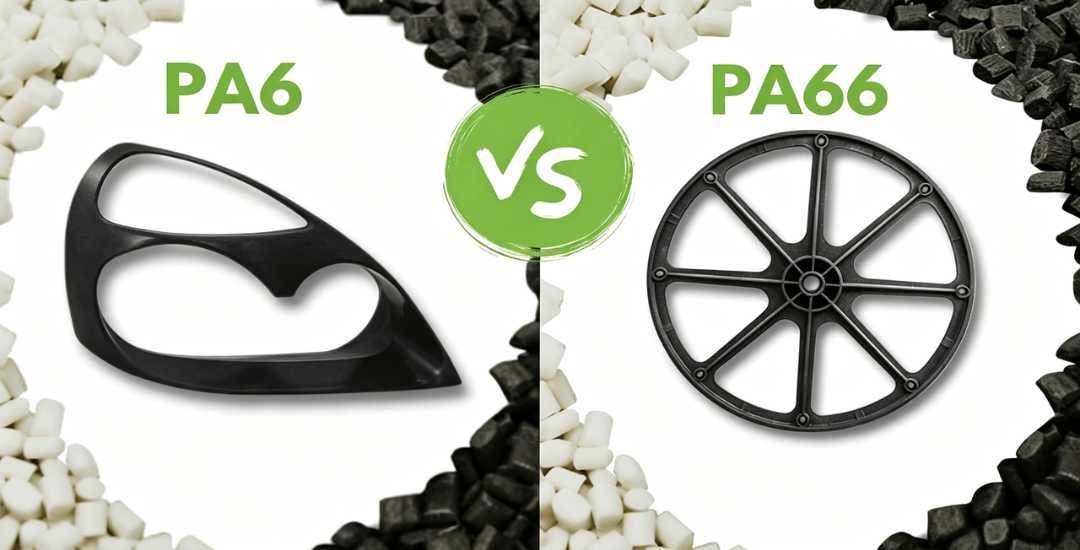
PA6, PA66, PA11, and PA12 differ most clearly in moisture sensitivity, strength, flexibility, thermal behavior, and dimensional stability. The melting temperatures shown here are approximate, while the other comparisons represent general performance trends. Actual properties vary with formulation, reinforcement, moisture condition, and supplier grade.
Свойство | PA6 | PA66 | PA11 | PA12 |
Melting point | ~220°C | ~260°C | ~185°C | ~180°C |
Moisture absorption | Самый высокий | Умеренный | Very low | Lowest |
Tensile strength | Умеренный | Самый высокий | Умеренный | Умеренный |
Impact resistance | Хороший | Умеренный | Отличный | Хороший |
Heat resistance | Умеренный | Best | Умеренный | Умеренный |
Стабильность размеров | Poor | Умеренный | Хороший | Best |
Relative cost | Lowest | Умеренный | Самый высокий | Высокий |
Обрабатываемость | Хороший | Очень хороший | Хороший | Отличный |
PA6 and PA66 are generally suited to conventional mechanical applications where strength, wear resistance, and cost are important. PA11 and PA12 become more attractive when flexibility, chemical resistance, or lower moisture sensitivity carry more weight.
For precision components exposed to changing humidity, dimensional stability can become a particularly important factor when comparing these nylon grades.
6. Typical Applications of Different Nylon Grades
The differences between nylon grades become clearer when they are applied to actual design requirements. Load, moisture exposure, chemical contact, flexibility, and dimensional stability can all shift the material choice.
Gears and Loaded Mechanical Parts: PA66
PA66 is commonly considered for gears and other mechanical components that require relatively high strength, stiffness, wear resistance, and thermal capability. Typical applications include automotive gears, pulleys, brackets, and other repeatedly loaded parts.
Compared with PA6, PA66 generally offers greater strength and heat resistance. Moisture absorption still needs to be considered, however, particularly when tooth geometry, bore size, or other critical dimensions must remain stable.
Fuel and Pneumatic Tubing: PA11 or PA12
PA11 and PA12 are widely associated with tubing and fluid-handling applications because they combine low moisture absorption, flexibility, and resistance to fuels and oils.
PA11 may be attractive where flexibility and repeated deformation are important, while PA12 offers very low moisture sensitivity and good dimensional stability. The final choice should be based on the required flexibility, chemical exposure, pressure, temperature, and applicable material specification.
Bearings and Wear Components: PA6
PA6 is commonly used for bushings, bearings, wear pads, and other sliding components because it offers useful wear resistance at relatively low material cost.
Its higher moisture absorption is the main design consideration. For close fits or dimensionally sensitive bearing components, the expected moisture condition should be considered when establishing clearances and inspection requirements.
Flexible Components: PA11
PA11 is useful for components that require flexibility, toughness, and resistance to repeated deformation. Examples include flexible connectors, clips, tubing, and other parts that must deform without behaving like a highly rigid structural component.
Compared with PA66, PA11 generally sacrifices stiffness in exchange for greater flexibility and lower moisture sensitivity. This makes it a different design option rather than simply a higher- or lower-performance nylon.
Precision Bushings and Dimensionally Sensitive Parts: PA12
PA12 is often considered for precision components exposed to changing humidity because its low moisture absorption helps reduce moisture-related dimensional change.
This can make PA12 attractive for bushings, connectors, enclosures, and other close-fitting parts where dimensional stability matters more than maximum stiffness. For heavily loaded components, its mechanical requirements should still be checked against alternatives such as PA66 or reinforced nylon.
7. Manufacturing and Machining Considerations
Nylon machining requires more attention to moisture condition, heat generation, chip control, and dimensional stability than many metals. These effects vary by nylon grade, part geometry, and material condition.
Moisture Control
Nylon absorbs moisture from the surrounding environment, and the amount varies significantly between grades. For close-fitting or tight-tolerance parts, changes in moisture content can affect both mechanical properties and final dimensions.
The material condition used for machining and inspection should therefore be defined consistently, particularly for moisture-sensitive grades such as PA6 and PA66.
Machining Behavior
Unfilled nylon can produce long or stringy chips during turning and milling. Sharp cutting tools, suitable chip evacuation, and controlled cutting conditions help reduce heat buildup and surface smearing.
Material condition also affects machining behavior. Moisture content, temperature, and internal stress can influence how the part responds during and after material removal.
Tolerances and Inspection
There is no single machining tolerance that applies to all nylon parts. Achievable tolerance depends on part size, geometry, nylon grade, moisture condition, machining strategy, and inspection environment.
For precision components, dimensional requirements should account not only for machining capability but also for possible dimensional change after the part reaches its service moisture condition.
Dimensional Stabilization
Some nylon parts may continue to change dimensions after machining as temperature and moisture conditions equalize. For tolerance-sensitive components, final inspection should be performed under a defined and repeatable material condition rather than immediately assuming the as-machined dimension represents the final service condition.
8. Nylon Material Selection Guide
Material selection becomes easier when the main design requirement is clear. The following grades are common starting points, but final selection should also consider the specific formulation, service environment, manufacturing process, and supplier data.
| Application Requirement | Commonly Considered Grade | Why It May Fit |
| High load and higher thermal requirements | PA66 | Relatively high strength, stiffness, and thermal capability |
| Cost-sensitive general-purpose parts | PA6 | Good balance of wear resistance, toughness, and cost |
| Humidity-sensitive or close-tolerance parts | PA12 | Very low moisture absorption and good dimensional stability |
| Flexible or repeatedly deforming parts | PA11 | Good flexibility, toughness, and impact resistance |
| Fuel or oil exposure | PA11 / PA12 | Good resistance to fuels and hydrocarbons |
| High stiffness requirements | Glass-filled PA66 | Increased stiffness and reduced creep compared with unfilled nylon |
| General molded components | PA6 | Good processability and relatively economical material cost |
These grades are starting points rather than fixed rules. Load, temperature, moisture exposure, chemical contact, tolerance requirements, and manufacturing method should be checked together before final material selection.
Заключение
No single nylon grade is the right choice for every application. The best fit comes from balancing strength, moisture sensitivity, dimensional stability, chemical resistance, temperature requirements, and manufacturability against the actual service conditions of the part.
PA6, PA66, PA11, PA12, and reinforced nylons each solve different engineering problems, so material selection should be considered together with part geometry, tolerances, and the production process. For CNC-machined nylon components, Beska can also support material review, machining, and tolerance evaluation based on the drawing and application requirements.
 Russian
 English
 Hebrew
 Turkish
 French
 German
 Spanish
 Portuguese