


Yield strength and tensile strength are two key values on a material data sheet, but they describe different limits.
Yield strength marks the onset of permanent deformation. Tensile strength is the maximum engineering stress reached in a tensile test. These values are used for different design checks and should not be treated as interchangeable.
This article explains yield strength vs. tensile strength, their main differences, and how they affect material selection, part design, and manufacturing.
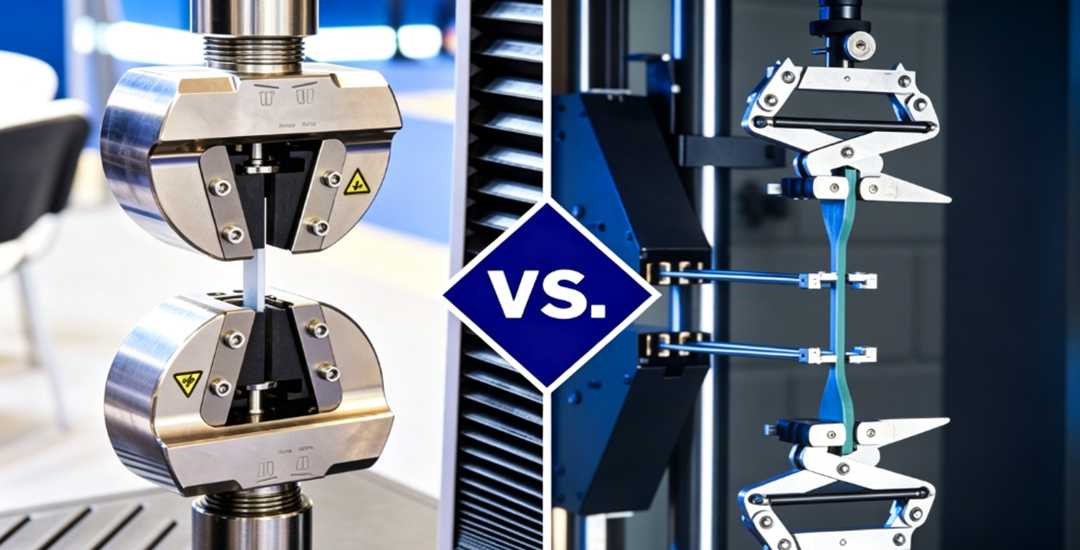
1. What Is Yield Strength?
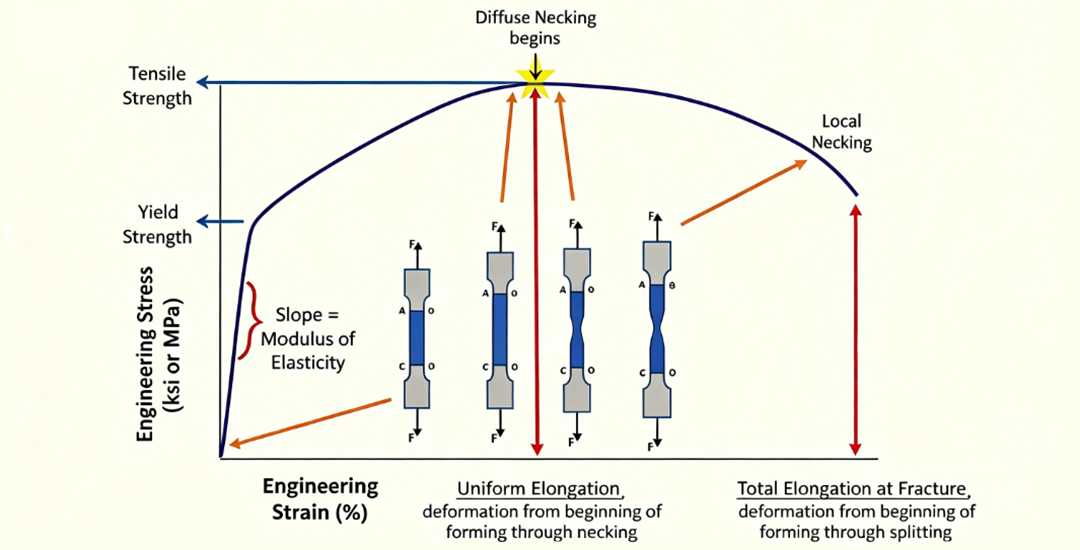
Yield strength is the stress at which a material begins to undergo permanent plastic deformation. Below this level, deformation is primarily elastic, so the material can return close to its original dimensions after the load is removed. Once yielding begins, some deformation remains after unloading.
Some steels show a distinct yield point on the stress-strain curve. Many materials, including aluminum alloys and many stainless steels, do not. For these materials, yield strength is commonly reported as the 0.2% offset yield strength, or 0.2% proof stress.
In design, yield strength is important when permanent deformation would affect the function, fit, or dimensional stability of a part.
2. What Is Tensile Strength?
Tensile strength, or ultimate tensile strength (UTS), is the maximum engineering stress reached during a tensile test. It corresponds to the highest point on the engineering stress-strain curve.
For many ductile metals, the material continues to deform plastically after yielding and may strengthen through strain hardening. Once the maximum engineering stress is reached, localized necking typically begins, and the specimen eventually fractures.
Tensile strength is commonly used to evaluate ultimate load capacity and resistance to tensile failure. Unlike yield strength, it does not indicate when permanent deformation starts.
3. Yield Strength vs Tensile Strength: Key Differences
Yield strength and tensile strength describe different stages of a material’s response to tensile loading.
| Фактор | Предел текучести | Предел прочности |
| Определение | Stress at which permanent plastic deformation begins | Maximum engineering stress reached during a tensile test |
| Position on stress-strain curve | Near the transition from elastic to plastic deformation | Highest point on the engineering stress-strain curve |
| What it indicates | Resistance to permanent deformation | Ultimate tensile load capacity |
| Typical design use | Checking whether a part will retain its shape and dimensions under load | Evaluating ultimate strength and tensile failure limits |
| After this point | Plastic deformation begins | Necking may begin in many ductile metals, followed eventually by fracture |
The main difference is that yield strength relates to the onset of permanent deformation, while tensile strength represents the maximum engineering stress reached before the load-carrying capacity begins to decrease.
4. How Engineers Use Yield and Tensile Strength
Yield strength and tensile strength are used for different design checks. Which value matters more depends on the material, loading condition, and expected failure mode.
Static Design of Ductile Parts
For many ductile metal parts under static loading, yield strength is an important design limit. If the applied stress exceeds the yield strength, the part can undergo permanent deformation even without fracturing.
This is important for components that must maintain their shape, alignment, preload, or dimensional accuracy during service.
Yield strength is not always the only design limit. Deflection, buckling, fatigue, contact stress, or requirements from an applicable design code may govern instead.
Ultimate Strength Checks
Tensile strength is used when evaluating the ultimate tensile capacity of a material or component.
It is particularly relevant when checking whether a part can withstand a severe or overload condition without tensile failure. In practical design, tensile strength may also be one of several material properties used in fastener, joint, or structural capacity calculations.
The exact calculation depends on the geometry, loading mode, material condition, and applicable standard.
Ductile vs. Brittle Material Behavior
Ductile materials can undergo significant plastic deformation before fracture. For these materials, yielding may occur well before the material reaches its ultimate tensile strength.
Brittle materials show much less plastic deformation before fracture and may not have a clearly defined yield region. For these materials, fracture behavior, tensile strength, and properties such as fracture toughness can become more important.
This difference is why yield strength and tensile strength should not be interpreted in isolation from the material’s overall mechanical behavior.
5. When Yield and Tensile Strength Are Not Enough
Yield strength and tensile strength describe important aspects of material strength, but they do not cover every failure mode. Other properties may control the design under cyclic loading, impact, high temperature, or stability-related conditions.
Fatigue
A part can fail under repeated loading even when the applied stress remains below its yield strength.
Fatigue behavior depends on factors such as stress range, number of cycles, surface condition, geometry, stress concentration, and material condition. Tensile strength may provide a rough reference for some materials, but it is not a substitute for fatigue data or testing.
Impact and Fracture
High yield or tensile strength does not necessarily mean a material will resist sudden impact or crack propagation.
Impact toughness, ductility, and fracture toughness become important when a component may experience shock loading, low temperatures, existing cracks, or other conditions that promote brittle fracture.
Elevated Temperature
Mechanical properties change with temperature. Yield strength and tensile strength measured at room temperature may not represent material behavior at the actual service temperature.
For elevated-temperature applications, designers should use temperature-specific material data and the requirements of the applicable design standard. Long-term exposure may also require creep or stress-rupture data.
Buckling and Stiffness
Some components fail or become unusable before reaching either yield strength or tensile strength.
Slender columns can buckle under compressive loads, while beams or thin sections may deflect beyond acceptable limits. These cases depend strongly on geometry, stiffness, boundary conditions, and elastic modulus rather than strength alone.
6. How Material Condition Changes Strength
Yield strength and tensile strength can vary even within the same material grade. Heat treatment, temperature, product form, and material condition all affect the values reported for a material.
Термическая обработка
Heat treatment changes the microstructure and mechanical properties of many metals.
Quenching, tempering, annealing, solution treatment, and aging can change yield strength, tensile strength, hardness, and ductility. For this reason, the alloy grade alone is not enough. The specified heat treatment or temper condition also matters.
Температура
Mechanical strength changes with temperature. At elevated temperatures, many metals lose yield and tensile strength. Long-term exposure can also introduce creep or stress-rupture concerns. At low temperatures, some materials can lose ductility and become more susceptible to brittle fracture.
Strength data should therefore match the expected service temperature rather than relying only on room-temperature values.
Material Specifications and Minimum Values
Material specifications may define minimum mechanical properties for a specific grade, product form, thickness, and condition.
Actual test results can vary between heats and suppliers while still meeting the same specification. When a minimum strength is required for design, specified minimum values are generally more useful than typical values.
The material data used for design should match the required grade, condition, product form, and specification.
7. Manufacturing Considerations
Yield strength and tensile strength also affect how a material behaves during manufacturing, but neither value alone determines how easy a material is to machine or form.
Обработка
Higher-strength materials often require greater cutting forces and can place more demand on cutting tools and machine rigidity. However, machinability also depends on hardness, ductility, work-hardening behavior, thermal conductivity, microstructure, and material condition.
Two materials with similar tensile strength can therefore behave very differently during machining.
Strength values are useful when reviewing material condition, but cutting parameters and tool selection should be based on the specific alloy and its actual condition.
Формирование
Yield strength has a more direct effect on forming force and springback. Materials with higher yield strength generally require more force to deform and may show greater elastic recovery after forming.
Formability, however, depends on more than strength alone. Elongation, strain-hardening behavior, thickness, bend radius, tooling, and the forming process all affect how much deformation a material can tolerate before cracking or losing dimensional accuracy.
For forming applications, yield and tensile strength should therefore be considered together with ductility and other forming-related properties.
Заключение
Yield strength marks the start of permanent deformation, while tensile strength represents the maximum engineering stress reached in a tensile test. They describe different limits and should not be used interchangeably.
For CNC parts, the material grade alone is not enough. Heat treatment, temper, and final material condition can change the actual strength of the part.
If you have a CNC project with specific material or mechanical-property requirements, send your drawings to Beska. Our engineering team can review the material, part geometry, and manufacturing requirements before production.
 Russian
 English
 Hebrew
 Turkish
 French
 German
 Spanish
 Portuguese