


Подшивание and seaming both involve folded sheet metal edges, but they are used for different purposes. Hemming folds an edge back on itself or around another panel, while seaming forms a joint by engaging or overlapping sheet edges.
The practical difference lies in what the formed edge needs to do: finish and reinforce an edge, retain another panel, or create a mechanical joint. This article explains how each process works, where each is commonly used, and which design factors affect forming quality.
1. Hemming vs Seaming: What Is the Real Difference?
Hemming and seaming both involve folding sheet metal edges, but the way the edge is formed and the role it performs are different.
In hemming, a flange or edge is folded back through a large angle. The fold may close against the same sheet to create a finished edge, or it may wrap around another panel to retain and join the two components. This is why hemming is used both for edge finishing and for assemblies such as automotive closure panels.
Seaming creates a joint by bringing two sheet edges together through overlapping, folding, or interlocking geometry. The seam itself becomes the connection between the panels and may also contribute to sealing, depending on the seam design and any additional sealing method used.
| Фактор | Подшивание | Закрытие швов |
| Primary function | Finish, reinforce, or close an edge; may also retain another panel | Form a joint between sheet metal edges |
| Edge geometry | Flange folded back onto itself or around another panel | Edges overlapped, folded, or interlocked together |
| Joining role | Can serve as an edge treatment or joining method | Primarily used as a joining method |
| Typical uses | Panel edges, enclosures, automotive closure panels | Ductwork, roofing panels, containers, sheet metal assemblies |
The key distinction is therefore not the number of parts involved, but how the folded edge functions in the final component.
2. How Hemming Works and Common Hem Types

Hemming is usually completed in more than one forming step. The edge is first bent to create a flange, then partially folded into a pre-hem shape before being closed to the required final geometry. The exact sequence depends on the hemming method, tooling, material, and part geometry.
On a press brake, this commonly involves an initial bend followed by a separate closing or flattening operation. Dedicated hemming dies and roller hemming systems use different forming sequences, but the same principle applies: the flange is formed progressively rather than forced directly into its final position in one step.
The final cross-section can take several forms depending on the function of the edge.
Closed Hem
A closed hem folds the flange tightly against the adjacent sheet surface, producing a compact double-layer edge. It is commonly used where a clean edge, local stiffness, or close layer contact is required.
Because the fold is highly compressed, material ductility, edge condition, bend radius, and tooling control become important to avoiding cracking or surface distortion.
Открытый подол
An open hem leaves a controlled gap between the folded flange and the base sheet. The larger internal space reduces the severity of the final closure and can provide more forming tolerance than a fully closed hem.
The amount of opening should be defined by the part requirement and the forming process rather than treated as a fixed dimension.
Каплевидный подол
A teardrop hem retains a rounded internal profile instead of flattening the fold completely. The larger radius reduces the severity of deformation at the folded edge and can be useful where a tight closed hem would place excessive strain on the material.
Веревочный подол
A rope hem forms the edge into a rounded or rolled profile. Compared with flat hems, it creates a more pronounced edge section and may be selected for edge protection, appearance, or local rigidity depending on the part design.
The appropriate hem type depends on the required edge geometry and how the material behaves during forming. Material condition, sheet thickness, bendability, tooling access, and the final function of the edge should be evaluated together before the hem profile is finalized.
3. How Seaming Works and Common Seam Types
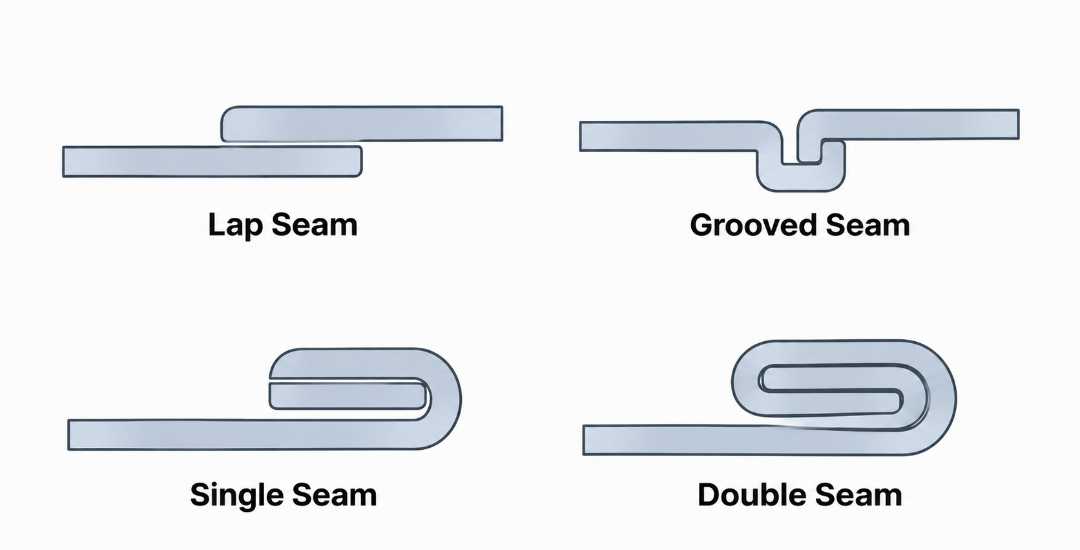
Seaming joins sheet metal edges by overlapping, folding, or interlocking them into a continuous joint. Depending on the seam design, the joint may rely mainly on formed geometry or may also use fasteners, sealant, adhesive, or another joining method.
The edges are typically prepared first by forming flanges or overlaps. These features are then brought together and closed into the required seam profile. Joint performance depends on the seam geometry, flange consistency, material thickness, forming accuracy, and any additional sealing or fastening method used.
Lap Seam
A lap seam places one sheet edge over another to create an overlapping joint. The overlap itself does not necessarily lock the sheets together, so additional fastening or sealing may be required depending on the application.
Its relatively simple geometry makes it useful where a straightforward sheet-to-sheet connection is needed without a more complex interlocking profile.
Grooved Seam
A grooved seam uses folded edges that engage with each other and are then closed to form a more positive mechanical joint.
The final seam geometry can provide greater resistance to separation than a simple overlap, while sealing performance depends on the profile, forming quality, and whether an additional sealant is used.
Single Seam
A single seam uses one primary folded engagement between the joined edges. It provides a compact joint and is commonly used where the connection does not require the more complex geometry of a double seam.
The exact profile can vary with the product and forming method, so the term should be interpreted together with the applicable drawing or process specification.
Double Seam
A double seam uses additional folding to create multiple layers of engagement between the joined components. This produces a more complex joint geometry and is widely used in metal containers and can closures where joint integrity and sealing must be tightly controlled.
In these applications, the finished seam depends not only on the folded metal geometry but also on accurate flange preparation, forming control, and, where required, sealing compound.
The appropriate seam type depends on how the joint must connect, retain, or seal the panels. Joint geometry should therefore be selected around the required function rather than by assuming that one seam type is universally stronger or more weather-resistant than another.
4. Material and Formability Considerations
Material behavior has a direct effect on hemming and seaming quality. Alloy or grade alone is not enough to predict formability; material condition, thickness, bendability, edge quality, rolling direction, and springback can all change how the edge behaves during forming.
Material Grade and Condition
Low-carbon steels generally provide good formability, while higher-strength steels and stainless steels can require greater forming force and closer control of springback.
For aluminium, alloy and temper are especially important. Some conditions tolerate severe edge folding better than others, while tighter folds or previously strained material can increase the risk of cracking or surface distortion. The bend direction relative to the rolling direction can also influence forming behavior.
Sheet Thickness and Bendability
Sheet thickness affects both the strain developed at the folded edge and the tooling needed to control the final geometry. Thicker material does not automatically rule out hemming or seaming, but it can increase forming force and limit how tightly the edge can be closed.
There is therefore no universal thickness limit. Feasibility depends on the material, hem or seam geometry, tooling, and forming method used.
Edge Condition and Previous Processing
The condition of the sheet edge can be just as important as the base material. Burrs, rough cut edges, local work hardening, or damage from previous operations can reduce the amount of deformation the edge can tolerate before cracking.
For seamed joints, variation in flange angle, edge position, or formed geometry can also affect how consistently the joint closes. These conditions should be reviewed before the hem or seam design is finalized.
5. Design Considerations for Hemmed and Seamed Parts
Hemming and seaming should be considered early in the sheet metal design rather than added after the surrounding geometry is fixed. Flange dimensions, bend geometry, nearby features, and tooling access all affect whether the edge can be formed consistently.
Flange Length and Bend Geometry
The flange must provide enough material for the forming sequence and for the final hem or seam geometry to develop properly. A flange that is too short may be difficult to control during pre-forming or closing, while an unnecessarily long flange can interfere with adjacent geometry or increase material use.
Bend radius also needs to match the material, thickness, and required edge profile. Tighter folds increase strain at the outside surface and can raise the risk of cracking, particularly in materials or conditions with limited bendability.
For this reason, flange length and bend radius should be confirmed against the selected tooling and material rather than taken from a fixed thickness multiplier.
Holes and Features Near the Edge
Holes, slots, cutouts, embosses, and other features placed close to a hem or seam can distort as the edge is formed. The risk depends on the feature location, forming direction, material, and amount of deformation.
Critical holes or locating features should therefore be reviewed together with the forming sequence. In some designs, moving the feature, changing the forming order, or adding the feature after hemming or seaming can improve dimensional control.
Tool Access and Edge Condition
The tooling must be able to reach and support the flange throughout the forming sequence. Nearby walls, returns, corners, or enclosed geometry can restrict punch, die, roller, or closing-tool access even when the hem or seam itself appears feasible.
Edge quality should also be checked before forming. Burrs, rough sheared edges, or local damage can increase crack initiation during severe folding and may affect how consistently two edges engage in a seam.
These details are best reviewed together with the actual material, thickness, hem or seam profile, and available tooling. At Beska, these checks are part of the sheet metal DFM review before production so that forming constraints can be identified before tooling and process planning are finalized.
6. Common Manufacturing Problems
Hemming and seaming defects usually develop when material behavior, edge geometry, and forming conditions are not working together as intended. The visible defect is often only the result; the root cause may involve several factors at the same time.
Common Hemming Problems
- Cracking can develop along the folded edge when the material cannot accommodate the required strain. Material condition, bend severity, edge quality, rolling direction, and the pre-hemming geometry can all influence crack formation.
- Roll-in and roll-out occur when the outer panel shifts relative to its intended final position during hemming. This can change the finished edge location and affect dimensional fit, particularly on curved or contoured panels. Flange geometry, pre-hem position, tooling path, and material flow all contribute to the final result.
- Springback can leave the hem partially open after the forming load is removed. Its severity depends on material strength, thickness, bend history, and how the final closing operation is controlled.
- Surface distortion may appear as waviness, local marking, or unevenness near the hem. These defects can result from uneven forming pressure, insufficient support, tooling contact, or material movement during closing.
Common Seaming Problems
- Seaming problems often begin with inconsistent edge or flange preparation. Differences in flange width, angle, alignment, or overlap can prevent the joint from closing uniformly and lead to variation along the seam.
- A poor interlock may occur when the formed edges do not engage as intended or when the closing operation does not fully develop the required seam geometry. This can reduce joint consistency and, where sealing is required, create potential leakage paths.
- Joint distortion or local opening can also develop when material thickness, springback, alignment, or forming pressure varies along the seam. In sealed assemblies, the seam profile, forming quality, and any sealing material must all be controlled together.
These defects are best evaluated as part of the complete forming system rather than by adjusting a single parameter. Material properties, flange geometry, tooling condition, process sequence, and dimensional consistency all influence the final hem or seam quality.
7. How to Choose Between Hemming and Seaming
The choice should be based first on what the finished edge or joint must do. Hemming is generally used when an edge needs to be finished, reinforced, or folded around another panel. Seaming is more appropriate when two sheet edges must form a continuous joint.
| Design Question | Подшивание | Закрытие швов |
| What must the edge do? | Finish, stiffen, or close an edge; may retain another panel | Connect two sheet edges into a joint |
| What geometry is required? | A flange that can be folded and closed | Compatible mating edges that can overlap or interlock |
| What material factors matter most? | Bendability, springback, edge condition, cracking risk | Flange consistency, springback, thickness, joint closure |
| Is sealing required? | Depends on the hem design and assembly | Seam profile and any sealant or sealing method must be considered |
| What limits the process? | Flange size, nearby features, forming access, tooling | Edge alignment, joint access, forming method, seam consistency |
| When does production volume matter? | Mainly when selecting between flexible and dedicated hemming tooling | Mainly when deciding whether dedicated or automated seaming is justified |
Material and tooling feasibility should be confirmed before cost becomes the deciding factor. A process may appear economical at a given production volume, but it is only suitable if the required edge or joint can be formed consistently with the selected material and geometry.
Заключение
Hemming and seaming both use folded sheet metal edges, but they solve different manufacturing problems. Hemming forms and closes a flange to finish an edge or retain another panel, while seaming creates a joint by overlapping or interlocking sheet edges.
The important distinction is the role of the formed edge: hemming controls the edge itself, while seaming is primarily about creating a joint between components.
For custom sheet metal parts, Beska can review hem and seam details during DFM before production, helping identify forming or tooling constraints early.
 Russian
 English
 Hebrew
 Turkish
 French
 German
 Spanish
 Portuguese