


PBT plastic is commonly used in electrical connectors, sensor housings, relay cases, and automotive under‑hood components. It is specified when a part needs to hold tight tolerances in humid environments, resist oils and solvents, and maintain electrical insulation over a wide temperature range.
In manufacturing, selecting the right plastic involves more than comparing data sheets. Processing behavior, moisture sensitivity, and production consistency often matter as much as mechanical properties in the final part. PBT offers a practical balance in all these areas, but it also has real limitations that engineers must understand before committing to production.
This guide explains the properties, processing characteristics, applications, and manufacturing risks of PBT plastic in practical shop‑floor terms.
1. What Is PBT Plastic?
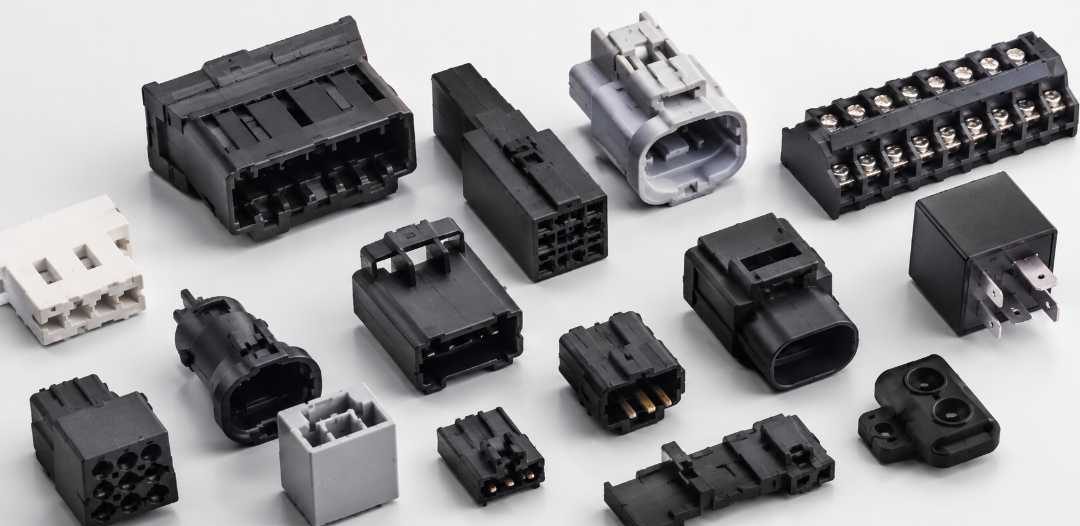
PBT, or polybutylene terephthalate, is a semi‑crystalline thermoplastic polyester. It is chemically related to PET but crystallizes faster and processes more readily in injection molding.
In manufacturing, PBT is typically chosen when a part must hold its shape across temperature changes, resist common chemicals and moisture, and provide stable electrical insulation. It is not the cheapest or strongest plastic, but it offers a practical combination of properties for many engineering components.
Unlike nylon grades such as PA6 or PA66, PBT absorbs very little water, about 0.1 percent over 24 hours. Parts stay dimensionally stable in humid environments where nylon would swell. Compared with acetal (POM), PBT provides broader chemical resistance and a higher continuous service temperature. It falls between commodity plastics and high‑end materials like SPÄHEN in cost and performance. Most engineers use PBT in unreinforced or glass‑fiber‑reinforced grades; the filled grades offer significantly improved strength and heat resistance.
2. Key Properties of PBT Plastic
Like most engineering plastics, PBT is selected based on a combination of mechanical, thermal, chemical, and electrical performance rather than a single property.
| Property (Unreinforced) | Typical Value |
| Zugfestigkeit | 50–60 MPa |
| Flexural Modulus | 2.3–2.6 GPa |
| Schmelzpunkt | ~225°C |
| Heat Deflection (0.45 MPa) | ~150°C |
| Continuous Use Temp | 120–140°C |
| Water Absorption (24 hr) | ~0.1% |
| Dichte | 1.31 g/cm³ |
Dimensional stability is one of PBT’s biggest advantages. With water absorption of only about 0.1%, parts remain stable in humid environments where nylon may swell enough to affect fit and performance.
PBT also combines good heat resistance, chemical resistance, and electrical insulation. Standard grades can operate continuously at 120–140°C, while glass-filled grades withstand even higher temperatures. The material resists many oils, greases, solvents, and dilute acids, making it suitable for automotive and electrical applications.
Its electrical properties remain stable across changing temperatures and humidity levels, which is one reason PBT is widely used for connectors, sensors, switches, and relay housings.
3. PBT vs Nylon (PA6/PA66): A Practical Comparison
PBT and nylon are often considered for the same applications, but they behave quite differently in service.
Eigentum | PBT | PA6 |
Water Absorption (24 hr) | ~0.1% | ~2.5% |
Dimensionsstabilität | Exzellent | Fair to good with fillers |
Zugfestigkeit | 50–60 MPa | 70–85 MPa |
Schlagfestigkeit | Mäßig | Hoch |
Heat Resistance (with GF) | 120–150°C | PA66 up to 210°C |
Elektrische Eigenschaften | Stable | Affected by moisture |
The biggest difference between the two materials is moisture absorption. Nylon offers higher strength and toughness, but it also absorbs significantly more moisture, which can affect dimensions and electrical performance over time.
For gears, wear components, and mechanically loaded parts, nylon is often the preferred choice. For connectors, housings, and other components where dimensional stability is critical, PBT is usually the more predictable option. PBT also crystallizes faster, which can help reduce molding cycle times in high-volume production.
4. PBT vs PET: Processing Differences
Though chemically related, PBT and PET are often chosen for different reasons.
PET generally offers slightly higher strength and a higher melting point. However, its slower crystallization rate makes injection molding more demanding, often requiring longer cycle times and tighter process control.
PBT crystallizes faster, flows well, and is easier to process consistently. These characteristics make it well suited for thin-wall parts, complex geometries, and high-volume production.
As a result, PET is widely used in packaging, films, and some reinforced engineering applications, while PBT is more commonly found in connectors, housings, and other precision molded components where manufacturing consistency is important.
5. Common PBT Grades and Modifications
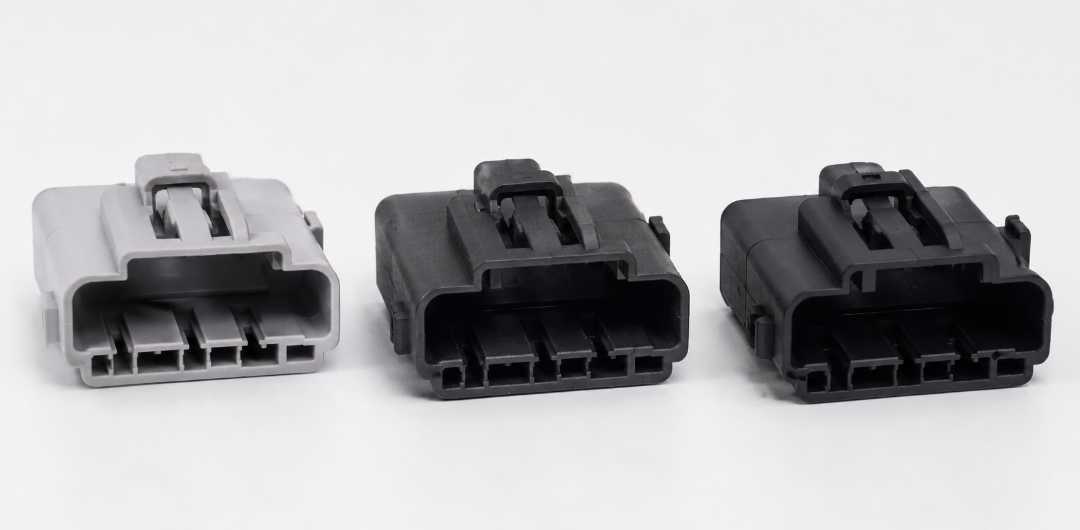
PBT is available in several modified grades, each designed for different performance requirements. Choosing the right grade is often as important as choosing the material itself.
| Grad | Typical Purpose |
| Unfilled PBT | General-purpose components requiring dimensional stability and electrical insulation |
| PBT GF15 | Improved stiffness and strength with moderate glass-fiber reinforcement |
| PBT GF30 | Higher mechanical strength, heat resistance, and dimensional stability |
| FR-PBT | Flame-retardant applications such as connectors, switches, and electrical housings |
| HR-PBT | Improved resistance to hydrolysis and prolonged exposure to heat and moisture |
Among these grades, PBT GF30 is one of the most widely used in industrial and automotive applications. The added glass fiber significantly improves stiffness and thermal performance while maintaining many of the dimensional stability advantages that make PBT attractive in the first place.
Flame-retardant grades are common in electrical and electronic components, where compliance with safety standards is required. Hydrolysis-resistant grades are often selected for environments involving elevated temperatures, humidity, or intermittent hot-water exposure.
6. Manufacturing PBT: Injection Molding and CNC Machining
PBT is valued not only for its performance in service but also for its relatively predictable processing behavior.
Spritzguss
Most PBT parts are produced through Spritzguss. Its fast crystallization rate helps reduce cycle times, while good flow characteristics make it suitable for thin-wall and complex components. Compared with many engineering plastics, PBT is generally considered easy to mold consistently in high-volume production.
The most important processing requirement is drying. Although finished PBT parts absorb very little moisture, excessive moisture in the pellets can lead to surface defects, reduced mechanical properties, and inconsistent molding results.
CNC-Bearbeitung
PBT can also be machined for prototypes, low-volume production, or secondary operations after molding. Unfilled grades machine cleanly and can achieve tight tolerances with standard tooling.
Glass-fiber-reinforced grades provide higher strength and heat resistance, but they are more abrasive and accelerate tool wear. Fiber pull-out can also affect surface finish, particularly around machined edges and drilled features.
7. Common Applications of PBT Plastic
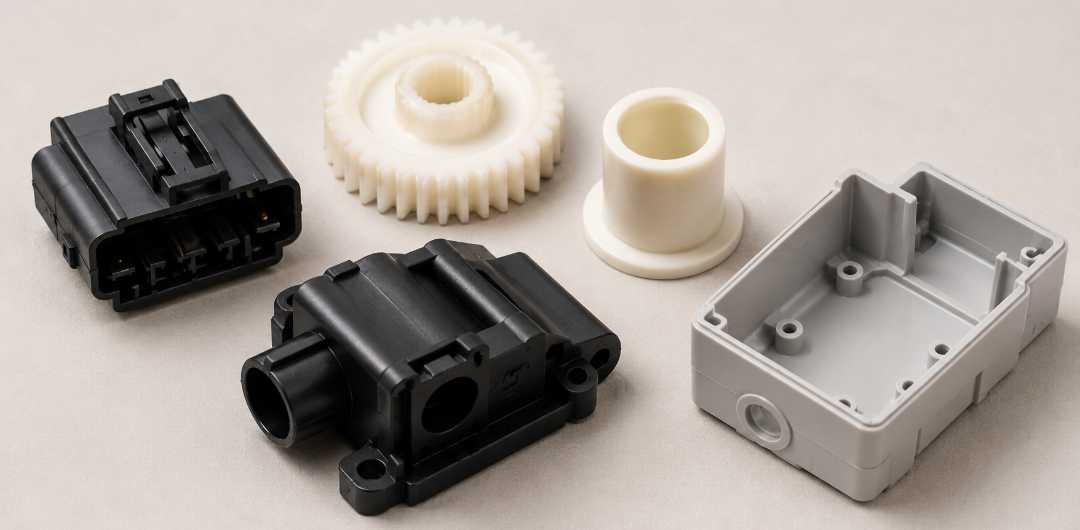
PBT is used across many industries, but it is most commonly found in components that require dimensional stability, electrical insulation, and long-term reliability.
Electrical Connectors
Electrical connectors are one of the largest applications for PBT. Automotive connectors, industrial control connectors, and consumer-electronics connectors often use PBT because it maintains stable dimensions while providing reliable electrical insulation.
Sensor Housings
Many temperature, position, and proximity sensors use PBT housings to protect internal electronics from heat, moisture, and automotive fluids. Low moisture absorption helps maintain consistent fit and assembly over time.
Relay and Switch Components
Flame-retardant PBT grades are frequently used for relay housings, switch bodies, terminal blocks, and circuit protection devices. In these applications, electrical insulation and dimensional stability are often more important than maximum mechanical strength.
Automotive Electrical Parts
Glass-filled PBT is commonly used for under-hood electrical housings, sensor mounts, and cable-management components. The added stiffness and heat resistance make it suitable for environments exposed to vibration, elevated temperatures, and automotive fluids.
In practice, many PBT applications are electrical rather than structural. When a design requires maximum strength, engineers often choose reinforced nylon or other materials instead.
8. Material Selection: When Is PBT the Right Choice?
PBT performs well in many engineering applications, but it is not always the best material choice. The requirements of the part ultimately determine whether PBT, nylon, acetal, or another plastic is more suitable.
| Application Requirement | Empfohlenes Material | Why |
| Humid environments with tight tolerances | PBT | Low moisture absorption helps maintain dimensional stability |
| High impact or mechanically loaded parts | Nylon (PA6/PA66) | Better toughness and impact resistance |
| Continuous hot-water exposure | HR-PBT or PPS | Standard PBT can degrade over time |
| High wear or low-friction applications | Acetal (POM) or Nylon | Better wear resistance |
| Electrical connectors and housings | PBT | Stable electrical properties and low moisture absorption |
| Cost-sensitive, non-critical parts | PP or ABS | Lower material cost |
| Under-hood applications above 150°C | PPS or PA66-GF | Better high-temperature performance |
Abschluss
PBT is not the strongest engineering plastic, nor is it the least expensive. Its value comes from maintaining consistent performance in environments where moisture, temperature changes, and electrical requirements can affect other materials.
Many designers switch from nylon to PBT not because they need more strength, but because they need more predictable dimensions. That is one reason PBT remains widely used in connectors, sensor housings, relay components, and other precision parts where long-term stability matters.
Bei Beska, we work with PBT in both injection molding and CNC-Bearbeitung applications. Whether the requirement is a glass-filled grade for higher stiffness, a flame-retardant grade for electrical components, or a standard grade for general engineering parts, selecting the right material is often just as important as selecting the right manufacturing process.
 German
 English
 Hebrew
 Turkish
 French
 Russian
 Spanish
 Portuguese