
Alodine Treatment Service
- Ideal coating for aluminum parts
- Maintaining electrical conductivity without effecting the tolerance

Beska – Beste Qualität zu wettbewerbsfähigen Preisen.
Wir sind mit unserer Fachkompetenz in der Blechbearbeitung und CNC-Bearbeitung für Sie da.
What Is Alodine?
Alodine is a crucial surface finishing step to make aluminum parts with excellent performance and durability standards. If you’re designing components that require conductivity, corrosion resistance, or paint adhesion without changing the base dimensions, Alodine can be your ideal surface finishing choice.

How does alodine work? The alodine process creates an ultra-thin chemical conversion coating (typically 0.5–4 microns thick). It’s an ideal surface finish for aluminum or other precision parts. Through applying a controlled alodine chemical formula, we could enhance paint adhesion, improve conductivity, and block oxidation of the parts without adding bulk.
That’s why it’s widely used on aerospace brackets, which specially need anti-corrosion without weight penalties. At Beska, we often combine CNC-Bearbeitung, aluminum, and alodine surface finish to create custom parts. Are you ready to start a new project?
Beska – Beste Qualität zu wettbewerbsfähigen Preisen.
Wir sind mit unserer Fachkompetenz in der Blechbearbeitung und CNC-Bearbeitung für Sie da.
The Advantages of Alodine on Aluminum Parts
After alodine, it creates a thin, chemically bonded conversion coating, which can protect aluminum surfaces from oxidation and corrosion.
The Alodine surface improves the parts’ adhesion of paints, primers, and adhesives, creating more durable finishes and stronger bonds.
Alodine still maintains the aluminum’s natural electrical conductivity.
Compared to surface treatments like anodizing or plating, Alodine can be a faster and more economical solution.
There are several environmentally friendly alodine processes like low-chromate or chromium-free options.
Alodine produces a consistent and thin conversion layer. It does not significantly alter part dimensions or tolerances.


Aluminum Alloy
Aluminium 6061
Arten der Alodine-Behandlung
When it comes to chromate conversion coating on aluminum, several types of Alodine are commonly used in various applications. Each type gets its key features and typical use cases. You can choose a proper type for your aluminum project.
| Type | Farbe | Hauptmerkmale | Typical Use Cases |
|---|---|---|---|
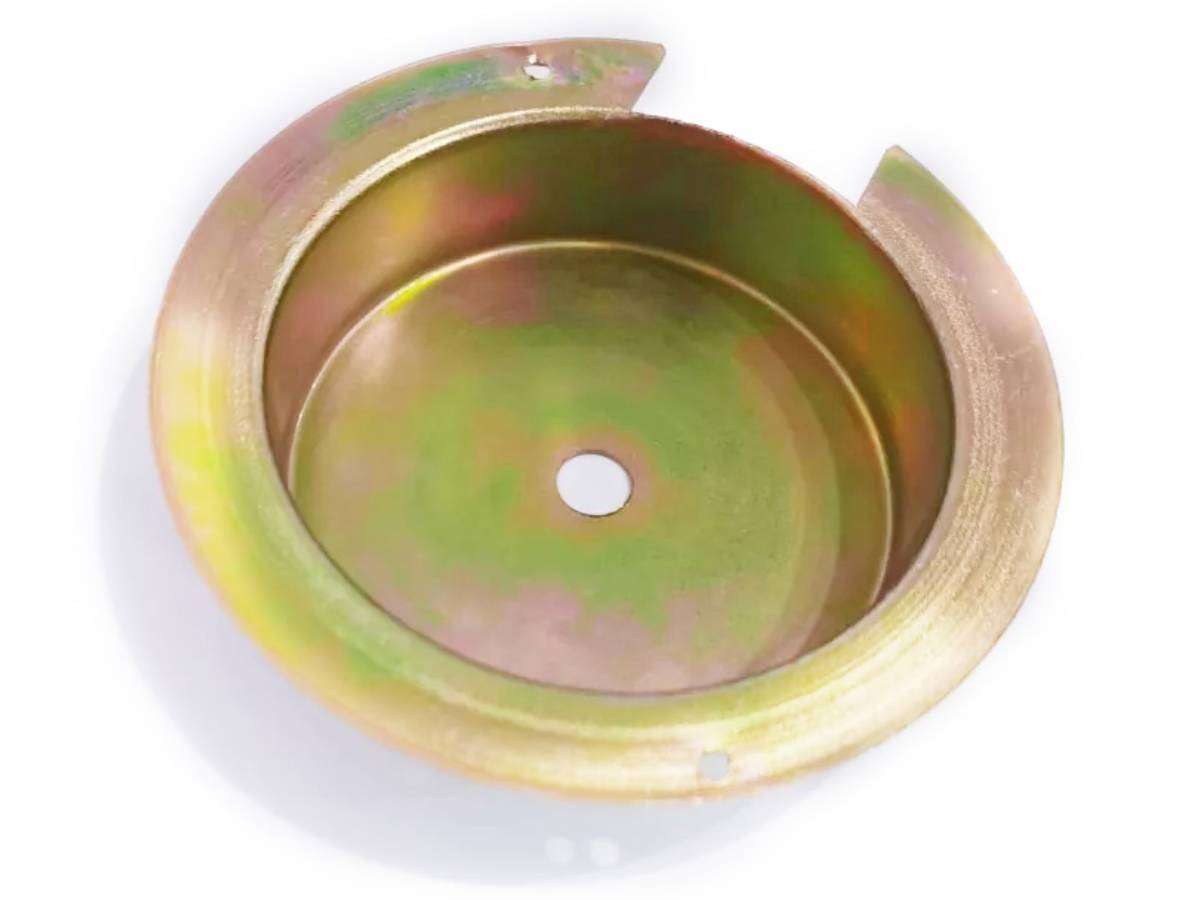
| Alodine 1200 | Golden/Yellow | Excellent corrosion resistance; leaves visible finish; conductive | Aerospace parts, military components, electrical enclosures |
| Alodine 1000 | Colorless | Minimal visual impact; slightly lower corrosion resistance than 1200 | Electronic housings, components requiring high conductivity |
| Alodine 5200 | Transparent | Chromium-free version; environmentally friendly; RoHS-compliant | Consumer electronics, green manufacturing |
| Alodine 5700 | Blue-tinted clear | Advanced non-chromium formulation; optimized for paint adhesion and conductivity | Automotive, marine, and medical devices |
Tip: Choosing the right type can make the parts better than you expected. For example, alodine 1200 is preferred when both visual confirmation and corrosion resistance are critical.
Anodize vs Alodine: Which Should You Choose
Both anodizing and alodine are popular surface finishing options. They may appear similar at first glance, but they differ significantly in purpose, performance, and application.

Anodizing is an electrochemical process that thickens the natural oxide layer on the surface of aluminum. It significantly enhances wear resistance, supports vibrant color finishes, and offers excellent protection in harsh environments. However, anodizing also renders the surface electrically non-conductive, which may not be suitable for assemblies requiring grounding or conductivity.
In contrast, Alodine treatment forms a thin, conductive protective layer without requiring electrical current. It’s particularly valued in the aerospace, defense, and electronics industries. In those applications, lightweight corrosion protection must coexist with electrical conductivity and paint adhesion. Alongside that, Alodine can be applied at room temperature, which makes it faster and more cost-effective solution for specific use cases. Mehr erfahren
Andere Nachbearbeitung
Except for alodine, we also apply other surface finishing options on the custom metal components. Let’s take a closer look at these options:

Pulverbeschichtung
Es handelt sich um eine beliebte Oberflächenveredelung für die Bearbeitung von Metallteilen, die Haltbarkeit, ein elegantes Aussehen, Kosteneffizienz und Umweltfreundlichkeit bietet.

Eloxieren
Dabei wird das Metall in eine Elektrolytlösung getaucht und ein elektrischer Strom angelegt, wodurch sich auf den Metallteilen eine schützende Oxidschicht bildet.

Vernickeln
Es handelt sich um ein weit verbreitetes Verfahren, bei dem eine dünne Nickelschicht auf ein Substrat aufgebracht wird, wodurch die Haltbarkeit, Korrosionsbeständigkeit und Ästhetik verschiedener Metallkomponenten verbessert wird.

Sandstrahlen
Dabei handelt es sich um ein Verfahren zur Oberflächenveredelung, bei dem mit Hochdruckluft abrasive Sandpartikel auf eine Oberfläche geschleudert werden, wodurch Verunreinigungen effektiv entfernt, raue Kanten geglättet und eine gleichmäßige Textur erzeugt werden.

Verchromung
Bei diesem Verfahren wird eine Metalloberfläche, typischerweise Stahl, durch Galvanisieren mit einer dünnen Chromschicht überzogen. Diese Beschichtung verbessert die Haltbarkeit, Korrosionsbeständigkeit und Ästhetik des Metallteils.

Wärmebehandlung
Bei diesem Verfahren wird das Material auf eine bestimmte Temperatur erhitzt, für einen bestimmten Zeitraum auf dieser Temperatur gehalten und anschließend kontrolliert abgekühlt.
Perfektionieren Sie Ihre CNC-Bearbeitung Blechbearbeitung Spritzguss Bedürfnisse mit uns
FAQs
Yes. One of the advantages of Alodine coating for aluminum parts is that it can retain electrical conductivity. It is crucial for grounding components in aerospace and electronic assemblies.
It depends on the type you choose. There are two common types: One appears gold (Type I) and the other clear (Type II). The color does not affect performance but may be useful for visual inspection.
Yes, Alodine is often used alone to protect aluminum surfaces from corrosion. But it’s also commonly used as a pretreatment before painting or powder coating to improve adhesion.
No. One of the main benefits of alodine is that it adds only a very thin film (usually just a few hundred nanometers). That's why it's the ideal choice for creating precision-machined aluminum parts.
Type I uses hexavalent chromium and forms a golden coating. It can offer strong corrosion resistance. But it has environmental and safety concerns.
Type II works by using trivalent chromium and forms a clear coating, meeting RoHS compliance standards.
Anwendung der Alodine-Behandlung
Alodine treatment is valued across multiple industries for its ability to protect metal surfaces, improve corrosion resistance, and maintain electrical conductivity. Below are some key sectors where this process delivers significant benefits.
Militär und Verteidigung
Schifffahrtsindustrie
Elektronik und elektrische Anwendungen
3 Tipps zur Auswahl einer Alodine-Behandlung
Selecting the right alodine treatment provider can make a significant difference in the protection, appearance, and longevity of your metal components. Here are three key factors to keep in mind when evaluating your options.
#1 Chromatlösungsexperte
#2 Erzielen Sie goldene und schillernde Oberflächen
#3 Nachbehandlungsprozesse
Tauchen Sie tiefer in unsere Ressourcen ein
Suchen Sie nach vielfältigeren Serviceoptionen? Stöbern Sie durch unsere handverlesene Auswahl:
Damit Sie einige aufschlussreiche Lektüre finden, haben wir eine Liste mit empfohlenen Artikeln speziell für Sie zusammengestellt:
Haben Sie noch nicht gefunden, wonach Sie suchen? Zögern Sie nicht, Kontaktieren Sie unsWir sind rund um die Uhr für Sie da und helfen Ihnen gerne weiter.
 German
 English
 Hebrew
 Turkish
 French
 Russian
 Spanish
 Portuguese