


A connector housing needs to hold its shape over thousands of thermal cycles. One supplier recommends PBT. Another suggests nylon. Both materials look similar on the data sheet—similar tensile strength, similar stiffness, similar melting point. But in real applications, they behave very differently. The nylon part may warp after absorbing moisture. The PBT part stays stable.
PBT and nylon are both widely used engineering plastics. Both offer good strength and heat resistance. But PBT is stable in humid environments and holds tight tolerances. Nylon is tougher, more wear‑resistant, and handles impact better, though its properties shift with moisture.
This article compares PBT against nylon (PA6 and PA66) across mechanical performance, heat resistance, moisture sensitivity, processing, and cost. It also covers how to select the right material for your application.
1. What is PBT?
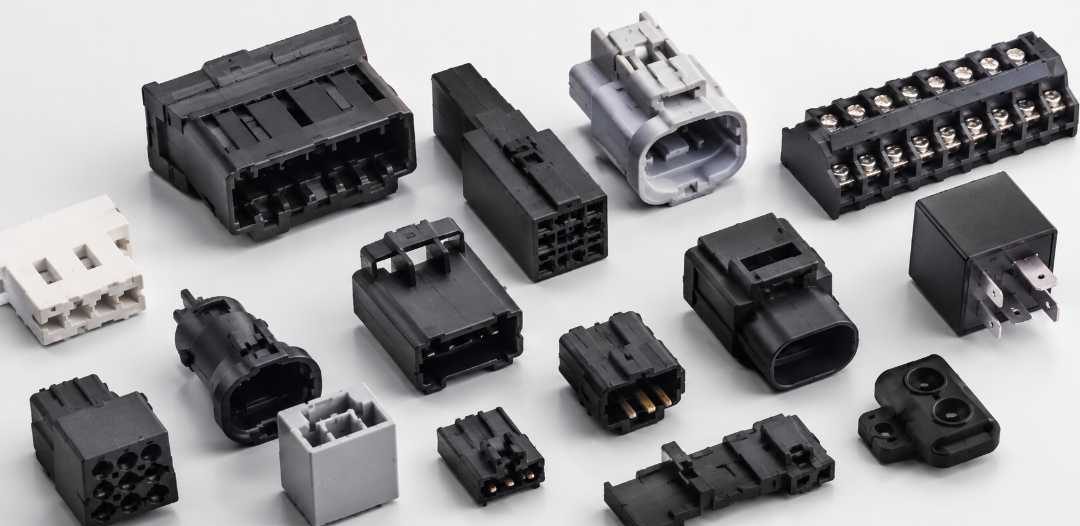
An electronic connector sits inside an engine bay. It sees temperature swings from -40°C to 150°C. It gets splashed with water, oil, and salt. After ten years, it must still fit snugly and conduct electricity reliably. This is the kind of part PBT was made for.
PBT is a semicrystalline plastic that combines good strength, stiffness, and stability. It melts around 230°C and can handle continuous use at 120–140°C.
One property sets PBT apart from many engineering plastics. It absorbs very little moisture. Parts stay the same size regardless of humidity. They do not warp or swell in wet environments. This is why PBT is the default choice for connectors, sensors, and other precision electrical parts.
PBT also processes well. It flows easily and crystallizes quickly during molding. That means shorter cycle times and lower part cost. In real production, you can often run a PBT mold 20–30% faster than a comparable nylon mold, which makes a measurable difference on a large production run.
2. What is Nylon (PA6 and PA66)?

A gear inside an automotive seat adjuster operates thousands of times throughout its service life. It must resist wear, absorb repeated impact, and continue running smoothly under constant friction. This is the type of application where nylon performs particularly well.
Nylon is a family of semicrystalline engineering plastics, with PA6 and PA66 being the two most widely used grades. Both offer good strength, toughness, and wear resistance, making them common choices for mechanical components.
PA6 is known for its toughness and impact resistance. It is often selected when durability and cost are more important than tight dimensional tolerances. PA66 provides higher strength, stiffness, and heat resistance, making it better suited for demanding applications such as under-hood automotive components. Although it costs more than PA6, the improved mechanical performance often justifies the additional cost.
Compared with PBT, nylon absorbs more moisture, but its excellent toughness and wear resistance make it the preferred material for gears, bushings, bearings, and many other moving parts.
3. PBT vs PA6 vs PA66: Moisture, Heat, and Strength Compared
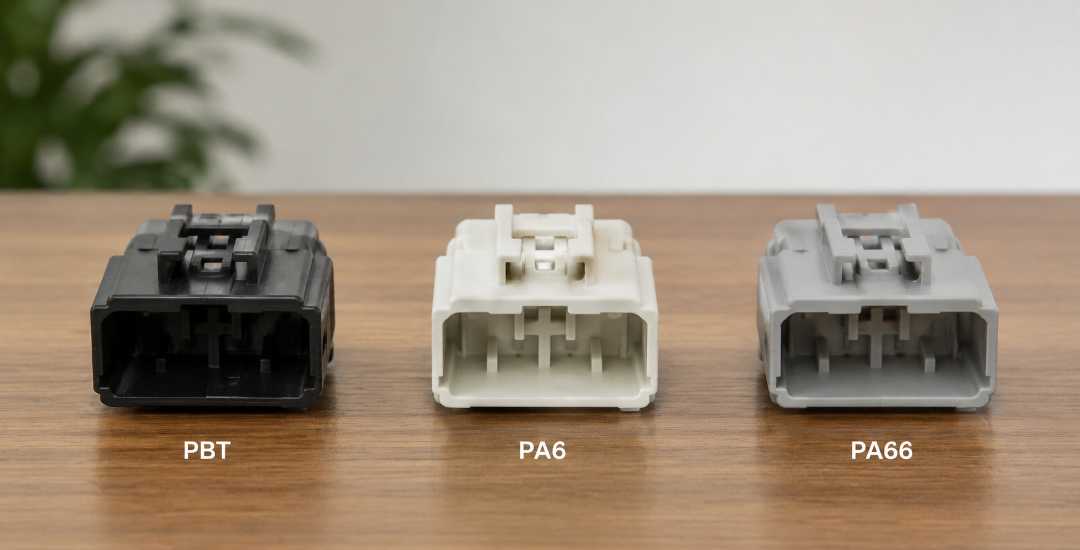
PBT, PA6, and PA66 share many similar properties, which is why they are often considered for the same applications. A closer look at their typical material properties reveals where each one has an advantage.
Eigentum | PBT | PA6 | PA66 |
|---|---|---|---|
Dichte (g/cm³) | ~1.31 | ~1.13 | ~1.14 |
Water absorption (saturated, %) | ~0.1 | ~2.8 | ~1.5 |
Melting point (°C) | ~225 | ~220 | ~260 |
Tensile strength (unfilled, MPa) | 50–60 | 70–80 | 80–90 |
Heat deflection temp. (°C, 0.45 MPa) | ~150 | ~180–200 | ~210–235 |
Notched impact (J/m) | 40–55 | 60–80 | Mäßig |
The comparison highlights three clear differences. PBT stands out for its low moisture absorption and dimensional stability. PA66 provides the highest strength and heat resistance, while PA6 offers a good balance of toughness, performance, and cost.
Sources: Typical values compiled from publicly available material databases and manufacturer technical data sheets. Actual values may vary depending on material grade, reinforcement, heat treatment, and testing conditions.
4. Glass Fiber Reinforced Grades: PBT-GF vs Nylon-GF
Unfilled PBT and nylon offer good overall performance, but many structural and mechanical applications require higher strength and stiffness than the base material can provide. Glass fiber reinforcement is the most common way to improve these properties. A grade such as GF30 contains 30% glass fiber by weight, making it suitable for more demanding applications.
How Glass Fiber Changes Performance
Glass fiber reinforcement significantly increases the strength, stiffness, and heat resistance of both PBT and nylon. Typical PBT-GF30 grades reach tensile strengths of around 140–160 MPa with stiffness of approximately 10–12 GPa. PA6-GF30 commonly reaches 170–190 MPa, while PA66-GF30 offers similar mechanical strength with improved heat resistance.
Glass fiber improves mechanical performance, but it does not eliminate nylon’s moisture absorption. Even reinforced nylon can still experience dimensional changes in humid environments. If maintaining tight tolerances is the priority, PBT-GF is often the more reliable choice. If higher mechanical strength and wear resistance are more important, nylon-GF remains an excellent option.
Processing Glass-Filled Grades
Glass-filled materials require more careful processing than unfilled grades. The added fibers increase melt viscosity, requiring higher injection pressure and more stable processing conditions. They are also more abrasive, which increases tool and mold wear over time. These factors should be considered when selecting materials for long production runs or precision components.
5. Processing Considerations: Drying, Mold Temperature, Shrinkage, and Melt Temperature
PBT and nylon differ not only in mechanical properties but also in how they process. Drying, mold temperature, shrinkage, and melt temperature all affect cycle time and part quality.
Faktor | PBT | PA6 | PA66 |
Drying requirement | Minimal; often not required | Required: 4–6 hrs at 80–90°C | Required: 2–4 hrs at 80–90°C |
Mold temperature | 40–80°C | 60–80°C (unreinforced), 80–100°C (GF) | 60–80°C (unreinforced), 80–100°C (GF) |
Shrinkage (typical, %) | 1.5–2.0% | 1.0–2.5% | 1.5–2.2% |
Melt temperature | 230–260°C | 230–260°C | 260–290°C |
PBT is the easiest to process. It requires less drying, molds at lower temperatures, and has a wider processing window. This translates to shorter cycle times and lower production costs.
PA6 and PA66 demand more attention. They must be dried thoroughly to prevent hydrolysis. They need higher mold temperatures for proper crystallization. PA66 in particular has a narrow processing window and requires tighter temperature control.
6. Application Guide: Where to Use PBT, PA6, and PA66
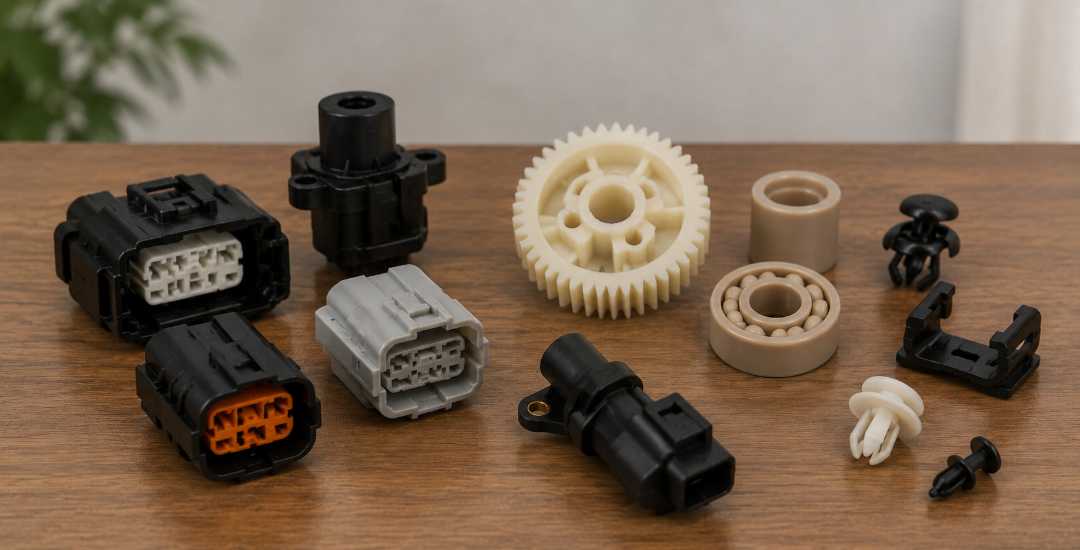
PBT, PA6, and PA66 are used in many of the same industries, but they are rarely chosen for the same reasons. The table below highlights where each material performs best.
Anwendung | Empfohlenes Material | Why |
|---|---|---|
Electrical connectors, sensor housings | PBT | Dimensional stability, electrical insulation |
Gears, bearings, wear parts | PA6 or PA66 | Toughness, wear resistance, self‑lubrication |
Under‑hood automotive components | PA66 | High heat resistance, strength |
Precision electrical/electronic parts | PBT | Low moisture absorption, stable tolerances |
Impact‑prone parts, clips, fasteners | PA6 | Good toughness, lower cost |
High‑temperature or high‑load mechanical parts | PA66 | Higher strength, stiffness, and heat resistance |
Material selection is rarely about choosing the strongest plastic. It is about matching the material’s strengths to the demands of the application. PBT is often selected when dimensional stability is critical, while PA6 and PA66 are more commonly used where toughness, wear resistance, or heat resistance become the priority.
7. How to Choose: PBT vs Nylon
The right material depends on how the part will be used. Before making a choice, identify which requirement is most important: dimensional stability, wear resistance, toughness, heat resistance, or production efficiency.
When to Choose PBT
Choose PBT if the part must maintain tight tolerances in humid environments, provide reliable electrical insulation, or resist fuels, oils, and automotive fluids. It is also well suited to high-volume production, where shorter molding cycles can help improve manufacturing efficiency and reduce part costs.
When to Choose Nylon
Choose nylon when toughness, wear resistance, or long-term mechanical durability is the priority. PA6 is often preferred for impact-resistant and cost-sensitive applications, while PA66 is better suited to components that require higher strength and elevated temperature performance.
Replacement Considerations
Replacing nylon with PBT is possible when dimensional stability is more important than maximum mechanical performance. Glass-filled PBT can achieve stiffness comparable to glass-filled nylon while providing better stability in humid environments. However, if the application depends on nylon’s toughness, wear resistance, or heat resistance, replacing it with PBT is generally not recommended.
8. Cost and Sustainability: PBT vs PA6 vs PA66
Cost is often the deciding factor in material selection, but raw material price is only part of the equation. Processing efficiency, cycle time, and scrap rates can have just as much impact on the final cost of a molded part.
Faktor | PBT | PA6 | PA66 |
|---|---|---|---|
Material cost (per kg) | ~$1.45–1.60 | ~$1.48–1.65 | ~$1.69–1.90 |
Drying required | Minimal | 4–6 hrs | 2–4 hrs |
Cycle time | Short | Medium | Medium |
Processing window | Wide | Mäßig | Narrow |
Effective part cost | Untere | Medium | Höher |
PBT often delivers the lowest overall production cost, not because it is significantly cheaper as a raw material, but because it is easier to process. Shorter molding cycles, minimal drying, and a wider processing window help improve production efficiency and reduce scrap in high-volume manufacturing. PA66 typically has the highest total cost due to both its higher material price and tighter processing requirements.
From a sustainability perspective, both PBT and nylon are recyclable, and some suppliers offer grades containing recycled material. When using recycled grades, mechanical properties should be verified to ensure they meet the application’s performance requirements.
Sources: Typical cost ranges are based on publicly available market data and manufacturer information. Actual costs vary by material grade, supplier, region, and order volume.
Abschluss
PBT, PA6, and PA66 each perform well when used in the right application. PBT is the preferred choice for parts that require dimensional stability and reliable electrical performance, while PA6 and PA66 are better suited to applications where toughness, wear resistance, or heat resistance are the priority.
Bei Beska, we regularly manufacture PBT, PA6, and PA66 components through CNC-Bearbeitung Und Kunststoffspritzguss. Whether the priority is dimensional stability, wear resistance, or heat resistance, selecting the right material early helps reduce development time and achieve more reliable production results.
 German
 English
 Hebrew
 Turkish
 French
 Russian
 Spanish
 Portuguese