


Metalloids have a unique combination of properties that place them between metals and nonmetals. Many exhibit semiconductor behavior, are hard but brittle, and can conduct electricity under specific conditions. These characteristics make them valuable in electronics, alloy design, and a wide range of engineering applications.
This guide explains the key properties of metalloids, how they differ from metals and nonmetals, the six commonly recognized metalloid elements, and how these materials influence manufacturing, machining, and real industrial components.
1. What Are Metalloids?
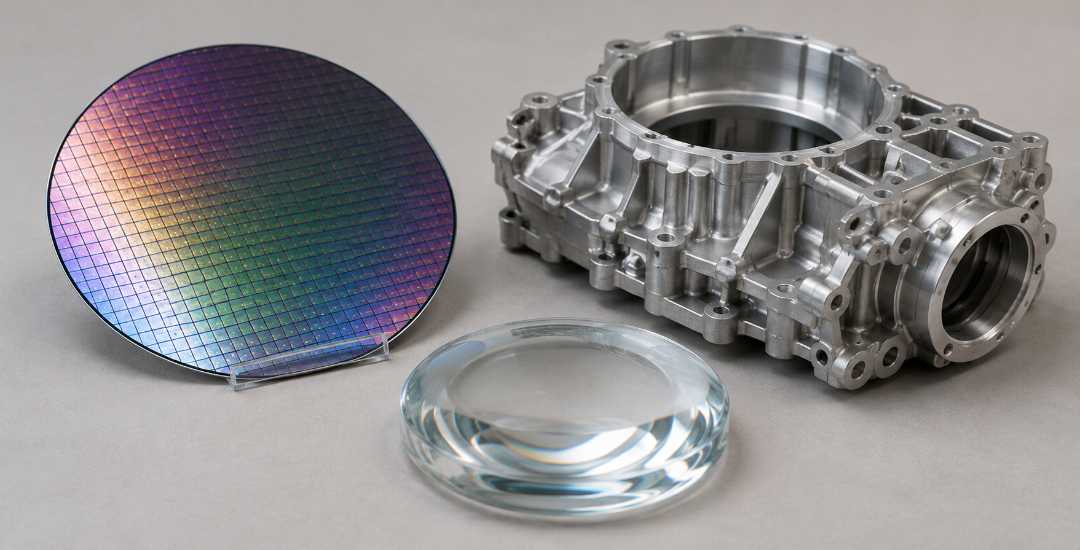
Metalloids are elements with properties between metals and nonmetals. They often have a metallic appearance, but their chemical behavior is not the same as typical metals. Their electrical conductivity also sits between conductors and insulators, and it can change under different conditions. This is why metalloids, especially silicon, are important in electronics, semiconductor devices, and some industrial materials.
In manufacturing, metalloids are rarely used as standalone structural materials. They are usually used as alloying elements, compound ingredients, or functional materials that change how another material performs. Silicon improves the castability of aluminum alloys. Antimony makes lead alloys harder and more stable. Tellurium helps certain steels form shorter chips during machining. These roles explain why metalloids matter beyond their position on the periodic table.
2. How Metalloids Differ from Metals and Nonmetals
Comparing metalloids with metals and nonmetals makes their unique characteristics much easier to see. Metals generally have high electrical conductivity, are ductile, and can be formed into wires or sheets. Most nonmetals have very low electrical conductivity, are brittle in solid form, and lack metallic luster. Metalloids share characteristics with both groups but do not fully belong to either.
The table below summarizes the main differences.
| Eigentum | Metalle | Metalloids | Nonmetals |
| Appearance | Metallic luster | Metallic luster | No metallic luster |
| Electrical conductivity | High, constant | Moderate, conditional | Very low or none |
| Ductility | Ductile, malleable | Brittle, not ductile | Brittle (if solid) |
| Thermal conductivity | Hoch | Mäßig | Niedrig |
| Common behavior | Always conduct | Switchable conductivity | Always insulate |
Among these properties, electrical conductivity is the feature that most clearly distinguishes metalloids. Unlike metals, which conduct electricity consistently, or nonmetals, which generally act as insulators, metalloids can change their conductivity under different conditions. This controllable behavior is what makes materials such as silicon suitable for semiconductor applications.
3. Where Metalloids Sit on the Periodic Table
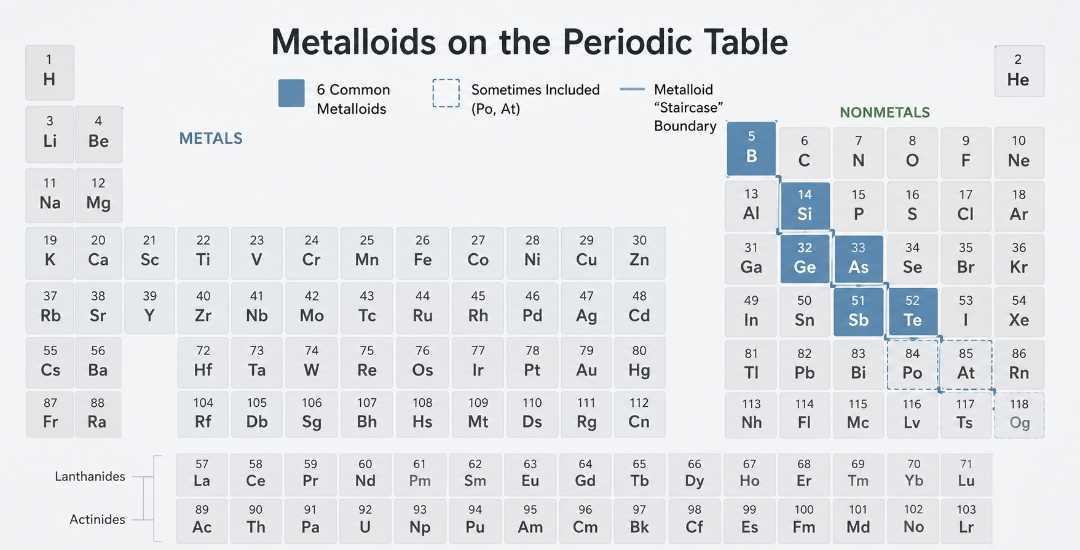
Metalloids are located along the boundary between metals and nonmetals on the periodic table, a region commonly known as the staircase. This boundary extends from boron near the upper left to tellurium toward the lower right. Elements on the left side are generally metals, while those on the right are nonmetals. Their position helps explain why metalloids share properties with both groups.
The exact list of metalloids varies slightly between scientific references. The six most widely recognized elements are boron, silicon, germanium, arsenic, antimony, and tellurium. Some references also include polonium or astatine, although these elements are rarely discussed in manufacturing because of their radioactivity and limited practical applications.
4. Common Misconceptions About Metalloids
Because metalloids share characteristics with both metals and nonmetals, they are often misunderstood. The following are some of the most common misconceptions.
All Elements Near the Staircase Are Metalloids
Not necessarily. Although metalloids are located along the staircase region of the periodic table, classification is based on an element’s physical and chemical properties rather than its position alone. For example, aluminum sits next to the staircase but is classified as a metal because of its metallic behavior.
All Metalloids Are Semiconductors
Semiconductor behavior is one of the best-known characteristics of metalloids, but it is not their only important property. Some metalloids are primarily valued for improving castability, machinability, hardness, or creep resistance rather than for electronic applications.
Metalloids Are Common Structural Materials
In most manufacturing applications, metalloids are not used as standalone structural materials. Instead, they are more commonly added to alloys or compounds to improve specific material properties. Even in small amounts, these additions can significantly influence manufacturing performance and the properties of the final component.
In engineering, what matters most is not where metalloids sit on the periodic table, but the unique properties they contribute to a material.
5. Key Properties That Matter in Manufacturing
In manufacturing, only a few metalloid properties directly influence material selection, machining, and product performance. These are the properties most commonly considered in engineering applications.
Semiconductor Behavior
Metalloids do not conduct electricity as freely as metals, but they are not complete insulators like most nonmetals. Their electrical conductivity can be adjusted through doping, temperature, or applied voltage. Silicon is the best-known example: pure silicon conducts poorly, but adding small amounts of phosphorus or boron creates a controlled semiconductor. This controllable conductivity makes silicon essential in semiconductor devices.
Hardness and Brittleness
Most metalloids are hard but not ductile. Boron is one of the hardest elements in solid form, while silicon is brittle enough that machining requires careful tool selection and process control. This combination makes metalloids suitable for wear-resistant applications but limits their use as standalone structural materials.
Metallic Appearance and Chemical Behavior
Most metalloids have a metallic appearance, but their chemical behavior differs from that of typical metals. Silicon forms acidic oxides rather than basic oxides, while antimony reacts with acids more like a nonmetal. Because appearance alone does not reflect chemical behavior, material selection should be based on material specifications rather than visual appearance.
6. The Six Metalloid Elements: Quick Profile
Although metalloids share several common characteristics, each element has distinct properties and industrial applications. The table below summarizes their key characteristics and typical manufacturing uses.
| Element | Symbol | Key Property | Primary Industrial Use | Manufacturing Note |
| Boron | B | Extremely hard, lightweight | Aerospace composites, borosilicate glass, boron carbide abrasives | Primarily used as compound or fiber, not as a machinable metal |
| Silicon | Si | Switchable conductivity | Semiconductor chips, solar cells, aluminum-silicon cast alloys | In aluminum alloys (silumin), silicon improves castability but increases tool wear during machining |
| Germanium | Ge | High infrared transparency | Fiber optics, infrared optics, transistor history | Rarely encountered in CNC shops; used in optical components |
| Arsenic | As | High conductivity in compound form | Gallium arsenide semiconductors, lead alloy hardener | Watch out: Highly toxic. Industrial handling requires strict safety protocols. Rare in general manufacturing |
| Antimony | Sb | Hardens soft metals | Lead-acid battery grids, flame retardants, type metal | Added to lead at low percentages to increase hardness and creep resistance in battery plates |
| Tellurium | Te | Improves machinability of steel and copper | Free-machining steel additive, thermoelectric devices, solar cells | Added in trace amounts to steel to improve chip-breaking behavior during turning operations |
Although these elements share several metalloid characteristics, each one is selected for a different engineering purpose, from improving alloy performance to enabling semiconductor technologies.
7. How Metalloids Are Used in Real Parts
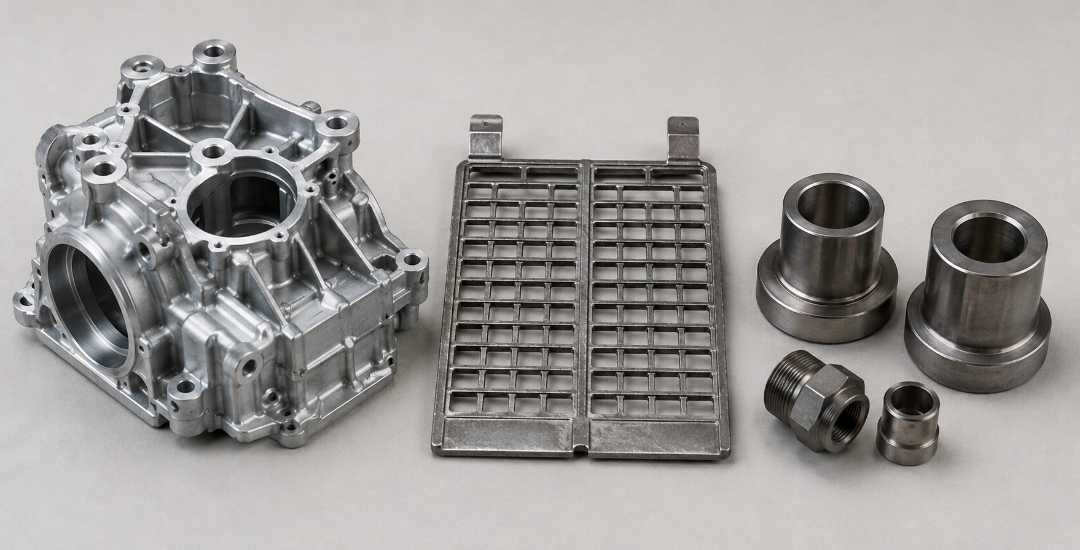
Although metalloids usually account for only a small portion of a material, they often have a significant impact on its properties and manufacturability. Rather than serving as standalone structural materials, they are commonly added to alloys or compounds to improve specific performance. The following examples illustrate how different metalloids contribute to real engineering components.
Aluminum-Silicon Cast Engine Blocks
Silicon is added to aluminum at concentrations typically around 7% to 12% to create casting alloys known as silumin. It lowers the melting point, improves casting fluidity, and reduces thermal expansion in the finished part. These properties make silumin a standard material for automotive engine blocks and cylinder heads. The trade-off is machinability: hard silicon particles accelerate tool wear and often require carbide or diamond-coated cutting tools during boring and milling.
Lead-Antimony Battery Grids
Antimony is added to lead at concentrations of about 1% to 6% to increase hardness and improve creep resistance. Pure lead is too soft to maintain its shape during handling and long-term service, while antimony helps the grid remain dimensionally stable. Because lead-antimony alloys are still relatively soft compared with most engineering metals, battery grids are typically produced by casting rather than machining.
Tellurium-Doped Free-Machining Steel
Tellurium is added to carbon steel in trace amounts to produce free-machining grades. It forms inclusions that break chips into shorter segments, reducing tool wear and allowing higher cutting speeds. These steels are commonly used for high-volume turned parts such as fittings, bushings, and fasteners, where machining efficiency is often more important than maximum mechanical strength.
Even small additions of metalloids can significantly change how a material performs, so they should be considered during both material selection and manufacturing planning.
Abschluss
Metalloids are rarely used as standalone structural materials, but they often have a significant influence on how engineering materials perform. Small additions of silicon, antimony, or tellurium can change machinability, wear resistance, thermal behavior, and long-term reliability. For this reason, material selection should consider not only the base metal but also the role that metalloid additions play in manufacturing and product performance.
Bei Beska, we regularly machine aluminum-silicon cast alloys and understand how silicon affects tool wear, dimensional stability, and surface finish. This experience helps us select appropriate machining strategies and maintain consistent part quality throughout production. If your project involves cast aluminum or other metalloid-containing materials, our team can help evaluate the most suitable machining solution for your application.
Deeper into Our Resources
Damit Sie einige aufschlussreiche Lektüre finden, haben wir eine Liste mit empfohlenen Artikeln speziell für Sie zusammengestellt:
 German
 English
 Hebrew
 Turkish
 French
 Russian
 Spanish
 Portuguese