


A spring pin relies on spring tension to hold itself in place. A dowel pin relies on interference fit. They look similar, but they work differently. One is hollow and compresses into the hole. The other is solid and gets pressed in. Using the wrong one causes assembly problems, loose alignment, or damaged holes.
This article compares spring pins and dowel pins across structure, installation, performance, and cost, and provides practical selection tips.
1. What Is a Spring Pin?
Spring pins are one of the most common mechanical fasteners used in assemblies that require flexibility.
A spring pin is a hollow, split cylinder that holds itself in place through spring tension rather than an interference fit. The pin is slightly larger than the hole, so it compresses during installation and then expands against the hole wall to create a secure fit.
This design makes spring pins more forgiving than solid locating pins. Standard drilled holes are usually sufficient, and reaming is not required, reducing both machining time and assembly cost.
Types of Spring Pins
Spring pins are available in two common designs, each suited to different applications.
- Slotted spring pins are formed by rolling sheet metal into a cylinder with a longitudinal slot. The slot allows the pin to compress during installation. They are the most economical option and are widely used in general-purpose assemblies where loads are relatively light.
- Coiled spring pins are manufactured by winding strip steel into multiple concentric coils. This design distributes stress more evenly around the hole wall, improves vibration resistance, and reduces stress concentration. Coiled spring pins are available in light-, standard-, and heavy-duty versions for different load requirements.

For static or light-duty applications, slotted spring pins are usually sufficient. For assemblies exposed to vibration, impact, or repeated loading, coiled spring pins generally provide better long-term performance.
2. What Is a Dowel Pin?
Dowel pins are the standard choice when precision alignment is the primary requirement.
A dowel pin is a solid, precision‑ground cylinder. The required interference fit varies depending on the pin diameter, hole tolerance, material, and applicable standards. The pin is always slightly larger than the hole to achieve the correct fit. When pressed in, the pin displaces the material around the hole. The interference fit creates a rigid connection that does not move.
This is the key difference from a spring pin. A spring pin uses spring tension. A dowel pin uses interference. The tightness of the fit is what holds it in place.
Dowel pins are made from hardened steel and ground to tight tolerances. The hole must be reamed, not just drilled, to get the correct fit.
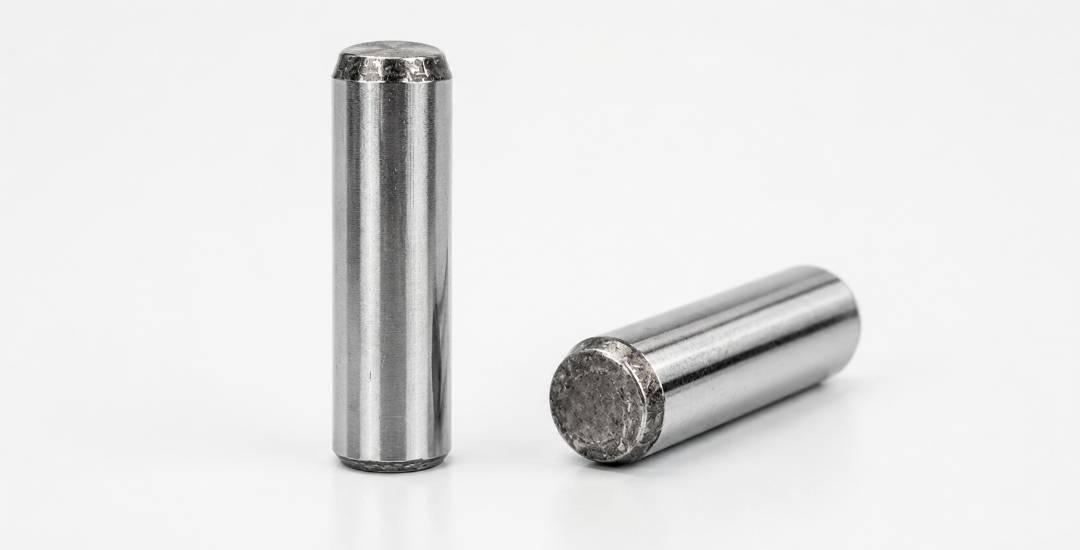
Once installed, a dowel pin does not move. It is the standard choice for precision alignment. The trade‑off is removal. Dowel pins are hard to take out, and each removal slightly reduces the holding force.
3. Key Differences: Spring Pin vs Dowel Pin
Spring pins and dowel pins look similar at a glance, but they work on completely different principles. One uses spring tension to hold itself in place. The other relies on a tight interference fit.
Aspekt | Spring Pin | Dowel Pin |
|---|---|---|
Structure | Hollow, split along length | Solid, continuous surface |
Holding mechanism | Spring tension | Interference fit |
Installation force | Low to moderate | Hoch |
Hole processing | Standard drilled hole (H11) | Reamed hole (H7) |
Positioning accuracy | Mäßig | Hoch |
Vibration resistance | Exzellent | Poor (may loosen under vibration) |
Blind hole suitable | Ja | No (air trapping) |
Spring pins handle vibration and are easier to install. Dowel pins provide precise, rigid positioning. The right choice depends on whether the assembly needs flexibility and reuse or fixed alignment and high shear strength. Neither is universally better. Each fits a different set of requirements.
Sources: ASME B18.8.2; ISO 8750; ISO 8734; manufacturer technical data. Values are typical and may vary depending on pin size, material, fit class, and manufacturer.
4. When to Use Which: Selection Guide
Although spring pins and dowel pins look similar, they are designed for different purposes. The selection process usually starts with one question: does the assembly require precise positioning or secure retention? Once that is clear, the remaining decision depends on load conditions, hole preparation, installation, and material selection.

Load and Alignment
Dynamic assemblies with vibration or shock loads need spring pins. The pin’s spring action absorbs energy and maintains constant radial force against the hole wall. This prevents loosening over time, even with continuous movement. Static assemblies that require rigid, precise alignment need dowel pins. The interference fit creates a solid connection that does not shift or loosen under steady loads.
Hole Preparation
Spring pins work with standard drilled holes. A standard tolerance is usually sufficient, which keeps machining time and cost low. The hole diameter should be about 0.2 to 0.3 mm smaller than the pin diameter. Dowel pins require reamed holes with H7 tolerance. Reaming adds time and cost, but it creates the smooth, round surface needed for a reliable interference fit.
Installation and Removal
Spring pins install with a light hammer tap or a simple hand press. Removal is just as simple. Compress the pin further and pull it out. This makes spring pins ideal for assemblies that need periodic maintenance or adjustment. Dowel pins need a press for installation. They are much harder to remove, and each removal slightly reduces the holding force. In critical applications, dowel pins should be replaced after removal.
Materialauswahl
Both spring pins and dowel pins are commonly available in carbon steel, hardened steel, and stainless steel. Carbon steel suits general industrial use, hardened steel provides higher wear resistance, and stainless steel is preferred in corrosive environments.
In our experience, the most common mistake in pin selection is not choosing the wrong pin, but preparing the wrong hole. Many assembly problems can be avoided simply by confirming the required hole specification before machining.
5. Common Mistakes and Misconceptions About Spring Pins and Dowel Pins
Spring pins and dowel pins look similar and are both used for fastening, but they work in completely different ways. Many engineers and assemblers treat them as if they are interchangeable or assume one is always better than the other. These assumptions lead to mistakes that affect assembly quality, reliability, and cost. The following misconceptions are among the most common causes of assembly problems in mechanical designs.
Myth: Spring Pins and Dowel Pins Are Interchangeable
They are not. A spring pin holds by spring tension and tolerates hole variation. A dowel pin holds by interference and requires precise hole preparation. Using the wrong one causes assembly problems or loose alignment.
Myth: Dowel Pins Are Always Better
Dowel pins are not universally better. They excel at rigid, precise alignment, while spring pins are better suited to vibration, easier installation, and repeated disassembly. Choosing between them depends on the application, not on a preference for one design.
Myth: All Spring Pins Are the Same
Slotted pins have a single gap and are low‑cost. Coiled pins have a multi‑coil structure that distributes force evenly and absorbs vibration. Coiled pins are better for dynamic applications. Slotted pins work for simple assemblies. Selecting the wrong spring pin type can lead to premature wear, vibration loosening, or assembly failure.
Myth: Dowel Pins Can Be Reused Indefinitely
Each installation and removal reduces the interference fit. Over time, the pin loses holding force. In critical applications, replace dowel pins after removal. Reusing them without checking the fit can cause loose pins and failed alignment.
Myth: Spring Pins Have Low Shear Strength
Slotted pins have moderate shear strength, but coiled pins are stronger than many expect. Heavy‑duty coiled pins can handle significant loads. For most dynamic applications, coiled pins provide adequate strength. The required shear strength should always be verified against the application’s load conditions.
The common thread across all these mistakes is treating pins as interchangeable components. Each type has a specific purpose, and the selection should match the application requirement. If the application requires both precise positioning and vibration resistance, consider using dowel pins for alignment and separate fasteners for retention, rather than expecting a single pin to perform both functions.
6. Cost Comparison: Material, Machining, and Installation
The cost difference between a spring pin and a dowel pin extends beyond the price of the pin itself. Hole preparation, installation time, and maintenance often have a greater impact on the total manufacturing cost.
Kostenfaktor | Spring Pin | Dowel Pin |
|---|---|---|
Pin material cost | Low (formed from sheet stock) | Higher (precision ground from bar stock) |
Hole preparation | Standard drill (H11) | Reamed hole (H7) |
Installation time | Low (light press or tap) | Higher (press fit) |
Replacement and maintenance | Easier and generally lower cost | More difficult; interference fit may be reduced after remo0val |
In high-volume production, the additional machining required for reamed holes can significantly increase manufacturing cost. For assemblies that require periodic maintenance or repeated disassembly, spring pins also reduce service time and replacement cost. In many applications, hole preparation and assembly time contribute more to the total cost than the price of the pin itself.
Sources: ASME B18.8.2; ISO 8750; manufacturer technical data. Actual costs vary depending on material, production volume, machining process, and regional labor rates.
Abschluss
Spring pins and dowel pins both look like simple cylinders, but they work on different principles. Spring pins are held by spring tension and tolerate vibration and disassembly. Dowel pins hold by interference and provide rigid precision alignment. The right choice depends on the application’s positioning requirements, load conditions, hole preparation, maintenance needs, and overall manufacturing cost.
In practice, pin selection is rarely made in isolation. Hole tolerance, machining capability, assembly method, and maintenance requirements all influence the final design.
At Beska, we help customers evaluate pin type, hole tolerances, machining methods, and assembly requirements to improve reliability and reduce manufacturing cost. Whether you need prototypes or production parts, our engineering team can recommend the most practical solution for your application.
Deeper into Our Resources
Damit Sie einige aufschlussreiche Lektüre finden, haben wir eine Liste mit empfohlenen Artikeln speziell für Sie zusammengestellt:
 German
 English
 Hebrew
 Turkish
 French
 Russian
 Spanish
 Portuguese