


304 and 201 stainless steel look almost identical, but substituting one for the other can lead to corrosion failures, compliance issues, and unexpected maintenance costs. The difference is not appearance, but alloy composition and service performance.
This article explains what 304 and 201 stainless steel are, how their chemistry creates different performance outcomes, and why 201 is not always a 304 substitute. You will also learn how the grade substitution trap works, three real parts where the choice matters, and when 201 is the correct selection.
1. What Are 304 and 201 Stainless Steel?
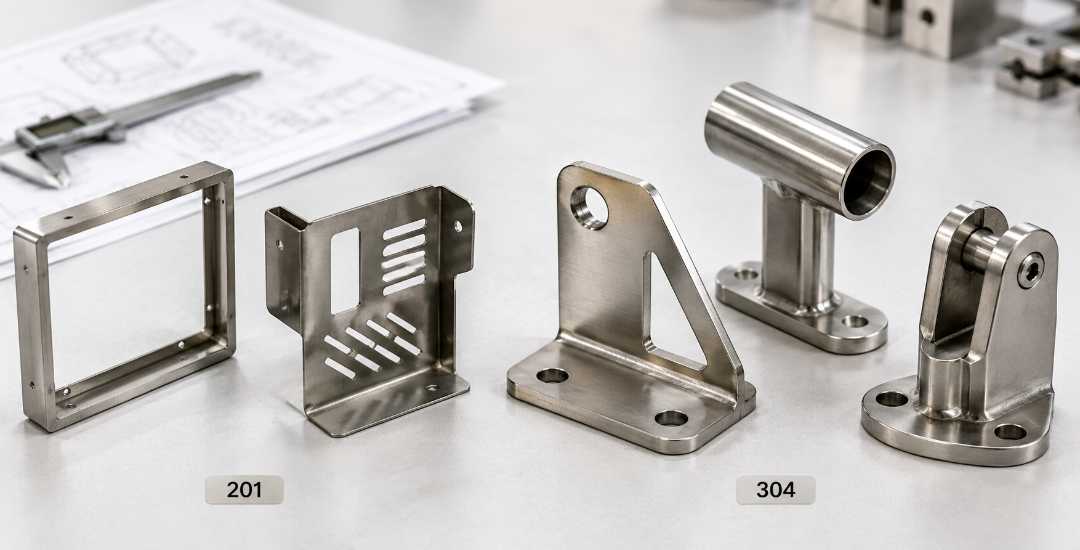
Both 304 and 201 belong to the austenitic family of stainless steels. Austenitic grades use a combination of alloying elements to produce a face-centered cubic crystal structure that is non-magnetic in the annealed condition and resistant to hardening by Wärmebehandlung.
- 304 is the benchmark grade: roughly 18 percent chromium and 8 percent nickel, with minimal manganese. Nickel provides both austenite stability and corrosion resistance in one element.
- 201 was developed as a lower-cost alternative by replacing most of the nickel with manganese and nitrogen. Manganese stabilizes austenite at lower cost, but it does not provide the same corrosion protection. The result is a grade that looks similar to 304 on the shop floor but behaves differently in corrosive environments.
In simple terms, 304 is corrosion-focused, while 201 is cost-focused with clear environmental limits.
2. What Makes 304 and 201 Different at the Chemistry Level?
The alloying strategy behind each grade determines everything that follows: corrosion behavior, machining response, and long-term reliability.
Element | 304 (Typical) | 201 (Typical) | Practical Effect |
|---|---|---|---|
Chrom | 18–20% | 16–18% | Lower Cr in 201 weakens the passive oxide film that resists corrosion |
Nickel | 8–10.5% | 1.5–3.5% | Low Ni in 201 reduces austenite stability and pitting resistance |
Mangan | ≤2% | 5.5–7.5% | High Mn in 201 increases work hardening rate during machining |
Nitrogen | ≤0.1% | ≤0.25% | Higher N in 201 adds strength but contributes to tougher chip formation |
Data source: ASTM A240 (304) and ASTM A666 (201) standard composition ranges.
Nickel stabilizes the austenitic structure and strengthens the passive chromium oxide film that protects the surface from corrosion. When nickel is removed and manganese is increased, the austenite structure stays intact, but the passive film becomes less robust. Nitrogen in 201 partially compensates by improving pitting resistance, but the overall corrosion performance still falls below 304. The lower chromium range in 201 further weakens the passive film. This is why 201 is not a cheaper version of 304. It is a different alloy with a different trade-off.
3. Corrosion Resistance: Where 201 Fails and 304 Holds
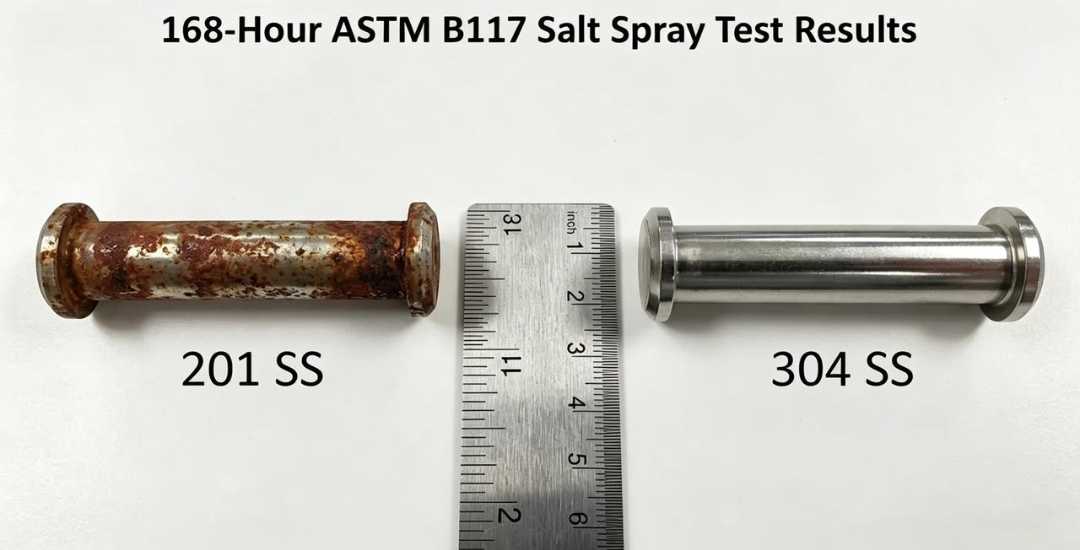
Corrosion performance is where the two grades diverge most clearly, and the gap widens depending on the environment. For humid, coastal, food-contact, or cleaning-chemical environments, 304 should be treated as the default choice.
Dry Indoor Environments
In dry, climate-controlled interiors, 201 can perform acceptably. Interior trim panels, display housings, and decorative railings in conditioned spaces rarely experience enough moisture to challenge 201’s passive film. The cost savings from using 201 in these applications are real, and the risk of failure is low.
Humid and Outdoor Conditions
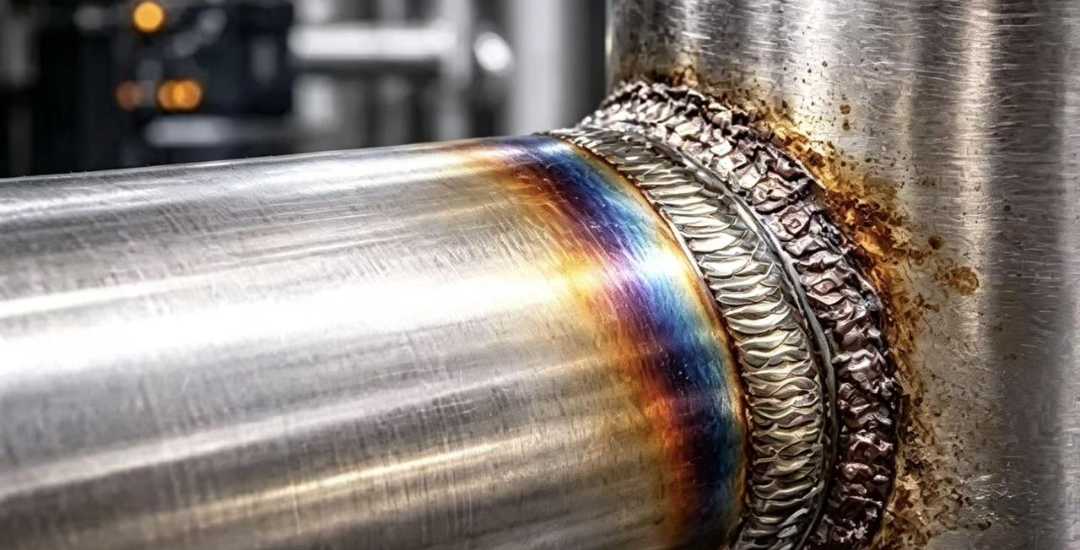
Once moisture, salt, or industrial chemicals enter the picture, 201 degrades noticeably faster than 304. Parts stored in humid warehouses before installation can develop light brown spotting on the surface. Marine and coastal environments accelerate this process: salt spray penetrates 201’s thinner passive film and initiates pitting at a rate that 304 resists. Weld seams and crevice corners on 201 parts are particularly vulnerable because the heat-affected zone disrupts the already-weak passive layer, and tight gaps trap moisture against the surface.
In stainless parts we have reviewed for rail fittings and welded brackets, 201 is more likely to show early rust at weld seams and crevice areas under humid conditions.
4. Machining 201 vs 304 Stainless Steel: Why 201 Is Not the Easy Discount Option
Although both grades can be machined using conventional CNC processes, differences in alloy composition affect cutting forces, chip formation, and tool life. The assumption that 201 is easier to machine because it is softer is wrong. Manganese changes how the material responds to the cutting tool.
Kaltverfestigung
Manganese increases the strain hardening rate of austenitic stainless steel. When a cutting tool engages 201 at light feed or shallow depth of cut, the surface ahead of the tool hardens before the tool can shear through it. The tool then rubs against a hardened zone instead of cutting clean material, which accelerates wear and generates excess heat.
The practical fix is to maintain an aggressive enough feed and depth of cut to stay below the work-hardened layer. Use sharp carbide tools and replace them before the cutting edge dulls, because a dull tool rubs the surface and triggers the hardening cycle faster. Keep chips moving out of the cut zone. Recutting hardened chips doubles the wear on the tool edge. On 304, the hardening rate is lower, so the tool has a wider operating window before it starts rubbing. On 201, the margin is narrower and every parameter matters more.
Tool Load and Chip Control
201 produces tougher, less brittle chips than 304. The chips string and wrap around the tool instead of breaking cleanly, which creates problems in drilling and tapping operations. Burrs at hole exits and thread edges are more persistent on 201 and require additional deburring time. Tool life on 201 is typically shorter for the same cutting parameters, not because the base hardness is higher, but because the work hardening and chip behavior make each cut more demanding on the tool edge.
For small holes, tapped features, and thin stainless brackets, 201 often requires more attention to burr control and tool condition than buyers expect.
5. Surface Finish and the Grade Substitution Trap
The most dangerous aspect of the 304-201 difference is that it is invisible on the day the parts arrive.
Polishing and electropolishing make both grades look nearly identical. A mirror-polished 201 bracket and a mirror-polished 304 bracket are visually indistinguishable. Passivation removes surface iron from both and improves the initial passive film. The problem emerges later. In humid storage, coastal transit, or cleaning-chemical exposure, 201’s weaker passive film breaks down. Brown rust spots appear at surface defects, heat-affected zones, and crevice locations that 304 would resist. By the time the defect is visible, the batch has already shipped.
The substitution trap works like this: a supplier quotes 201 at a lower price for a drawing that specifies 304. The parts pass visual and dimensional inspection because the surface finish is identical. Months later, corrosion appears in service. The cost of rejection, replacement, and reputational damage far exceeds the initial material savings.
6. 304 vs 201 on Real Engineering Examples
The examples below show how the choice between 304 and 201 stainless steel affects real components operating in different service environments.
Part | Grad | Why | Risk of Wrong Choice |
|---|---|---|---|
Kitchen bracket | 304 | Food contact, chemicals, salt | Weld seam pitting within months |
Display panel frame | 201 | Dry indoor, no chemical exposure | Minimal |
Outdoor rail fitting | 304 | Coastal rain, salt air, vehicle spray | Rust at welds in first wet season |
Kitchen Equipment Bracket
A food-processing bracket holds a cutting blade assembly in a commercial slicer. 304 is more commonly specified and accepted for food-contact stainless applications, while 201 may create approval and corrosion concerns. Machining 304 for this bracket requires carbide tooling at moderate feeds, and the surface finish after passivation is stable under repeated cleaning. If 201 is substituted, the bracket will pit at the weld seam where the mounting tab joins the main body within months of service. The cost difference at the material level is modest, but the failure cost is high.
Indoor Display Panel Frame
A decorative frame holds an LCD panel in a climate-controlled retail display. The environment is dry, the part carries no mechanical load beyond its own weight, and there is no chemical exposure. 201 works here. The frame can be laser-cut, bent, and welded with standard austenitic procedures. The cost savings are real and the risk of corrosion failure is minimal because the environment does not challenge the material.
Outdoor Rail Fitting
A railing end-fitting connects a stainless handrail to a concrete mounting post on an exterior walkway in a coastal city. The drawing specifies 304. Rain, salt air, and occasional spray from nearby vehicles create a consistently corrosive environment. 201 fittings installed in similar conditions have shown visible rust at weld seams and crevice corners within the first wet season. The manufacturing process for both grades is similar, but the service outcome is different enough to make 201 an incorrect specification for this part.
7. When 201 Is the Right Choice (and When It Is Not)
The decision is not about which grade is better overall. It is about whether the environment and the application requirements match what the grade can actually deliver.
201 is the right choice when:
- The part operates in a dry, climate-controlled interior
- There is no exposure to salt, cleaning chemicals, or food contact
- The application is decorative or structural with low corrosion stress
- Cost reduction is a stated requirement and the customer accepts the performance trade-off
201 is not the right choice when:
- The part is exposed to humidity, rain, or coastal atmosphere during storage or service
- The part contacts food, medical surfaces, or cleaning agents
- The drawing specifies 304 and the customer has not approved a grade change
- Long-term appearance matters, because 201 will develop spotting in any moist environment
The common thread: 201 works when corrosion stress is absent, and fails when it is present. If you cannot confirm that the part will stay dry throughout its entire lifecycle, from storage through shipping through service, specify 304.
Abschluss
The word “stainless” does not guarantee the same outcome for every grade that carries it. 304 and 201 share an austenitic structure, but their different alloying paths create a performance gap that surface treatment and passivation cannot close. That gap shows up months after delivery, where the part actually operates. The right grade depends on one question: will this part face moisture, salt, or chemical exposure at any point from storage through end-of-life? If the answer is uncertain, 304 is the only safe specification.
Beska processes both 304 and 201 stainless steel across CNC-Drehen, milling, and sheet metal fabrication. Material certification accompanies every shipment, and grade verification can be confirmed on request. If your project requires a specific stainless grade and you want to make sure the material matches the drawing, contact Beska to discuss your part requirements.
Deeper into Our Resources
Damit Sie einige aufschlussreiche Lektüre finden, haben wir eine Liste mit empfohlenen Artikeln speziell für Sie zusammengestellt:
 German
 English
 Hebrew
 Turkish
 French
 Russian
 Spanish
 Portuguese