


In today’s global manufacturing landscape, abrasive blasting has become a critical surface treatment method across industries. From precision aerospace parts to architectural stone finishes, from automotive component refurbishing to corrosion removal in shipyards, abrasive blasting is everywhere. But behind every successful blasting process lies a key decision: selecting the right grit size.
The grit size directly affects surface texture, cleaning efficiency, material removal rate, and overall cost. Whether you’re preparing a metal surface for coating or performing detailed etching on glass, the choice of abrasive grit plays a defining role in the end result.
This article explores how different grit sizes work, when to use them, and provides a practical blasting grit size chart to help you make informed decisions for your specific application.
1. What Is Blasting Grit Size?
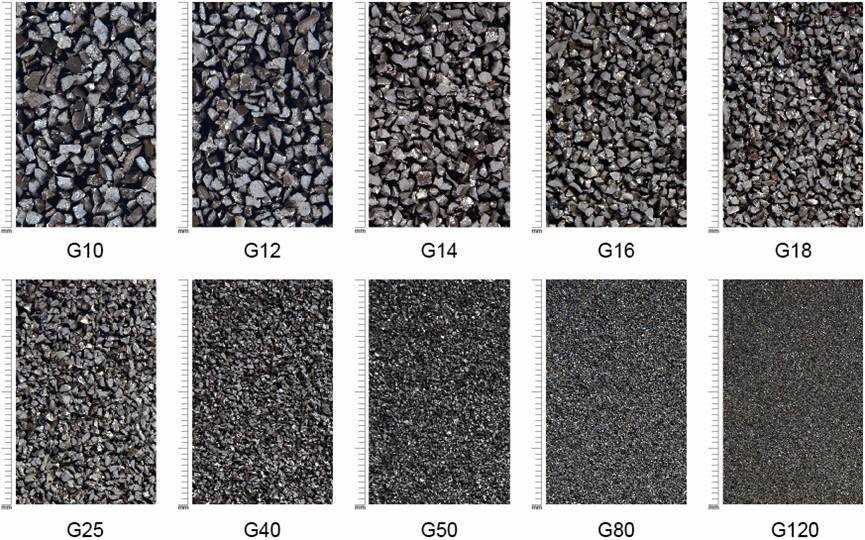
Blasting grit size simply refers to how coarse or fine the abrasive particles are. It’s usually measured in mesh numbers; a higher mesh means smaller particles, while a lower mesh means larger, rougher particles.
Grit size matters when you need to control the surface finish of a part. Coarser grits (like 24 or 36) are used for heavy cleaning, rust removal, or fast material stripping. Finer grits (like 80 or 120) are used when you need a smooth finish, especially before coating, painting, or anodizing.
2. Common Blasting Grit Size Standards
Blasting grit isn’t defined by a single global system. Depending on where the abrasive is manufactured or sourced, you’ll encounter different grit size standards.
Here are the most common ones:
- FEPA (Federation of European Producers of Abrasives): Uses an “F” prefix, such as F24 or F60
- ANSI (American National Standards Institute): Uses plain mesh numbers, like 24 or 60
- JIS (Japanese Industrial Standards): Uses a “#” sign, such as #24 or #60
- GB (Chinese National Standard): Uses numeric grades similar to ANSI
While the naming differs, the grit sizes across these systems are broadly equivalent. For example, F24 ≈ ANSI 24 ≈ JIS #24—all refer to abrasive particles in the same size range.
Below is a comparison chart showing how grit sizes line up across standards, along with their average particle size and typical use cases:
| FEPA | ANSI | JIS | Avg. Size (µm) | Typical Application |
| F16 | 16 | #16 | 1180–1400 | Heavy rust removal, aggressive blasting |
| F24 | 24 | #24 | 700–850 | General descaling and prep |
| F36 | 36 | #36 | 500–600 | Medium-duty surface treatment |
| F60 | 60 | #60 | 250–300 | Coating removal, welding post-treatment |
| F80 | 80 | #80 | 180–212 | Fine cleaning and surface texturing |
| F100 | 100 | #100 | 150–180 | Polishing and detailed finishing |
| F120 | 120 | #120 | 125–150 | Ultra-fine prep, precision components |
This chart can help you quickly match grit sizes across systems and choose the right grade based on your application needs.
3. Choosing Blasting Grit Size by Application

Selecting the right grit size depends heavily on the material being treated and the desired surface finish. Here’s how grit sizes vary across common applications:
3.1 Metal Surface Preparation
- Heavy Rust Removal (F16–F36):
Coarse grits in this range have larger abrasive particles that deliver strong impact energy, making them ideal for quickly removing thick rust, scale, or old coatings. However, they leave a relatively rough surface texture, which may require further finishing. - Post-Welding Cleanup (F24–F60):
Medium grits effectively remove welding slag and spatter without damaging the base metal. This balance prevents excessive surface roughness while ensuring cleanliness for subsequent processes. - Pre-Coating Treatment (F46–F80):
This grit range creates a controlled surface profile—sometimes called an anchor pattern—that promotes better adhesion of paints or coatings. The abrasives remove contaminants while producing a texture that helps coatings bond securely. - Fine Deburring & Cleaning (F80–F120):
Finer grits gently remove burrs and residues without altering the part’s dimensions or geometry, making them suitable for precision components that require a smooth, clean finish.
3.2 Stone and Concrete
- Stone Engraving (F60–F100):
Finer abrasives provide control over the depth and detail of engravings or lettering on stone surfaces. This ensures crisp, well-defined designs without excessive surface damage. - Concrete Profiling (F16–F36):
Coarser grits roughen concrete surfaces to improve mechanical bonding for paints, sealants, or overlays. The increased texture enhances adhesion but doesn’t remove large amounts of material. - Historical Restoration (F46–F80):
Soft abrasives combined with medium grit sizes gently remove dirt and stains from delicate historic stonework or concrete, preserving original surface features without aggressive abrasion.
3.3 Glass and Specialty Materials
- Glass Frosting (F100–F220):
Very fine abrasives etch glass uniformly, creating a consistent matte finish that diffuses light without weakening the material. - Glass Carving (F80–F150):
A balance of fine grit allows for detailed pattern control while minimizing the risk of cracks or chips in the brittle surface. - Electronics Cleaning (F150–F400):
Ultra-fine media safely remove dust, oxides, and contaminants from sensitive electronic components without causing mechanical damage or static buildup.
Even within the same process, subtle shifts in grit size can dramatically change how the surface behaves and how downstream coatings perform.
4. Factors That Influence Grit Size Selection
Choosing the right blasting grit size depends on several critical factors.

4.1. Surface Finish vs. Material Removal Rate
The coarseness of abrasive particles directly affects how fast material is removed and what kind of surface texture is left behind:
- Coarse Grit (8–40 mesh): Larger particles remove material quickly but leave a rough, uneven surface. This is ideal when speed and aggressive cleaning are priorities, such as on structural steel or concrete preparation.
- Medium Grit (40–80 mesh): Offers a balance between removal rate and surface finish, suitable for general fabrication and ship hull cleaning.
- Fine Grit (80–220+ mesh): Smaller particles produce smooth, even surfaces, essential for high-precision parts like automotive components or medical devices.
| Mesh | Size Range (mm) | Type | Use Case |
| 8–16 | 1.2–2.0 | Extra Coarse | Structural steel, concrete prep |
| 20 | 0.42–0.85 | Coarse | Pipeline refurbishment |
| 30–40 | 0.3–0.6 | Med-Coarse | Ship hulls, general fabrication |
| 60–80 | 0.18–0.3 | Fine | Auto parts, casting finishing |
| 100+ | < 0.15 | Ultra-Fine | Stainless steel polishing, medical devices |
4.2 Matching Grit to Coating Thickness
The thickness of any coating or paint layer on your parts influences the grit you should use:
- For coatings thicker than 0.25 mm, a coarser grit (20–40 mesh) helps create a stronger mechanical bond by roughening the surface adequately.
- For thinner coatings under 0.25 mm, a finer grit (60–100 mesh) preserves surface smoothness while still promoting adhesion.
4.3 Material Type and Hardness
Different materials respond differently to abrasive blasting, so grit choice must consider material hardness and chemical compatibility:
| Material | Recommended Grit | Vermeiden |
| Weichstahl | 16–40 | — |
| Stainless/Titanium | 80–150 | Iron-based abrasives (risk of corrosion) |
| Aluminium | 60–100 | Silica sand (may embed in surface) |
| Plastics/Wood | 100–220+ | Hard abrasives (risk of warping) |
4.4 Surface Requirements
Finally, the desired surface quality after blasting guides grit selection:
- Surface Roughness: Choose a grit size that creates a consistent and suitable texture for downstream processes.
- Flatness/Tolerance: For parts needing tight dimensional control and flat surfaces, finer abrasives reduce distortion.
- Cleanliness: In industries like medical or food processing, abrasive residue must be minimized, requiring carefully selected grit and thorough post-processing.
Selecting grit size is ultimately a balancing act between finish, adhesion, material behaviour and cost instead of a number picked in isolation.
5. How We Use Blasting in Real-World Projects

At Beska, in our day-to-day work with CNC-gefräst parts and sheet metal components, abrasive blasting can prepare surfaces for the next steps.
For example, before applying powder coating or paint, we use blasting to clean and slightly roughen the surface. This isn’t just about removing dirt or oxidation—it’s about creating the right texture so coatings stick better and last longer.
When working with aluminum parts destined for anodizing, we carefully select fine grit sizes—often between F80 and F120—to ensure the surface is smooth and even without changing the part’s precise dimensions.
Blasting also helps us remove burrs and soften sharp edges, especially after CNC milling or laser cutting. This step is crucial for parts with complex shapes or smaller production runs, where manual finishing would be too time-consuming.
By matching the grit size and blasting approach to each material and process, we help improve coating adhesion, enhance durability, and reduce the risk of product failures once parts are in use.
Abschluss
Grit size selection isn’t just a technical detail. It’s a key factor in blasting efficiency, product quality, and production cost. From heavy-duty descaling to ultra-fine polishing, knowing what grit works best for your application helps you meet both functional and aesthetic standards.
If your project involves CNC-machined parts, aluminum components, or precision-finished surfaces, selecting the right blasting grit makes all the difference. Still unsure which grit size or media type is right for your application? Feel free to consult with the Beska team—we turn your ideas into reality by selecting the proper grit size and machining method.
Tauchen Sie tiefer in unsere Ressourcen ein
Damit Sie einige aufschlussreiche Lektüre finden, haben wir eine Liste mit empfohlenen Artikeln speziell für Sie zusammengestellt:
- Was ist Sandstrahlen?
- How to Sandblast Aluminum
- Blasting vs Painting
- Sandstrahlservice
- CNC Post-processing Service
 German
 English
 Hebrew
 Turkish
 French
 Russian
 Spanish
 Portuguese