


The same metal component can behave very differently depending on whether it is cast or forged. Casting shapes molten metal inside a mold, while forging reshapes solid metal under compressive force. That difference changes the grain structure, defect profile, design freedom, and mechanical performance of the finished part.
Casting is often better suited to complex shapes and internal passages, while forging is widely used where strength, toughness, and fatigue resistance carry more weight. Cost, production volume, inspection, and secondary machining also affect the final decision, especially when both processes could technically produce the part.
1. What Is Casting?
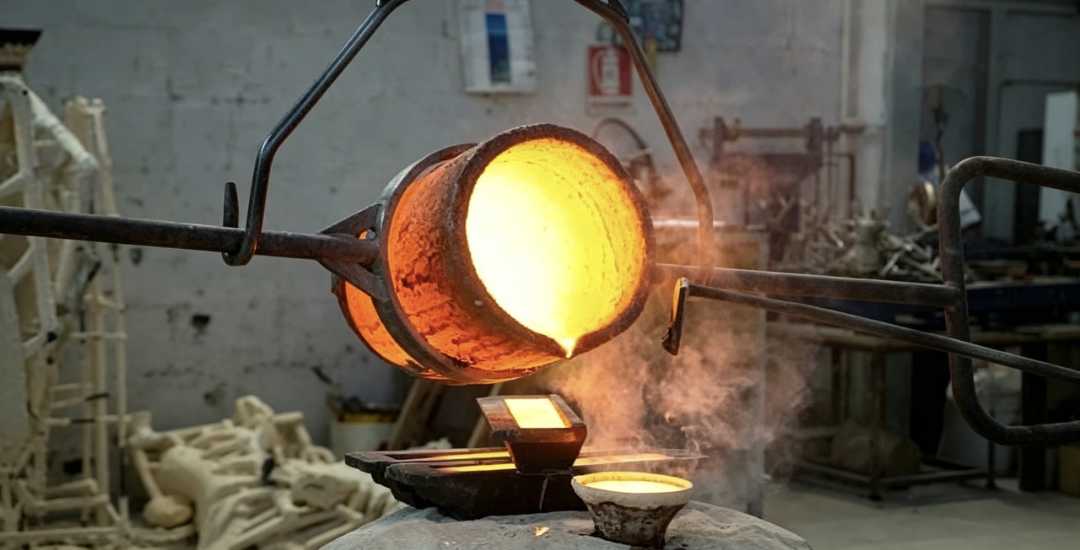
Casting forms a metal part by pouring molten material into a mold cavity and allowing it to cool and solidify. Because the metal takes the shape of the mold, the process can produce complex external geometry, internal cavities, and features that may be difficult to create from solid stock.
Several casting methods are widely used. Sand casting is commonly used for larger parts and flexible production requirements. Investment casting is suited to finer details and more complex shapes, while die casting is often used for high-volume production where repeatability and shorter cycle times are important.
The basic principle is the same in each case: molten metal fills a mold, solidifies, and is then removed for any required finishing or secondary machining.
2. What Is Forging?
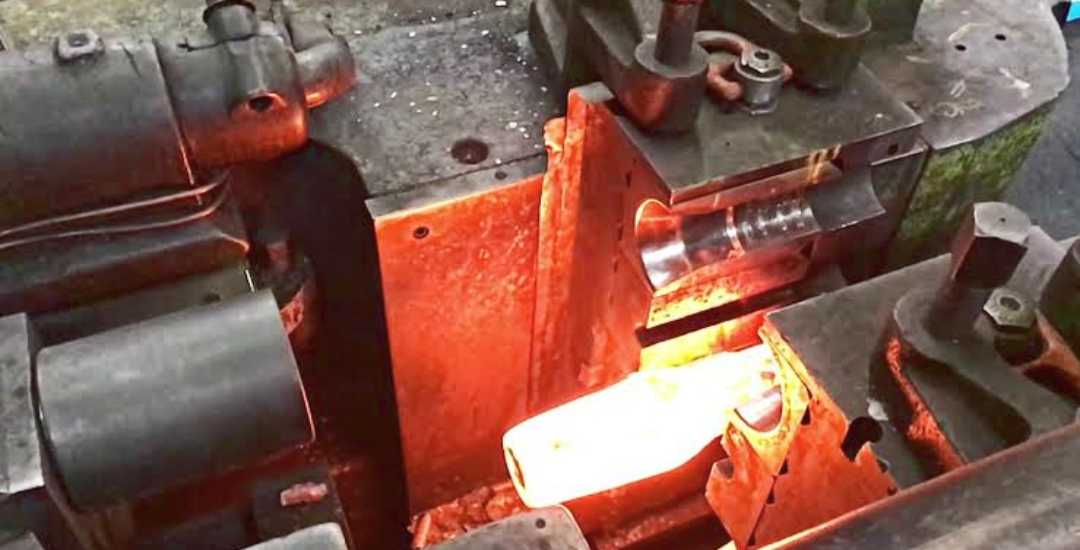
Forging shapes metal while it remains in the solid state. The workpiece is compressed with presses, hammers, or dies until it reaches the required form, rather than being melted and poured into a mold.
The deformation changes the metal’s grain flow and can improve internal soundness by reducing some voids and discontinuities present in the starting material. This is one reason forged parts are often used where strength, toughness, and fatigue performance are important.
Forging can be carried out hot, warm, or cold. Hot forging is widely used when larger amounts of deformation are required because the heated metal is easier to shape, while warm and cold forging are used where closer dimensional control, surface finish, or specific material properties are important.
3. Casting vs Forging: Key Differences
Casting and forging can both produce reliable metal components, but they create very different material structures and place different limits on geometry, tooling, and production planning. The most useful comparison is therefore not simply which process is “better,” but how each one behaves under the requirements of the actual part.
Mechanical Properties and Grain Structure
Forged parts often provide higher strength, toughness, and fatigue resistance than comparable cast parts, particularly when the alloy, Wärmebehandlung, and section size are similar.
During forging, the metal is plastically deformed while remaining solid. This changes the grain flow and can improve internal soundness, which is valuable for components exposed to repeated or impact loading.
Casting follows a different route. The metal solidifies from a liquid state, so cooling rate, feeding, section thickness, and mold design all influence the final structure. If solidification is not well controlled, internal porosity or shrinkage can affect mechanical performance.
This does not mean every forging is stronger than every casting. Alloy selection, heat treatment, section geometry, and process control still have a major influence on the final properties. Modern casting processes can produce highly reliable parts when their capabilities match the application.
Geometry and Design Freedom
Casting offers much greater freedom when a part contains internal passages, enclosed cavities, complex external shapes, or features that would be difficult to form through deformation.
This is why castings are common in parts such as pump housings, valve bodies, manifolds, and engine components. Cores and shaped mold cavities can create much of the geometry before machining begins.
Forging works best when the part can be shaped through controlled metal flow. Complex internal cavities are much harder to create directly, so additional machining may be needed where the finished geometry goes beyond what the forging process can form.
Part size also depends on the specific process and available equipment. Large components can be produced by either casting or forging, but mold handling, pouring capacity, press capacity, tooling, and material flow all affect what is practical.
Surface Finish and Dimensional Accuracy
Neither casting nor forging has one fixed level of surface finish or dimensional accuracy.
A sand casting, for example, normally has a rougher surface and wider dimensional variation than an investment or die casting. Forging shows a similar range. Open-die forgings usually leave more stock for later machining, while closed-die and precision forging can produce shapes much closer to the final geometry.
For this reason, comparing “as-cast” with “as-forged” surfaces without specifying the actual process can be misleading.
Critical bores, sealing faces, threads, bearing seats, datum surfaces, and tighter GD&T requirements are commonly finished by CNC machining regardless of whether the starting blank is cast or forged.
Defect Risks
The two processes tend to fail in different ways because the metal experiences a completely different manufacturing route.
In casting, many defects originate during filling and solidification. Gas or shrinkage can leave porosity inside the part, while poor metal flow may create incomplete filling or cold shuts. Thick and thin sections cooling at different rates can also contribute to shrinkage cavities or hot tearing.
Forging avoids those same solidification mechanisms because the metal remains solid, but it introduces its own risks. Poor material flow or die filling can create laps, folds, or underfilled areas, while excessive deformation or unsuitable process conditions may lead to cracking. Defects already present in the starting material can also remain or change orientation during forging rather than simply disappearing.
The important point is that forging does not eliminate defect risk, and casting does not automatically mean an unreliable part. Inspection should be matched to the material, manufacturing route, part criticality, and drawing requirements.
Tooling, Production Volume, and Cost
Cost can vary widely within both processes, so there is no simple rule that casting is cheaper or forging is more expensive.
Sand casting may require relatively simple tooling and can make sense for low-volume or large components. Die casting requires much greater tooling investment but can become efficient at high production volumes. Investment casting follows a different cost structure again, particularly when complex near-net-shape geometry reduces later machining.
Forging has the same variation. Open-die forging may use relatively simple tooling but leave more machining stock, while closed-die forging requires dedicated dies and becomes more attractive when the same geometry is produced repeatedly.
The final cost therefore comes from the complete manufacturing route rather than the forming process alone. Tooling, material usage, machining time, inspection, finishing, scrap risk, and production quantity all contribute to the economics of the part.
| Faktor | Casting | Schmieden |
| Mechanical performance | Strongly influenced by alloy, casting method, heat treatment, and defect control | Often offers higher strength and fatigue performance for comparable materials |
| Geometry | Well suited to complex shapes and internal cavities | Better suited to shapes that can be formed through controlled deformation |
| Surface and accuracy | Varies widely from sand casting to investment and die casting | Varies widely from open-die to closed-die and precision forging |
| Typical defect concerns | Porosity, shrinkage, filling defects, inclusions, hot tearing | Laps, folds, underfill, cracking, improper material flow |
| Tooling investment | Can range from relatively low to very high | Can range from simple open-die tooling to expensive production dies |
| Production volume | Suitable for low through very high volumes depending on the method | Suitable from low-volume open-die work to high-volume closed-die production |
| Secondary machining | Often required for functional and precision features | Often required for functional and precision features |
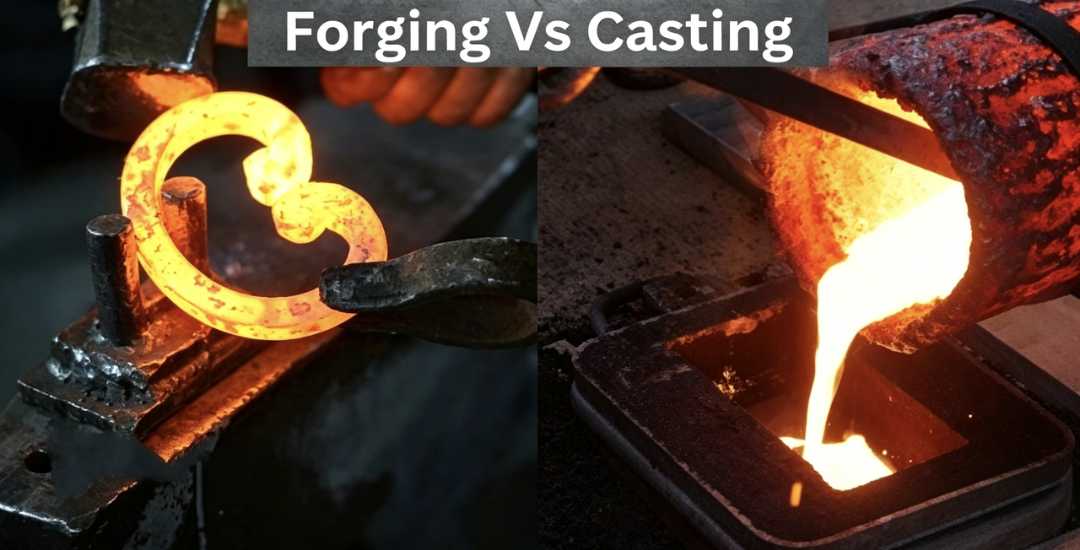
4. Common Applications of Casting and Forging
The way casting and forging are used in real components reflects the strengths of each process. Casting is often selected when geometry and internal passages drive the design, while forging is common where strength, toughness, and fatigue resistance are more important.
Automobilkomponenten
Connecting rods and crankshafts are common examples of forged components. These parts operate under repeated loading, so fatigue resistance and consistent mechanical properties are important design considerations.
Engine blocks and cylinder heads follow a different manufacturing route. Their internal coolant passages, oil galleries, and complex port geometry make casting a practical way to create much of the shape before final machining.
The contrast is useful: forging is often favored for highly loaded moving parts, while casting works well when the component contains complex internal geometry.
Luft- und Raumfahrtkomponenten
Forging is widely used for aerospace parts that must carry high structural or cyclic loads, including many landing-gear and rotating components. High-strength aluminum, titanium, and alloy steels can all be forged depending on the application.
Not every high-performance aerospace part is forged, however. Turbine blades are an important example where investment casting may be used to create complex airfoil shapes and internal cooling passages that would be difficult to form through forging alone.
This shows why process selection cannot be based on strength alone. Geometry, temperature, material, and service conditions all influence the manufacturing route.
Industriemaschinen
Casting is common for valve bodies, pump housings, and compressor casings because these parts often contain internal flow paths, multiple ports, and relatively complex external geometry.
Forging is more common for components such as shafts, gears, and other highly loaded parts where fatigue strength, toughness, and material continuity are important.
Some assemblies use both processes. A valve, for example, may use a cast body to create the internal flow path while other load-bearing components are forged or machined from wrought material. The manufacturing route follows the function of each part rather than one process being used for the entire assembly.
5. How to Choose Between Casting and Forging
The better process usually becomes clearer once the part geometry, loading, production quantity, and material are considered together. Casting and forging can sometimes produce the same general component, but the manufacturing route may be very different.
Start with Part Geometry
Casting is often more practical when the design contains internal cavities, complex flow passages, enclosed shapes, or geometry that would require extensive machining from a forged blank.
Forging is better suited to shapes that can be formed through controlled deformation. If the part is relatively compact and does not depend on complex internal geometry, forging may provide a more direct route to the required mechanical performance.
Consider the Load and Service Conditions
Parts exposed to repeated impact, cyclic loading, or demanding fatigue conditions often benefit from the material flow and internal structure produced by forging.
Casting can still be fully suitable where the required mechanical properties can be achieved through the selected alloy, casting method, heat treatment, and quality control. The decision should therefore be based on the actual load case rather than assuming that every highly loaded part must be forged.
Compare Tooling and Production Volume
Production quantity affects the economics of both processes, but there is no fixed volume at which one automatically becomes cheaper.
Sand casting, investment casting, die casting, open-die forging, and closed-die forging all have different tooling and production costs. A low-volume part may justify one route, while repeat production of the same geometry may shift the balance toward another.
Machining and inspection should also be included in the comparison. A lower forming cost does not always lead to a lower finished-part cost if the blank requires substantially more secondary work.
Check Material and Process Availability
Not every alloy is equally well suited to every casting or forging process. Material behavior, section size, heat treatment, supplier capability, and the applicable specification can all influence what is practical.
For this reason, material availability should be reviewed together with the intended manufacturing route rather than treated as a separate decision after the process has already been selected.
Some Assemblies Use Both
Casting and forging do not have to be used exclusively within the same product. A cast component can provide complex geometry, while forged or machined parts handle areas where higher strength or fatigue performance is needed.
This mixed approach is common when different parts of an assembly have very different functional requirements.
6. CNC Machining Cast and Forged Parts
Casting and forging often produce the basic shape of a component, but critical features still require CNC-Bearbeitung. Bores, sealing faces, threads, bearing seats, datum surfaces, and tighter GD&T requirements are commonly finished after the blank has been cast or forged.
Machining Cast Parts
Cast components can vary in surface condition and stock allowance depending on the casting process. Sand castings may require more cleanup and machining stock, while investment or die castings can arrive much closer to the final shape.
Porosity, inclusions, or uneven stock can also affect machining stability. Critical sealing surfaces and pressure-related features therefore need careful inspection after machining.
Machining Forged Parts
Forged blanks often provide good material continuity and mechanical properties, but they can still require substantial machining around functional features.
Higher-strength forged alloys may increase cutting forces and tool wear, while uneven stock or forging scale can affect the first machining operations. Stable workholding and consistent datum control are important when tight tolerances need to be maintained.
Why Secondary Machining Still Matters
Neither casting nor forging normally eliminates the need for machining when the part includes precision fits, sealing surfaces, threads, or controlled geometric relationships.
The machining allowance should therefore be considered early in the casting or forging design rather than treated as an afterthought. Too little allowance may leave defects or incomplete cleanup, while excessive stock increases machining time and material removal.
Abschluss
Casting and forging solve different manufacturing problems. Casting gives designers more freedom for complex shapes, internal passages, and near-net geometry, while forging is often preferred for components that place greater demands on strength, toughness, and fatigue performance. Neither process is automatically the better option; the useful comparison comes from how well each one fits the geometry, material, loading, production volume, and inspection requirements of the part.
For components that still need precision bores, threads, sealing faces, datum surfaces, or tight GD&T after forming, secondary CNC machining becomes part of the manufacturing plan. Beska can review the drawing and machining requirements for cast or forged blanks and help plan the CNC operations needed to reach the final dimensions and surface requirements.
 German
 English
 Hebrew
 Turkish
 French
 Russian
 Spanish
 Portuguese